#1. COAX Software. The most efficient fleet management software development company by our criteria. AI fleet safety, driver workforce, and transit builds with case-proven compliance.
#2. Clockwise Software. Strict budget and timeline control with a strong track record in transit and routing.
#3. RST Software. Wrocław-based geospatial and road transport specialists handling massive map API scale.
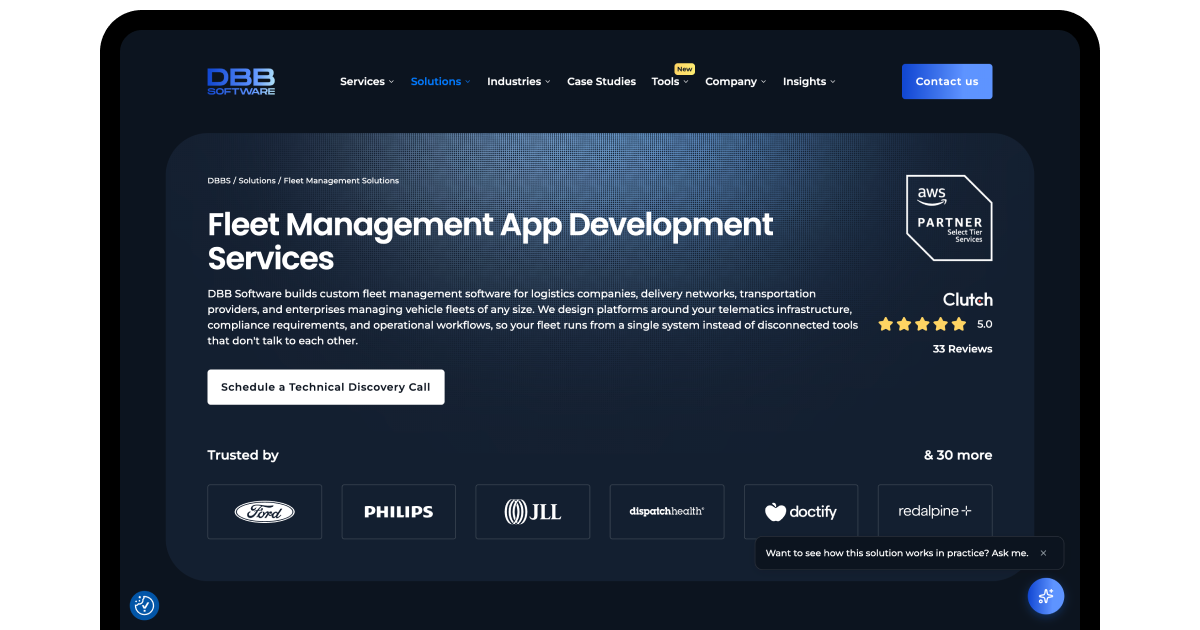
#4. DBB Software. Telematics-first development partner specializing in safety apps and rapid data pipelines.
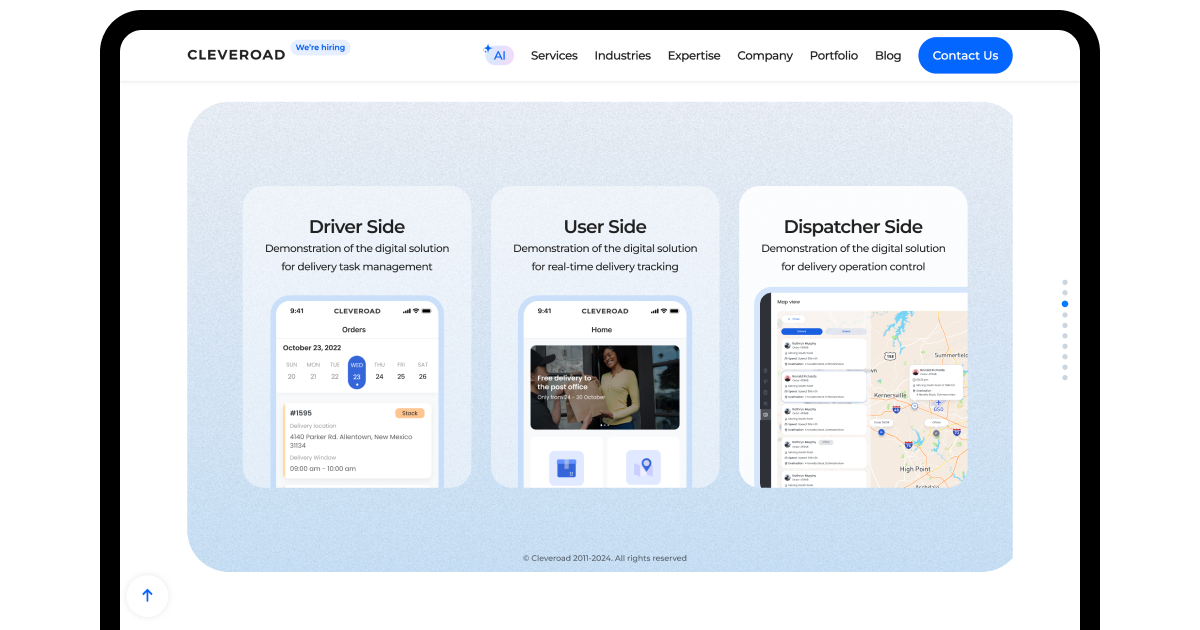
#5. Cleveroad. Mid-market supply chain and shipping partner with a proven record of cutting logistics overhead.
#6. The NineHertz. Large-scale developer offering accident detection, geofencing, and claims processing tooling.
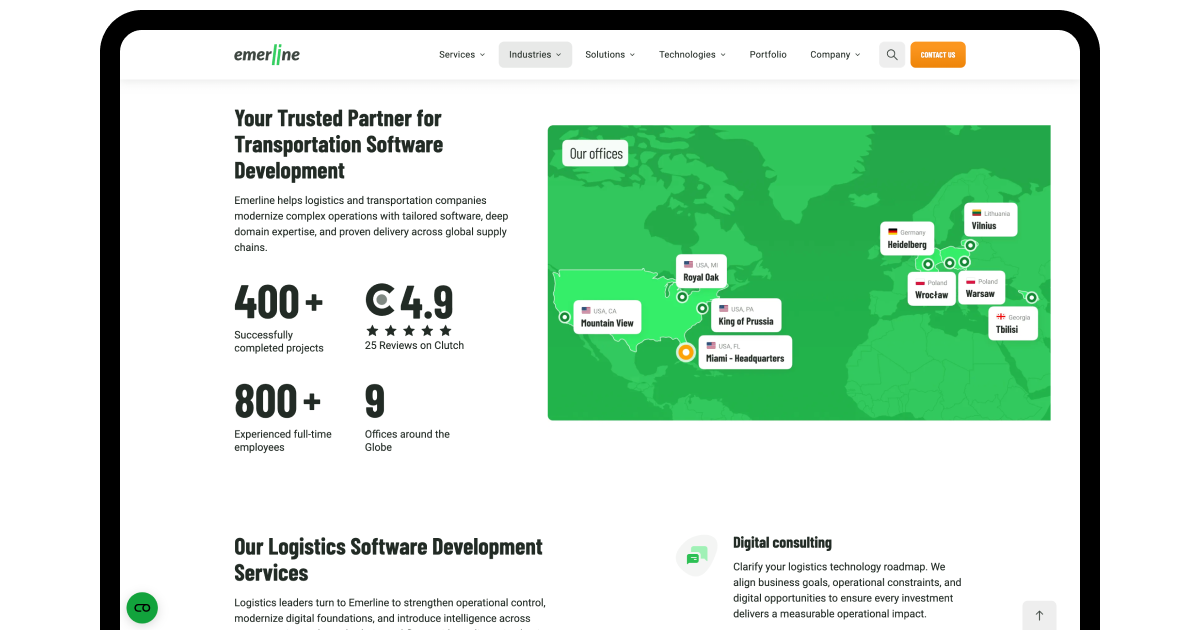
#7. Emerline. ISO-governed enterprise partner specializing in predictive maintenance and heavy industrial fleets.
#9. Exoft. Reliable fleet management software development company for rescue projects, custom GPS tracking, and large-scale EV charging networks.
#10. Cognativ. US-focused engineering firm building cloud-native TMS and dispatch systems mapped to strict regulations.
COAX Software tops our 2026 list of fleet management software development companies. Clockwise Software, RST Software, and DBB Software come next. Cleveroad, The NineHertz, Emerline, Brights, Exoft, and Cognativ complete the top 10.
The right choice matters more every year. Every fleet leaks money somewhere. Diesel burns at a loading dock. A tired driver creeps past his legal hours. A dispatcher reroutes a load by phone. Then someone retypes it into a spreadsheet. Good software seals those leaks. Weak software just paints them on a prettier map.
Designed for fleet operators, supply chain directors, and product leaders looking to commission custom development, this handbook helps you navigate the market with confidence.
Does custom fleet management software pay for itself?
Custom fleet software earns its budget on specific P&L lines. Fuel, empty miles, dispatcher hours, fines, and churn are the usual suspects.
Ready-made platforms fit standard fleets nicely. Problems begin when your business strays from that standard. Maybe you use tracking tools from three suppliers. Maybe a major client wants bills split by driver and stop. Perhaps two different regulators check the same trucks. Monthly fees per vehicle also rise for each added unit.
This is where the return on investment usually appears. Here’s what a fleet management software development company can offer, judging from COAX Software’s showcased results:
P&L line
Software lever
Documented example
Fuel
Context-aware in-cab voice coaching
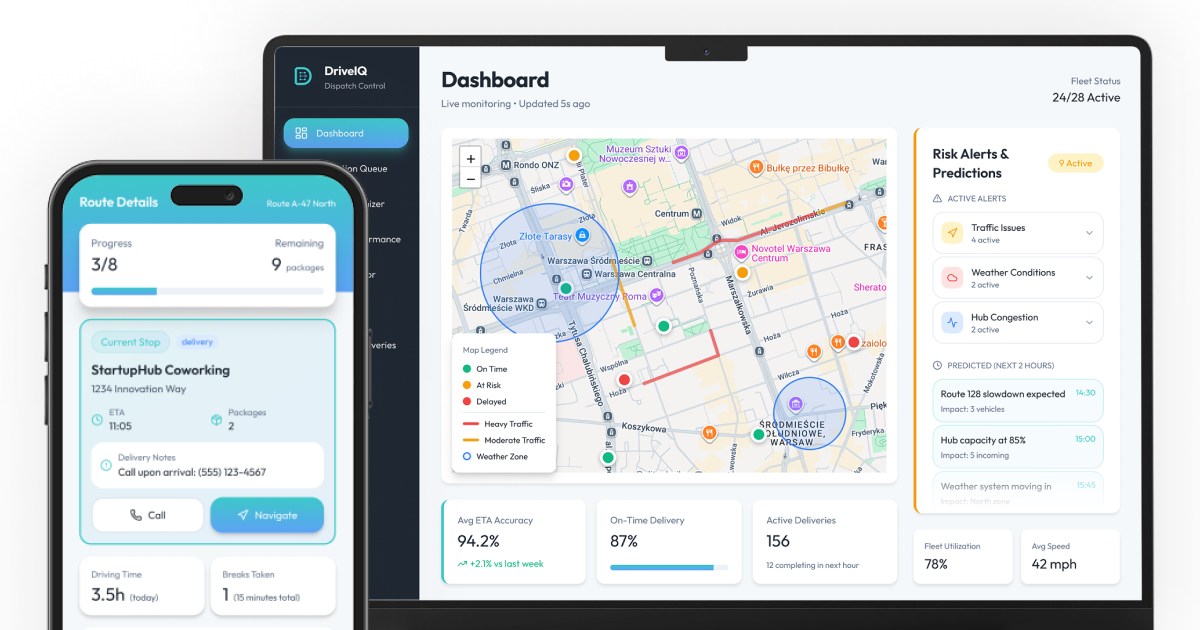
DriveIQ: 12% lower fuel consumption
Empty miles
Auto-recovery rerouting for at-risk deliveries
DriveIQ: 8% fewer empty miles
Dispatcher payroll
Automated exception handling in one live view
DriveIQ: 31% more daily routes per dispatcher, 22% less overtime
Safety and fines
Biomathematical fatigue and HOS prediction
DriveIQ: 40+ HOS violations prevented in one quarter, 38% fewer safety incidents
Driver churn
Proactive AI operations and transparent peer scorecards
DriveIQ: turnover down 22% from a 45% baseline
Support load
Intelligent exception clustering
DriveIQ: 35% fewer support tickets
Back office
Automated verification, invoicing, and payouts
DrivenPeople: driver payouts processed within 48 hours
Another reason for custom software is mixed hardware. Real fleets use trackers, logs, and dashcams from various brands. A custom pipeline brings all those feeds into one clean system. Some companies below have already built solutions for this exact problem.
The final reason is full ownership. You control your roadmap, data, and long-term costs. That is why our ranking rewards agencies that ship real results.
How we evaluated every fleet management software development company on the list
We scored every fleet management software development company against eight criteria, weighted as follows. Checkable evidence earned full credit. Think disclosed metrics or named clients. Feature lists and capability pages earned partial credit at most.
Criterion
Full credit
Partial credit
Real-time telematics and predictive maintenance
GPS, CAN-bus, and OBD-II data unified with predictive alerts
A tracking map with reactive alerts
Fuel and eco-driving optimization
Shipped coaching or routing with attributed savings
Fuel dashboards without disclosed outcomes
Driver safety, fatigue, and HOS/ELD compliance
Fatigue modeling proven to prevent violations
An ELD logging feature
AI route optimization and exception handling
Auto-recovery routing with disclosed efficiency figures
A standard map API integration
Workforce verification and shift management
Verification, matching, and payouts with precision figures
A job board or document upload
Hybrid fleet and subcontractor orchestration
Owned fleets managed alongside supplier networks
Marketplace claims without a case
Compliance breadth, honestly scoped
Shipped compliance clearly separated from stated capability
A wall of badges
Client retention and verified ratings
Clutch score plus repeat or long-term engagements
A rating alone
We held COAX Software to criterion seven very strictly. Its profile marks which compliance items shipped. It shows which ones remain stated claims. It also notes that COAX holds no fleet awards. Award badges counted as proof for no company here.
Best fleet management software development companies ranked
All 10 entries build software for vehicles, drivers, or fleet-dependent logistics. They differ most in how much they prove. The table gives you the fast comparison, and the profiles add context.
Company
Core fleet focus
Strongest public proof
Compliance evidence
Best for
COAX Software
AI control towers, driver safety, dispatch, workforce
DriveIQ: 12% less fuel, 38% fewer incidents, 31% more routes per dispatcher
HOS and UK emissions tax work; ISO 9001 and ISO/IEC 27001
Fleets consolidating scattered tools under one AI layer
Clockwise Software
Fleet performance, routing, integrations
One support request in six months; routing module for a top London bus operator
ELD and HOS automation listed as features
Budget- and schedule-disciplined builds
RST Software
GIS, routing, road-transport platforms
Trans.eu: 100,000 daily users, $420,000 saved monthly on map APIs
Not detailed publicly
Map-heavy platforms at continental scale
DBB Software
Telematics-first fleet platforms, safety apps
SafeMode: 25% gain in driver safety, 35% more app downloads
ELD, HOS, and FMCSA reporting listed
Safety products fed by many telematics sources
Cleveroad
TMS, route planning, freight tech
27% to 36% lower logistics overhead for a US client
ISO 9001 and ISO/IEC 27001; cites EU Regulation 561/2006
Mid-market logistics firms
The NineHertz
Dispatch, accident detection, fleet analytics
IoT tracking app in Canada; blockchain fleet ops in Australia
ISO 9001
Incident and claims tooling from a large bench
Emerline
Predictive maintenance, AI routing
Predictive maintenance platform for a large mining company
ISO 9001, 27001, 22301, and 55001
ISO-governed enterprises
Brights
Telematics infrastructure, video, OTA updates
Nova Assure: hardware-agnostic IoT platform
Not detailed publicly
Telematics startups and insurers
Exoft
GPS tracking apps, EV infrastructure
EV charging platform across 70,000+ stations
Not detailed publicly
Rescue projects and EV networks
Cognativ
Cloud TMS, dispatch, IoT tracking
RAPID delivery framework with mapped FMCSA and DOT controls
Stated FMCSA, DOT, and PCI DSS scope
US builds that start from compliance
1. COAX Software
COAX Software builds single control centers for fleets buried in scattered tools. Separate GPS apps, spreadsheets, and driver programs merge into one live screen. That dashboard covers tracking, training, dispatch, worker checks, and green rules.
This fleet management software development company has operated for sixteen years with one stable crew. Over a hundred of its experts work from Ivano-Frankivsk, Ukraine. Buyers give it a 4.9 rating on Clutch. ISO 9001 and ISO/IEC 27001 stamps protect all tasks everywhere. Engineers also hold AWS Solutions Architect Associate and SysOps Administrator Associate credentials.
DriveIQ shows this model best. It is an AI tool for predictable delivery and driver safety. The user runs a five-hundred-truck transport line. Voice guidance alerts drivers to road risks, speed caps, and time buffers. Fuel consumption fell 12%. An auto-recovery optimizer trimmed overtime by 22%. Safety gains came from a biomathematical fatigue and HOS model. Safety incidents dropped 38%. Dispatchers now manage 31% more daily routes with no added headcount.
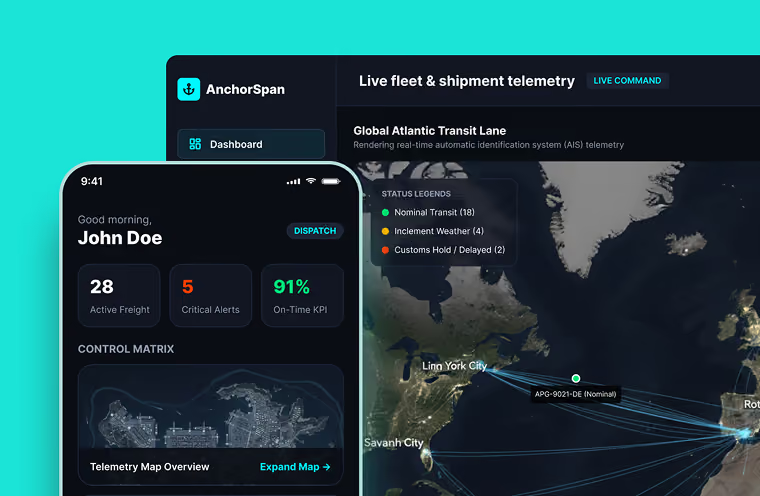
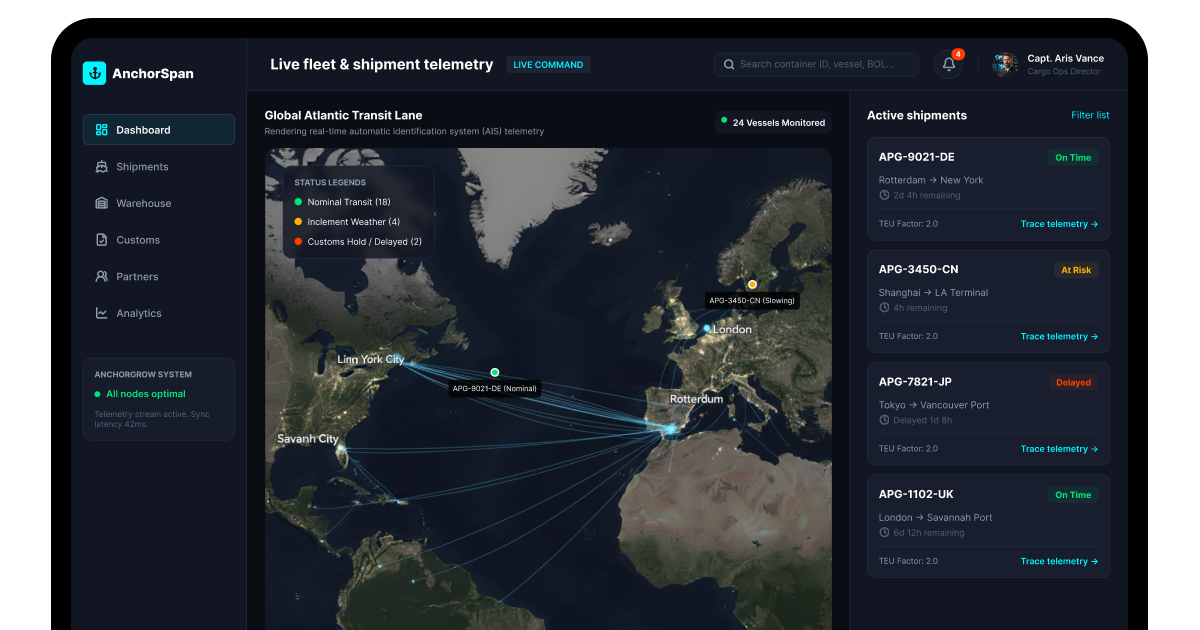
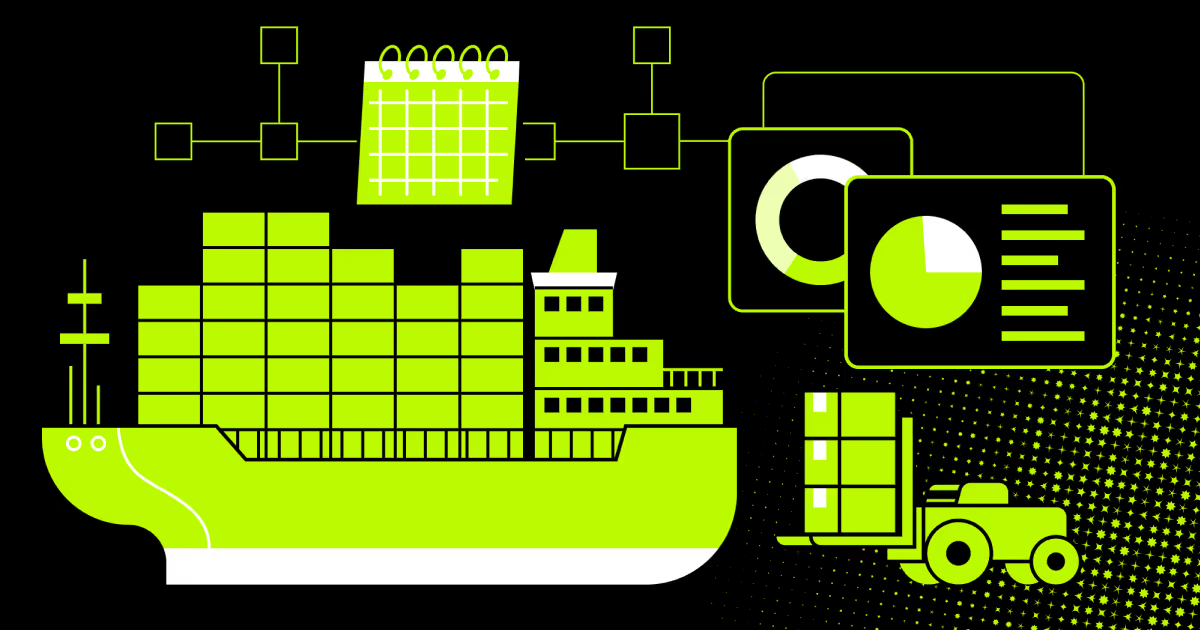
AnchorSpan carries the same idea into freight and ports. It unifies fleet, warehouse, and port visibility for AnchorGrow Cargo Group. The group moves 40,000 containers a year. Its network includes two terminals and six inland warehouses. Shipment lookup time fell from 20 minutes to 90 seconds. A predictive ETA engine hits 91% accuracy within a two-hour window. Average container dwell time dropped from 11 hours to 6.4.
Three more platforms cover drivers, suppliers, and subcontractors:
DrivenPeople: a UK workforce platform for 4,700+ drivers and 175 companies. Credential checks run at 98.7% precision, and shift approvals hit 99.2% accuracy.
DrivenConnect: a UK coach and minibus marketplace linking 400+ operators. Route planning and vehicle monitoring share one operator dashboard.
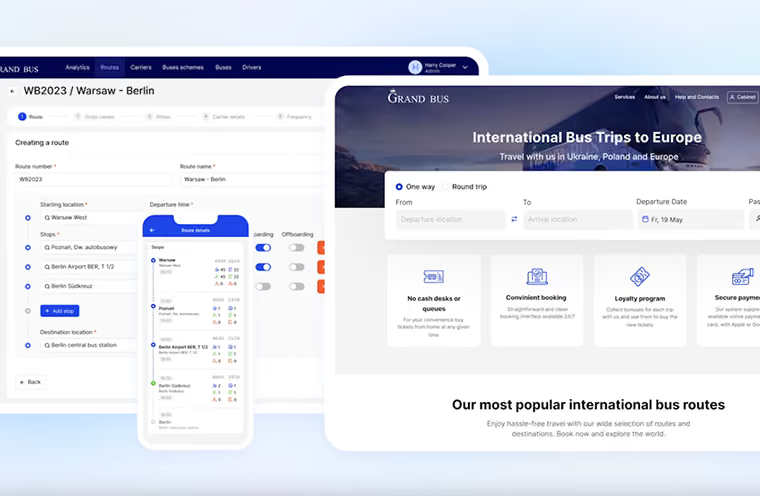
GrandBus: a European bus platform with subcontractor performance monitoring. Route-completion reporting now takes 35 fewer minutes per route.
Projects start at $10,000. Typical budgets land between $30,000 and $150,000. Large fleet builds like DriveIQ reach $200,000 to $999,999+. Hourly rates run $50 to $99. One client put the working style simply. "They took responsibility and offered solutions we never thought about." That's Dominik Rostaing, Managing Director, Tint Tourism Technology LTD.
COAX Software is the best fleet management software development company for operators that want AI safety, dispatch, and driver automation together.
2. Clockwise Software
Clockwise Software has built products since 2014. It runs delivery by the numbers. It tracks cost and schedule performance indexes on every project. Variance stays under 10%, according to the company. Clockwise reports 10+ logistics projects and a 5.0 rating on Clutch.
Two fleet management project examples stand out. A US fleet tool launched with over one thousand tests. Code coverage hit 99 percent. It got one support ticket in its first half-year. For UK partner Foresolutions, Clockwise built a routing and tracking add-on. Clockwise notes that the tool now runs London’s top bus network.
Its site lists duty tracking and hours rules with live alert warnings. Public studies do not yet tie compliance results to those tools. Staff stay an average of 3.8 years, which aids long projects.
Clockwise Software fits firms wanting strict budget and timeline control.
3. RST Software
RST Software works from Wrocław, Poland. It focuses on road transport and geospatial engineering. Its anchor client is Trans.eu. RST calls it Europe's second-largest logistics platform. More than 100 RST specialists work alongside Trans.eu's in-house teams.
The scale is serious. The platform serves 100,000 daily active users across 45 countries. It handles 6 million map-related API requests every day. RST's custom mapping work saves $420,000 a month on third-party map APIs.
RST also builds fleet management, route optimization, and freight forwarding systems. Its portfolio includes Bussr, a cross-platform mobility app. Public pages don't detail HOS or driver-verification work.
RST Software is a suitable fleet management software development company for platforms that live or die on maps and throughput.
4. DBB Software
DBB Software is headquartered in Kraków, Poland. It designs fleet platforms around your existing telematics. It lists 100+ professionals, a 5.0 Clutch rating, and AWS partner status. It says 80% of clients stay seven years or longer.
Its vehicle proof comes from SafeMode. That is an AI safety and driver reward tool. DBB built a driver behavior app and cloud setup for it. Driver safety rose 25 percent, and downloads grew 35 percent. A long-term follow-up added reusable data pipes. They clean each new client's tracking feeds.
DBB shows clear cost ranges. MVPs begin near fifty to eighty thousand dollars. Medium platforms run eighty to two hundred thousand dollars. Duty connection, hours tracking, and federal reporting sit on its service list.
DBB Software suits safety products that must onboard many telematics sources fast.
5. Cleveroad
Cleveroad has built supply chain apps since 2011. Tech hubs are located in Estonia, Poland, and Ukraine. Business offices operate in the US and Norway. It holds ISO 9001 and ISO/IEC 27001 certifications.
Its top case is a transport system for a US warehouse firm. Cleveroad added auto route planning and a driver map app. Warehouse and client tool links followed. The buyer cut total transport costs by 27 to 36 percent.
Cleveroad's fleet guide lists EU driving-time laws, like Regulation (EC) 561/2006. It also suggests log devices as a core feature. View those as design advice instead of shipped compliance outcomes.
Cleveroad is among the best fleet management software development companies for mid-market shipping businesses that want routing built into their main platform.
6. The NineHertz
The NineHertz brings scale from Jaipur, India, plus US sales offices. It reports 15+ years, 575+ dedicated developers, and 92% client retention. The company is ISO 9001 certified.
Its fleet catalog runs unusually wide. Dispatch, geofencing, accident detection, and insurance claim processing all appear. One case: an IoT fleet tracking app for a Canadian logistics firm. Another gave an Australian food distributor blockchain-based fleet operations. Temperature monitoring came built in. Case pages list features but don't disclose outcome metrics.
The NineHertz suits buyers wanting accident and claims tooling at scale.
7. Emerline
Emerline is headquartered in Miami. European hubs operate in Poland, Lithuania, and Germany. It reports 15+ years, 400+ completed projects, and 700+ full-time employees. It holds a 4.9 Clutch rating. Four ISO certifications apply: 9001, 27001, 22301, and 55001.
Its fleet offering spans tracking, AI routing, predictive maintenance, and NLP reporting. The closest published proof is a predictive maintenance platform. The client is a large iron and mining company. Its fleet page quotes 15% to 30% lower fleet costs as typical. No named fleet case backs those ranges publicly.
Emerline publishes price bands too. Smaller fleet projects start from $30,000. Mid-sized builds run $60,000 to $200,000.
Emerline suits enterprises that want ISO-heavy governance and predictive maintenance depth.
8. Brights
Brights runs a dedicated telematics platform practice. It builds cloud backends, device integrations, and OTA firmware updates. Video telematics with AI incident detection is available too. White-label platforms and SDKs are on the menu too.
Its showcase is Nova Assure, a SaaS platform for cross-device IoT management. It ingests data from any GPS tracker, sensor, or camera. The system translates between device protocols in real time. Operators get one dashboard, whatever hardware they run. Brights holds a 5/5 average on Clutch. The case page publishes no performance figures.
Brights fits telematics startups and insurers that need hardware-agnostic infrastructure.
9. Exoft
Exoft, based in Lviv, Ukraine, has delivered 500+ projects since 2013. It reports a 95% customer satisfaction rate. Its fleet services cover GPS tracking, geofencing, dispatch, fuel, and driver monitoring.
Two cases show its range. Exoft inherited a UK company's GPS tracking app from another vendor. The team rebuilt it from scratch and supported it through release. Exoft also built an EV charging platform. It spans 70,000+ stations in 30 countries. That client grew its customer base by 40%.
Exoft is an efficient fleet management software development company for businesses rescuing a stalled fleet app or adding EV infrastructure.
10. Cognativ
Cognativ is a US-focused engineering firm organized around its RAPID transformation framework. Its transportation practice covers cloud-native TMS software, load planning, and dispatch. IoT tracking spans GPS and ELD devices.
Compliance is where its pages go deepest. Cognativ describes ELD integration, driver qualification files, and CSA score automation. Inspection reporting appears too. It also lists GDPR, CCPA, PCI DSS, and WCAG 2.1 controls. These remain stated capabilities. The page names no fleet case or metric. Timelines are explicit: a fleet tracking MVP takes three to six months.
Cognativ suits US enterprises wanting FMCSA and DOT rules mapped early.
How to choose the right fleet management software development company?
Start from your costliest leak. Then find a vendor who has already plugged it elsewhere. A brilliant GIS team may struggle with fatigue modeling. A safety specialist may flounder on port logistics.
Match proof to your fleet type
To choose among the fleet management software development companies, match your specific operational challenges with the concrete evidence you demand upfront:
Long-haul trucking with HOS exposure: Demand proof of violations prevented beyond hours logged. Look for this in COAX or Cognativ.
Mixed telematics hardware: Look for protocol translation across device brands. Find this capability with Brights or DBB.
Map-heavy dispatch at scale: Ask for API cost, request volume, and load figures. Check these metrics at RST or Clockwise.
Driver staffing and subcontractors: Require verification precision and payout speed. Review examples from COAX.
Asset-heavy maintenance: Demand predictive models running on real equipment. Look to Emerline or The NineHertz.
Freight, port, and warehouse visibility: Look for lookup times and ETA accuracy. See examples featured in COAX or Cleveroad.
Use these benchmarks to filter your shortlist and ensure your chosen vendor delivers real operational value rather than empty promises.
5 red flags during calls with a fleet management software development company
A few warning signs surface early in conversations. Watch out for these critical danger points:
Logo walls: Compliance badges and partner certificates shown with no named case studies or real projects behind them. Vendors should readily prove where and how they implemented those standards.
Demo dashboards: A polished map interface or slick UI, but no clear answer on how they handle messy data ingestion, hardware integration, or legacy protocols.
Big-bang cutovers: A high-risk transition plan that kills your old operating system entirely on launch day instead of proposing a phased, parallel rollout.
Floating percentages: Vague performance claims promising "up to" massive gains with zero attached clients, starting baselines, or timeframes.
Missing exit terms: Contracts that lack clear intellectual property ownership, source code escrow, or structured knowledge transfer procedures for your internal team.
Spot two or more of these during your discovery calls, and your shortlist just got shorter.
How to start a successful fleet software partnership?
Signing the contract with any fleet management software development company only gets you to halftime. The first 90 days decide whether you get value or burned budget. These six moves keep both teams pointed at the same outcome.
Appoint one owner on your side.
Name a single decision-maker who knows dispatch and has budget authority. Committees slow sprints. One accountable owner keeps questions from piling up.
Hand over real data before discovery.
Export a month of telematics pings, ELD logs, and dispatch records. Include the messy spreadsheets your team actually uses. Real data exposes integration traps before they reach the estimate.
Lock baselines and targets in writing.
Record today's fuel per mile, violation count, and routes per dispatcher. Then agree on target numbers and a measurement window. Without a baseline, success becomes a matter of opinion.
Pilot on one depot or route group.
Pick a slice of the fleet that's representative but contained. Run old and new systems in parallel until the numbers agree. Scale only after drivers and dispatchers trust the tool.
Set a governance rhythm.
Hold weekly demos and a monthly steering review. Ask for budget-versus-actual reporting every sprint. Clockwise, for instance, publishes cost and schedule variance tracking as standard practice.
Plan support and handover from day one.
Write IP ownership, documentation, and knowledge transfer into the first contract. Define support response times before launch. Your fleet runs around the clock, and your software must too.
Fleet management software development companies that welcomes this structure usually delivers inside it. One that resists it has told you something valuable early.
Final thoughts
A good fleet management software development company publishes proof you can check. By that standard, COAX Software leads this 2026 list. Your best match still depends on fleet type, region, and existing stack.
Before starting development, run a trial pilot, lock in baseline numbers, and establish a governance rhythm with your vendor. Whether you need an AI control tower or map-heavy dispatch scaling, the agencies on this 2026 list offer proven engineering foundations. Review your top candidates against these benchmarks to secure long-term P&L gains.
FAQ
Which fleet management software development company is best for AI driver safety?
COAX Software ranks first on this list for AI-driven driver safety. Its DriveIQ platform prevented 40+ HOS violations in one quarter. Safety incidents fell 38% across a 500-vehicle cross-border fleet.
Is custom fleet software worth it compared with Samsara or Geotab subscriptions?
Subscriptions suit fleets with standard workflows and single-vendor hardware. Custom software pays off with proprietary dispatch logic or mixed hardware. Multi-client billing is another trigger. A common middle path keeps your telematics hardware. You add a custom layer on top.
How much does it cost to build fleet management software in 2026?
Vendors on this list typically quote MVPs between $30,000 and $100,000. Full operational platforms range from roughly $60,000 to $500,000, depending on scope. COAX projects start at $10,000, with typical budgets of $30,000 to $150,000.
How long does it take to develop a custom fleet management system?
A core MVP with tracking and reporting takes three to six months. Full platforms with telematics, routing, and analytics need six to 12 months. Enterprise systems with ELD compliance and IoT can run past a year.
Can custom fleet software work with my existing GPS trackers and ELDs?
Yes, if your partner builds a hardware-agnostic ingestion layer. That layer normalizes CAN-bus, OBD-II, and GPS data from different device brands. Ask for named examples, like Brights' Nova Assure or COAX's DriveIQ.
How does AI cut fuel costs in a trucking fleet?
AI models flag waste such as idling, harsh acceleration, and inefficient routes. Real-time voice alerts then coach drivers without pulling their eyes off the road. On DriveIQ, in-cab voice coaching cut fuel consumption by 12%.















































































_.avif)









%2520explained.avif)

We are interested in your opinion