


















































Agentic AI development services
We build custom AI agents that keep context, respond on the spot, and act only within the limits you set. Each one connects to your PMS, TMS, or CRM and is measured against a baseline. They operate within configured boundaries with the right architecture.
Industry leaders we work with



Your agentic AI solution, sized right
What the free scan does (self-serve)
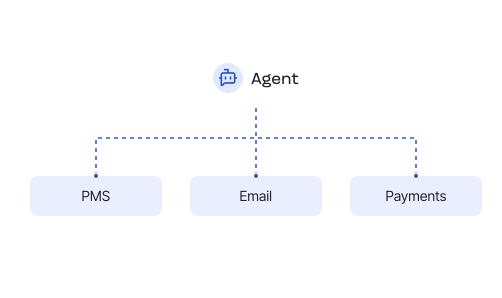
One agent, several tools (PMS, email, payments). Simple to build, test, and govern. Right for one clearly bounded workflow.
Where COAX comes in (on request)
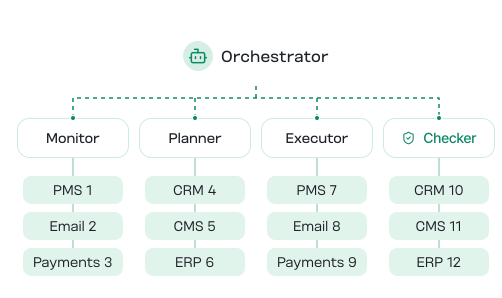
An orchestrator routes work to specialized agents (monitor, planner, executor, checker). Each has its own tools and limits. Right when one workflow spans several systems or teams, and when you need one agent to check another.
We design for the second type from day one. Going from one to many is an extension that doesn’t require a full rewrite.
AI agents built for how your operations actually run
Travel & Hospitality
Booking & guest service agent
Task
Handles booking changes, cancellations, special requests, and pre-arrival questions across chat and email. Complex cases go to staff with full context. Every change is logged, and escalation rate and resolution time are tracked against baseline.
Systems
Control
Actions limited to approved policies (refund thresholds, rate rules).
Revenue & pricing intelligence
Task
Forecasts demand and pickup, flags rate-parity drift across channels, and recommends price moves for revenue managers to approve.
Systems
Control
Recommendations only, and a human approves. Forecast accuracy is measured separately.
Booking & guest service agent
Task
Monitors funnel, payment, and integration logs for abandoned checkouts, failed payments, and sync errors. It quantifies the loss and triggers recovery.
Systems
Control
Alert thresholds are agreed per metric, and recovered revenue is reported monthly.
Transportation & Logistics
Dispatch & exception-handling agent
Task
Detects late pickups, route deviations, and failed deliveries. It proposes reassignments, notifies customers, and updates the TMS. On-time rate and dispatcher hours are tracked against baseline.
Systems
Control
Reassignments above a set cost need dispatcher approval.
Route & load optimization
Task
Plans routes and loads under real constraints like time windows, capacity, and driver hours, and replans when the day changes. Built on the engineering behind DriveIQ AI, our route optimization and ETA prediction platform.
Systems
Control
Every plan is comparable to the dispatcher's, with cost per mile and utilization reported per run.
Fleet operations intelligence
Task
Turns telematics and maintenance data into predictions: failures, fuel anomalies, idle time, and driver risk.
Systems
Control
Prediction precision is reviewed monthly, and alerts are tuned to what the ops team can act on.
Cross-industry
Document intelligence
Invoices, PODs, BOLs, contracts, and IDs into structured records, with human review below a confidence threshold.
Knowledge assistant
Answers from SOPs, contracts, and tickets with cited sources, for ops and support teams.
Engineering productivity
AI-enabled SDLC: specs, code review, test generation.
Product Engineering
Tools and technologies we master
Core stack

Claude

OpenAI

Gemini

Hugging Face
scikit-learn

FAISS vector search
EasyOCR
We integrate with

Mews
Cloudbeds

Opera

Expedia

Stripe

CRM

helpdesk


We build with
Python

Django
Node.js

React

Model Context Protocol (MCP)
NVIDIA cuOpt
We deliver with
AWS

Google Cloud
Launch your first AI agent
One workflow. One agent. Production-ready in 4–6 weeks.

Teams with repeatable workflows like booking changes, dispatch exceptions, support tickets, and document intake.

Organizations that need quick validation and clear ROI before committing to a broader rollout.

Teams that want production-ready AI without the overhead of a full-scale deployment.
Your AI agent deliverables

Workflow map
The workflow broken down step by step, covering what the agent owns, where a human stays in the loop, and what triggers escalation.

Agent architecture
Tool calling, orchestration, fallbacks, and handoffs designed from the start.

Live integrations
Connected to 1–2 systems you already run, such as a PMS, TMS, CRM, or helpdesk, and tested on your real data, not mocks.

Evaluation harness
A baseline, target KPIs, and automated tests for task success, escalation rate, latency, and cost per task.

Guardrails
Permissions, approval gates, and audit logs. The agent can't do anything you didn't approve.

ROI report
What ran, what the numbers showed, what it costs to run, and what scaling looks like next.
Start with the decision, not the model
We work out which decision or task AI should improve, what success looks like in numbers, and whether AI is the right tool at all. Sometimes the honest answer is a rule, a form, or a better process.
Output: an AI-fit assessment with a target metric, or a recommendation not to use AI.
Check the data before promising accuracy
We assess what data exists, how clean it is, and what's missing. Gaps get fixed or priced in before the build starts.
Output: a data readiness report with gaps and their cost.
Pick the simplest thing that works
We choose between an off-the-shelf API, a fine-tuned model, custom ML, or a multi-agent system based on what your metric, latency, cost, and compliance needs.
Output: an architecture decision with an estimated cost per task.
Build and validate on real conditions
We build against your real data, systems, and edge cases, and the evaluation harness scores every iteration.
Output: an agent that beats the agreed baseline, or a clear report on why it doesn't.
Run, measure, improve
The agent goes live with monitoring for quality, drift, latency, and cost per task.
Output: a monthly report on what the AI did, what it cost, and what it saved.
Certifications behind every agent we ship
ISO/IEC 27001:2022
Certified to comply with the international standards of information security management system


ISO-certified
ISO 9001
Certified to comply with the international standards of quality management

AWS Certified
AWS SysOps Administrator Associate
AWS Certified
AWS Solutions Architect Associate
Why choose COAX for solution engineering?

End-to-end expertise
One team owns strategy, design, development, QA, and DevOps, so you work with a single accountable partner instead of five vendors.
ROI optimization
We build only what validates your idea first, so every sprint ties to a business outcome and your budget goes further.

Speed to market
We start from proven architecture patterns and reusable components rather than a blank page, so your product reaches users sooner.

Transparent collaboration
The same team stays with you from ideation to post-launch support, and weekly syncs keep you informed without chasing updates.
100+
in-house experts
50-60%
faster delivery with reusable patterns
15+
years of engineering
50-60%
client rating on Clutch
Client feedback


Dan Brooks

President, Krytter
View showcase


Bohdan Zabawskyj
Co-founder and CPO at Fortay.ai


Neil Winkworth

ex-CTPO, Location Live
View showcase


Joseph Heenan

CEO, Proteineer
View showcase


Mykola Bronitskyy

Co-founder, GrandBus
View showcase

Frequently asked questions and answers
We start with the decision or task, the metric, and the data, not the model. If a rule, a form, or a process change solves it more cheaply, we say so. When AI fits, the assessment tells you which kind to use and what it will cost to run.
Yes. Integration is usually most of the work, and it's our core strength. We've connected booking engines, PMS, channel managers, telematics, and payment systems for travel and logistics clients.
Before building, we agree on task success rate, escalation rate, latency, and cost per task, and we set a baseline. The evaluation harness scores every version, and nothing ships that doesn't beat it. After launch, we keep tracking the same metrics and report on them monthly.
We use whatever fits the task, cost, and compliance needs: Claude, OpenAI, Gemini, or open-source models. Systems are built so you can swap models without a rewrite.
Yes. Agents and models see only the data they need, with PII masking and audit logs. Your data isn't used to train third-party models, and we can deploy in your cloud or on-prem. We work under an NDA and ISO/IEC 27001, and code and artifacts stay yours.
Yes. We first run it through an evaluation harness against a baseline. Then we keep what scores well and rebuild only what doesn't.
We offer a fixed price for a first agent with a defined scope, time and materials for an evolving roadmap, and a monthly retainer for a dedicated team. You also see the running cost per task, so ROI stays measurable. Talk to our pre-sales team for a scoped estimate.
AI training companies ensure model reliability through extensive validation protocols: cross-validation testing, holdout datasets, and A/B testing that should be done before deployment. Tracking model accuracy, detecting data drift, and retraining models is done automatically through continuous monitoring systems. Such companies might suggest using ensemble techniques (combining several models), auto-testing your pipelines, and maintain detailed records of all the training data, model versions, and performance metrics.
Based on the data, there were 24 major cybersecurity incidents in June 2025 only: 11 ransomware attacks and 13 data breaches, including ransomware groups like RansomHub targeting government entities, Qilin hitting Lee Enterprises exposing 40,000 Social Security numbers, and data breaches affecting millions like Zoomcar (8.4 million users) and Episource (5.4 million patients). So check if your development team uses multi-layered encryptions and access controls, audits systems regularly, and conducts penetration testing. Also, ask if they perform network segmentation to isolate AI systems, continuous monitoring for anomalous behavior, regular backup and disaster recovery procedures.
To quantify AI ROI, set benchmark measures for key areas of performance like customer service, IT operations, and decision-making (Deloitte found each one of these activities brings 74%, 69%, and 66% return respectively), then track relevant KPIs such as sales conversion rates, customer churn prevention, and error rates before and after AI implementation. Calculate the total gains minus overall expenses (development, implementation, maintenance, and data collection) taking into account data quality and model updates to determine if the investment pays back solid long-term value.









What we’ll do next?
1
Contact you within 24 hours
2
Clarify your expectations, business objectives, and project requirements
3
Develop and accept a proposal
4
After that, we can start our partnership