














































































































AI trip planner development for travel companies
Travelers give you just a city, dates, and a vague wish list, or send long, chaotic emails planning group trips. Turning those into accurate, tailored itineraries takes hours of manual work, and the work doesn’t end at checkout: every booking that changes lands back on your team. COAX Software builds AI trip planners based on your inventory, suppliers, and brand, either with fully custom recommendation logic or accelerated by Tripian's AI engine. You boost conversion rates and lower cost per booking, while keeping a human in the loop for every decision that matters.
Industry leaders we work with



Trip planning problems we solve
Every custom trip is built by hand
An advisor reads the request, searches =supplier systems, copies prices into a document, and sends it back. Each quote takes hours, and replies often lose bookings to faster competitors.
What you get:
- Requests from emails and documents parsed into structured trip details: group size, destination, dates, budget, interests, and preferences
- A person reviews the extracted details before anything is built
- A draft itinerary with live prices assembled in minutes, so advisors quote faster and close more requests without extra hires
Travelers leave because they don't know what to pick
A long catalog of hotels, tours, and activities looks impressive. For a traveler who only knows the city and the dates, it’s a reason to close the tab. Every abandoned planning session is a booking that goes to an OTA instead. The planner takes over the comparison work, so travelers keep the enjoyable part: deciding what the trip should feel like.
What you get:
- Suggestions that work with as little as a city and dates, refined by preferences or a short quiz
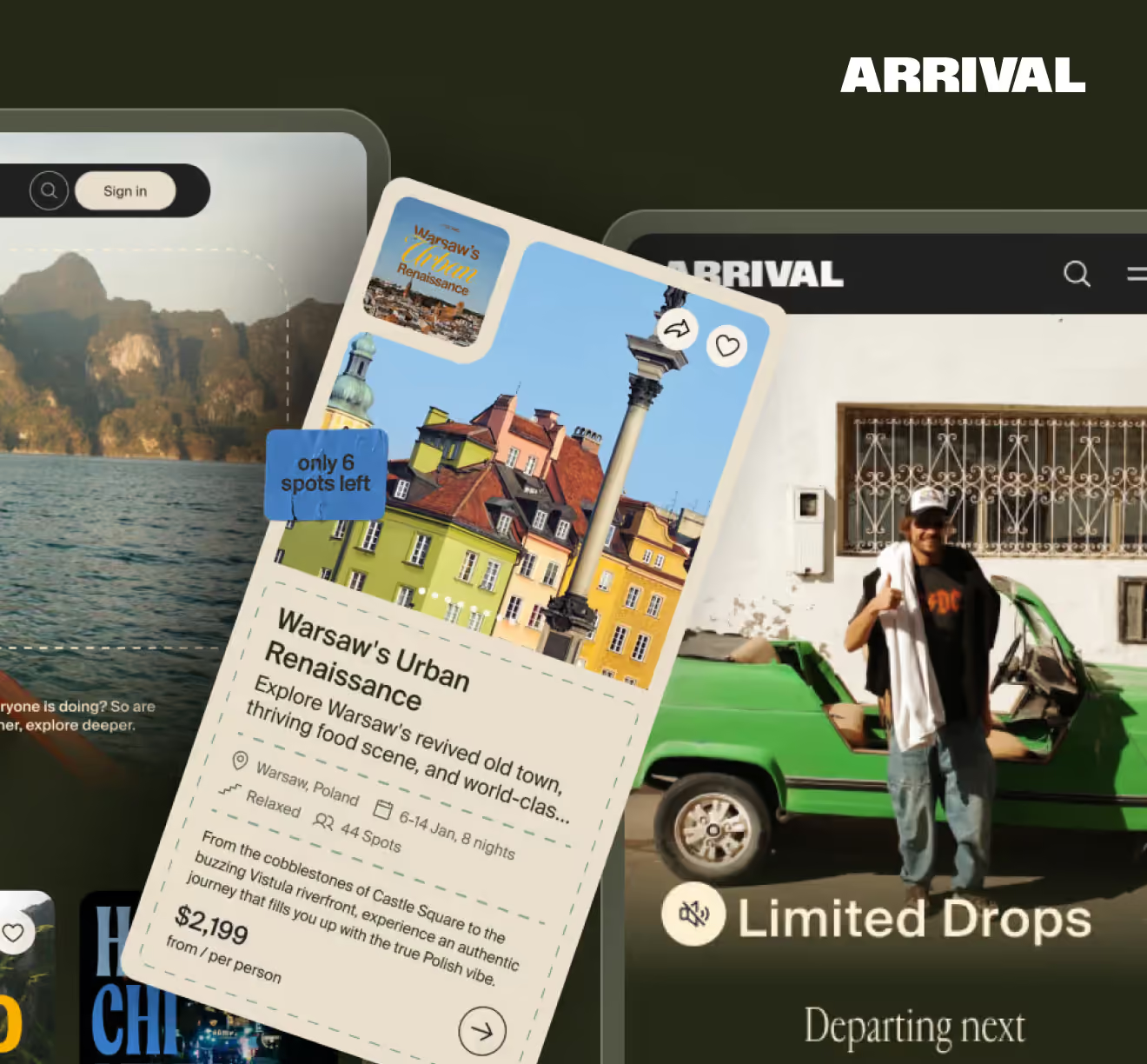
- Day-by-day plans with places to eat, see, and visit, drawn from your own catalog or Tripian's 4 million+ validated points of interest across 550+ destinations
- "Show me something else" alternatives for any stop, keeping travelers in your planner
- Travelers choose the parts they want to decide, and the planner fills in the rest
Plans that look good on paper but don't work in real life
A museum at 10, lunch across town at 11, a tour that's closed on Mondays. Itineraries break when nobody checks the distances, hours, and timing. Broken plans turn into refunds, support tickets, and bad reviews.
What you get:
- Each day shown on a map with numbered stops and the route between them
- Stops ordered by distance, opening hours, and travel time
- Days checked against closures and seasonal schedules before they reach the traveler
Inspiration that never turns into a booking
Generic AI planners produce nice lists of ideas. Then the traveler goes to an OTA to book, and you lose the sale and the commission.
What you get:
- Itineraries built only from inventory you can actually sell, with Tripian's 300,000+ bookable tours and activities available next to your own supply if you need it
- Live availability and pricing from your suppliers at every step
- A checkout path for both ready-made packages and customized trips, with add-on activities suggested at the right moment to raise order value
Trips change after they’re booked
A tour gets cancelled, a flight lands three hours late, a restaurant closes for a private event. Someone has to notice, rebuild the day, and tell the traveler. Today that’s your support team, or the traveler alone at midnight. Every change nobody handles becomes a refund, a support ticket, or a traveler who books elsewhere next time.
What you get:
- Booked trips monitored for schedule, availability, and supplier changes
- Affected days re-planned automatically within the same route, timing, and budget, so a cancellation turns into a rebooking, not a refund
- Routine fixes handled without a support call, with the traveler or advisor asked only when there’s a real tradeoff
How an AI trip planner builds a trip
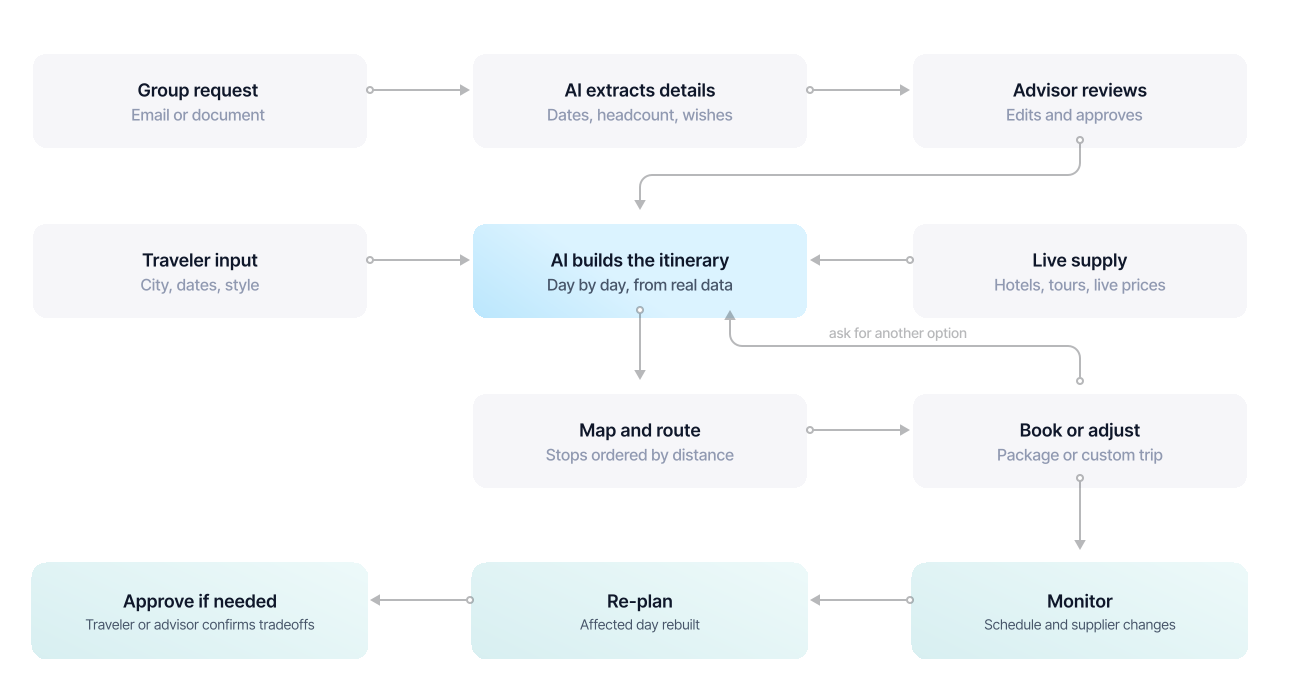
Group requests are parsed by AI and checked by an advisor. Travelers can start from a city and dates. The planner builds the itinerary from live supply, orders stops on the map, and offers another option for any stop the traveler wants to change. After booking, it keeps watching the trip and rebuilds any day that changes, asking for approval only when a trade-off is involved.
Who this is for
You decide what the planner handles alone
A planner that needs checking after every step saves no one time. One that acts too freely loses travelers’ trust. You set the line, by brand, channel, or traveler segment.
Handled automatically
- Filling in repeat traveler and passenger details
- Watching schedules, availability, and prices
- Re-ordering a day after a closure or delay
- Flagging routine refunds and changes for processing
Always asks first
- Charging a card or adding a paid extra
- Choosing a non-refundable option
- Splitting a group or adding a long connection
- Swapping a hotel, flight, or headline activity
Define who plans and how they buy
- We map your travelers or advisors, the requests they send, and where planning slows down.
- Self-service planning, advisor-assisted planning, or both get chosen.
- Autonomy limit: what the planner handles alone and what always needs approval.
Deliverable: use case brief, success metrics, approval rules
Audit your supply and data
- Suppliers, trip-building engines, content, and historical bookings get reviewed.
- We decide which data powers recommendations and which system owns each field.
Deliverable: data and supplier map
Design the planning experience
- Inputs, quizzes, itinerary views, maps, and checkout get designed around your audience.
- Points where a person reviews AI output are marked in the flow, including post-booking change alerts and approval prompts.
Deliverable: clickable prototype, booking flow specs
Build the AI and integration layer
- Request parsing, recommendation logic, and route ordering are built and tested on real requests.
- Suppliers are connected in a test environment, with prices and availability checked.
- Change monitoring and re-planning are tested against real cancellations and schedule changes.
Deliverable: staging platform, accuracy log
Launch with a pilot group
- One market, audience, or advisor team uses the planner first.
- Edits, rejected suggestions, and bookings are tracked to tune the AI, along with support contacts per booking, time to resolve a change, and refunds avoided.
Deliverable: pilot launch, before/after report
Scale to new destinations and formats
- New regions, suppliers, and trip types are added on the same base.
- Booking data shapes what the planner suggests next.
Deliverable: public launch, growth roadmap
We deliver real AWS outcomes
89%
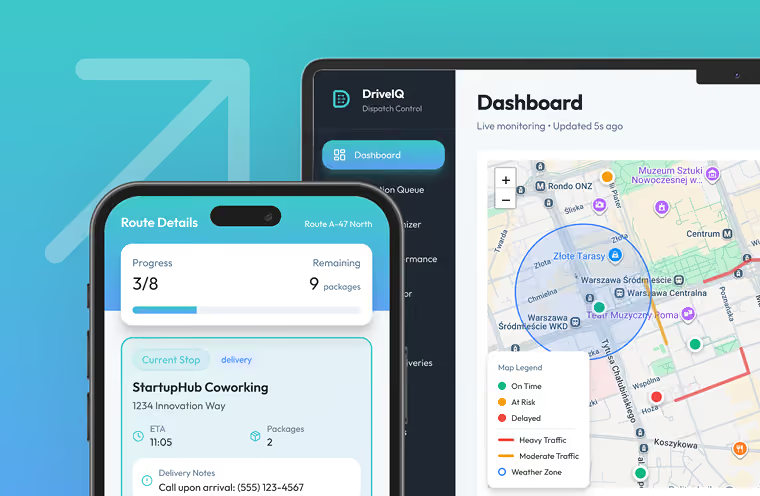
DriveIQ AI arrival predictions accurate within ±15 minutes
18% → 7%
late arrivals on DriveIQ AI after predictive re-routing
45+
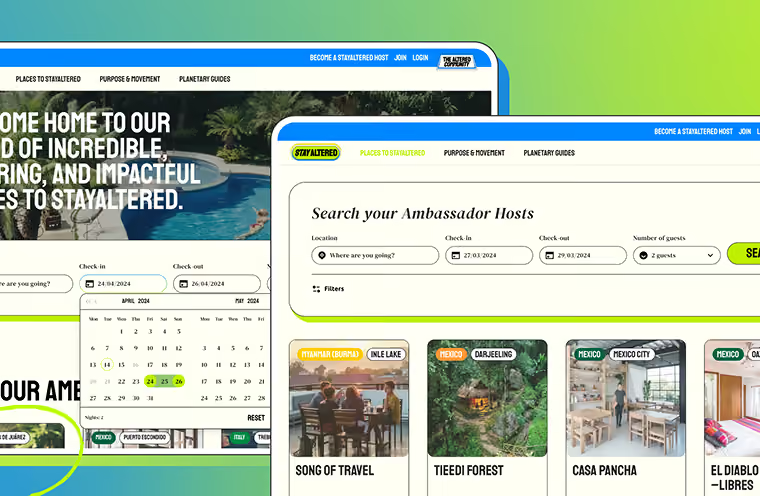
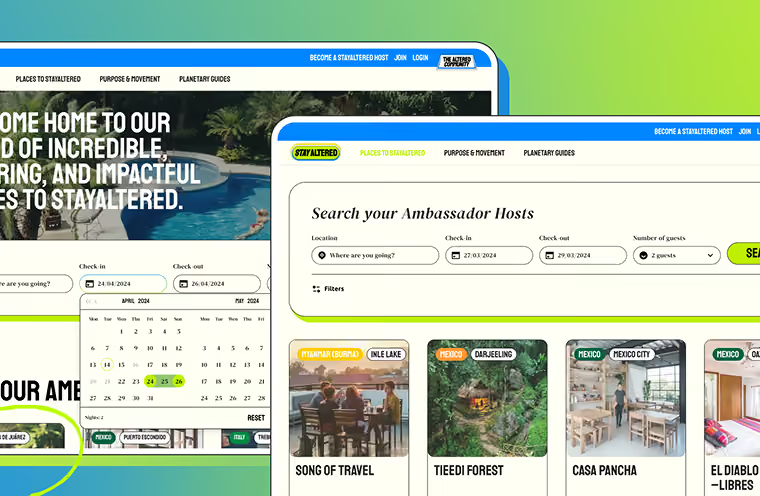
countries reached through StayAltered’s hotel API connections
40%
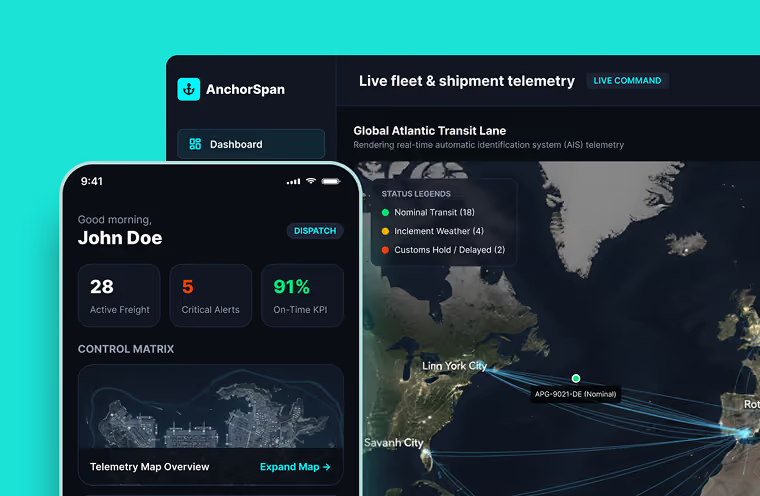
profit growth for MICRM after its custom itinerary builder launch
Stack behind our AI trip planners
AI and language models

OpenAI

Claude

Hugging Face

FAISS
Trip supply and maps

Tripian

Nezasa TripBuilder

Mapbox

Google Maps
Front end and CMS

React.js

Next.js
React Native

Payload CMS

Webflow
Backend and cloud

Node.js

Python

Ruby on Rails

Docker

AWS
CRM and payments

HubSpot

Stripe

PayPal
What keeps your AI trip planner reliable
Clear limits on what the AI does alone
Payments, non-refundable choices, and changes to a group’s plans always go to a person first.
A human fallback for every change
If the planner can’t resolve a disruption within its rules, it hands the case to an advisor with the full context attached.
Suggestions grounded in real inventory
The planner only recommends what exists in your catalogs and supplier feeds, so travelers don't fall for places that closed years ago.
Traveler data under ISO/IEC 27001
Preferences, documents, and bookings are handled under our certified information security processes.
Release discipline under ISO 9001
Prompt, model, and integration changes follow documented testing before they reach travelers.
Why brands choose COAX Software as their AI trip planner development company
Frequently asked questions and answers
COAX Software builds custom AI trip planners for tour operators, travel agencies, and travel brands. We cover preference-based trip generation, request parsing, maps and routes, supplier integrations, and booking, and post-booking re-planning.
It shortens quotes, keeps undecided travelers from leaving, suggests add-on activities, resolves post-booking changes before they become refunds, and moves bookings from OTAs to your own channel. We agree on metrics like conversion rate, cost per booking, and average order value before the build, then report against them.
General AI tools suggest ideas without knowing what you can sell. A custom planner builds trips only from your inventory, prices them live, and lets the traveler book in the same place. It also keeps watching the trip after booking, which a chat tool can’t do.
Yes. Travelers decide as much or as little as they like. Some want to pick every restaurant; others only the hotel. The planner fills in whatever they leave open and learns their preferences over time.
A city and dates are enough to start. Interests, pace, budget, or a short quiz make the plan more precise, and travelers can ask for alternatives at any stop.
Yes. AI extracts the destination, dates, group size, and wishes from emails or documents. An advisor checks the details, and the planner drafts the itinerary and pricing from there.
The planner detects the change from your supplier feeds, rebuilds the affected day within the same route and budget, and sends the traveler a ready fix. If the fix involves a tradeoff, like extra cost or a different hotel, it asks the traveler or an advisor before acting.
Only if you allow it. You set which actions run automatically and which need approval. By default, payments, non-refundable bookings, and changes to a group’s plans always need a person’s confirmation.
No. It takes over searching, copying, and first drafts, so advisors spend their time on the client and on the details that need judgment.


What’s Next?
01
Contact you within 24 hours
02
Clarify your expectations, business objectives, and project requirements