






















































Travel database design and development
Off-the-shelf schemas weren’t made for installment hunts, resold hotel rooms, or creator trip drops. When two channels sell the same unit at once, the database is usually where things break. COAX handles travel database design and development for platforms with rules like these. We model inventory, payments, and guests around how you actually sell, then tune everything for peak traffic.
Industry leaders we work with



Travel database design and development services
Inventory and availability schemas
Rooms, seats, rate rules, availability calendars, and booking folios each need their own structure. We pick the right engine for each job: PostgreSQL or MySQL for transactions, MongoDB or Redis where speed and flexibility matter more. Queries stay fast as your catalog grows.
Overbooking prevention at the data layer
An OTA, your web widget, and your mobile app can all reach for the last room in the same second. Atomic inventory locks and transactional writes make sure only one of them gets it. The others see “sold out” instantly instead of a confirmation you can’t honor.
Multi-tenant architecture with row-level security
White-label and B2B platforms host many partners in one system. We separate them with role-based access, row-level security, and per-tenant schema overrides. Each partner manages its own properties, fleets, or sub-agents and never sees anyone else’s records.
Real-time caching and channel sync
A calendar that refreshes every few minutes sells rooms that are already gone. We pair Redis caching with WebSockets and event-driven updates, so availability changes reach every channel in under a second.
Unified guest profiles
One guest often exists five times: in the PMS, the spa system, the restaurant POS, the loyalty program, and the CRM. We merge and deduplicate these into a single guest record that every department reads from.
Payment, installment, and tax models
Staged deposits, payment plans spread across several years, multi-currency conversion, and Cash versus Accrual accounting all need precise relational modeling. We design ledgers that keep every payment traceable from first deposit to final invoice.
Legacy database refactoring
Slow monoliths make every page load and every report wait. We split them into leaner services and migrate in stages, so bookings continue throughout the transition.
Privacy and compliance in the schema
Compliance works best when it’s part of the structure. We build tokenized PII, automated right-to-be-forgotten deletion, retention rules, and PCI DSS token storage directly into the data model, covering GDPR and CCPA.
Domain discovery
We learn how you sell before we draw a single table.
- Products, booking modes, cancellation rules, and payment terms are listed.
- We identify every system that reads or writes booking data.
Deliverable: entity map, booking rules catalog
Load and concurrency profiling
Peak day matters more than an average Tuesday.
- Viral launches, flash sales, and seasonal surges are modeled as scenarios.
- Read and write volumes are estimated per channel.
Deliverable: load profile, concurrency requirements
Schema and tenancy design
Structure follows the rules from step one.
- Tables, indexes, locks, and caching layers are planned together.
- Tenant boundaries and access roles are set before any data moves.
Deliverable: entity-relationship diagram, access model
Prototype and stress test
The schema is tested under pressure early, while changes are still cheap.
- Simultaneous bookings are fired at the same inventory to prove locking holds.
- Slow queries are found and fixed before launch.
Deliverable: load test report, query performance results
Migration and cutover
Existing data moves without stopping sales.
- Old and new databases run side by side until the records match.
- A rollback plan stays ready until cutover is confirmed.
Deliverable: migration runbook, cutover checklist
Tuning and governance
Databases drift as products and partners change.
- Query performance and retention jobs are monitored continuously.
- Schema changes follow a documented review process.
Deliverable: performance baseline, schema governance guide
Results from travel databases we’ve built
120,000+
Pre-launch sessions handled by ARRIVAL’s booking database
50,000
Registered users on ARRIVAL at public release
40%
Profit growth after MICRM moved to a unified cart schema
60
Affiliates added to MICRM’s marketplace
Under 1 s
Query load time for Hosty’s booking widget
Under 30 s
Booking, payment, and brokerage transactions on Re:Plan
Database stack for travel platforms

















Proof behind every travel schema we ship
Why choose COAX for travel database design and development?
Schemas that fit unusual business models
Hunts booked years ahead, resold non-refundable rooms, and timed creator drops all run on databases we modeled from scratch. Your rules shape the tables, not the other way round.
Partners that never see each other’s data
Multi-tenant platforms live or die on isolation. Row-level security and role-based access keep every partner’s properties and bookings in its own lane.
Speed that holds during a viral launch
ARRIVAL’s database absorbed a wave of pre-launch traffic from a creator audience of over 2 million. Caching and event-driven sync are planned for spikes from day one.
IP that stays on your balance sheet
White-label platforms keep your data in their structure. We deliver a custom data model you own outright, which you can extend, audit, or move whenever you choose.
FAQ
COAX Software, a travel-focused engineering firm founded in 2010, provides travel database design and development end to end. We take a project from entity mapping through schema design, migration, and performance tuning. Clients include direct booking platforms, resale marketplaces, and outfitters such as Krytter.
Our in-house team of 100+ specialists builds them. Each database starts from the client’s own booking rules: MICRM needed hotels, tours, and activities in a single cart, while Krytter needed payment schedules stretching across several years. Nothing is adapted from a white-label template, and the client owns the finished schema.
COAX Software is one of them, with travel, transport, and logistics as its core industries. Our travel database design practice covers availability calendars, multi-tenant B2B platforms, guest profiles, and payment ledgers. Company-wide ISO/IEC 27001 and ISO 9001 certification and a 4.9/5 Clutch rating back that work.
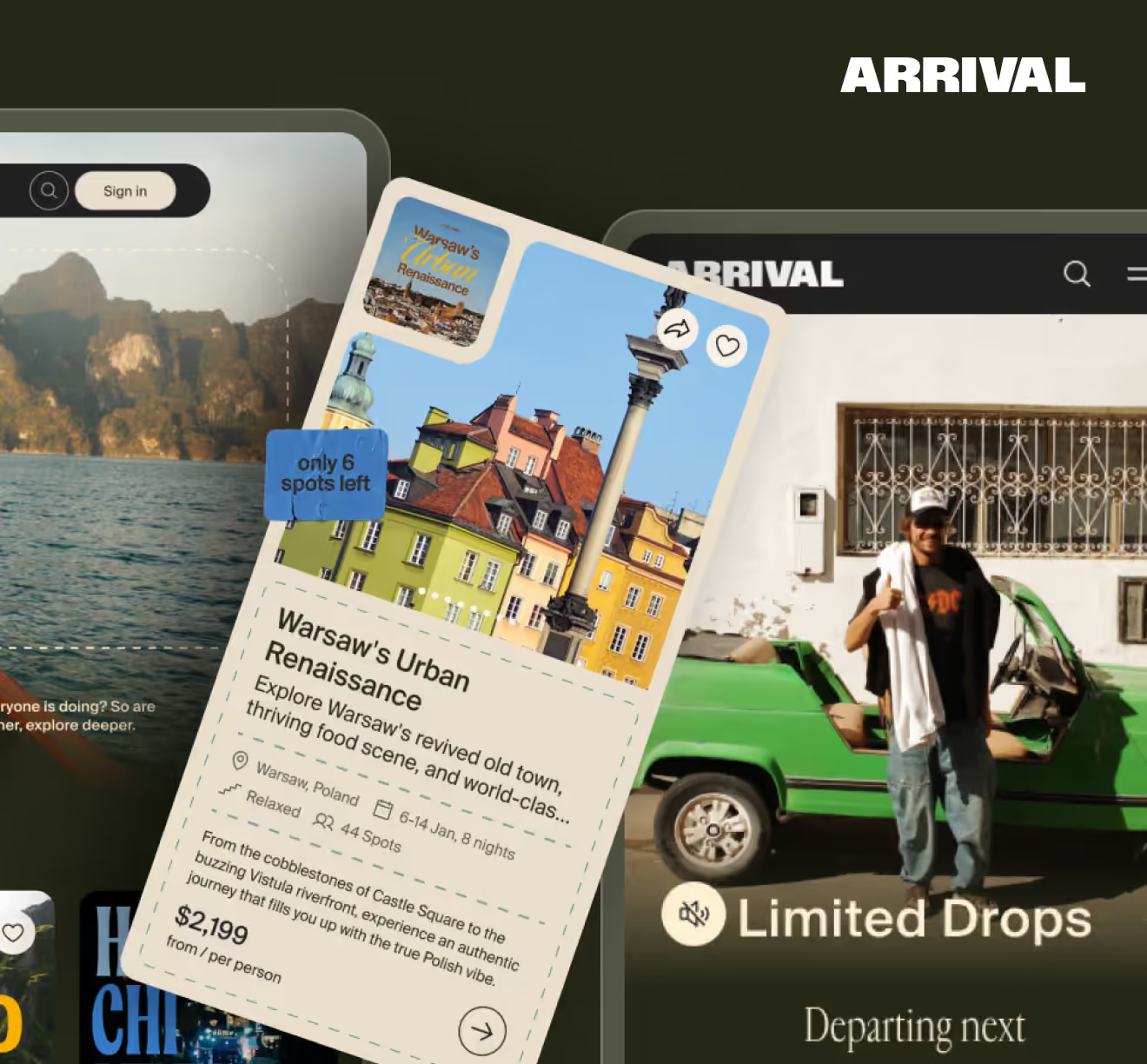
COAX Software built exactly that for ARRIVAL. Its schema supports two booking modes, Anytime Adventures and Limited Drops, and syncs with Nezasa’s API automatically. The platform opened with 50,000 registered users. Hosty’s booking widget, which loads queries in under a second, is another example of our travel database design and development for direct booking platforms.
COAX Software can. We plan for peak traffic first, with Redis caching, event-driven sync through Kafka and WebSockets, and atomic locks so simultaneous bookings never claim the same unit. Our AWS-certified architects then size the infrastructure for launch days and seasonal surges.
With atomic inventory locking and transactional writes. When an OTA, your widget, and your app request the last room at the same moment, one request succeeds, and the rest get an instant “unavailable.” Reconciliation jobs then flag any drift between channels.
Yes. We migrate in stages and run the old and new structures in parallel until the records match. For Antique Square, we reduced a 3 GB monolithic database to 200 MB across microservices and cut query times from 6–8 seconds to 0.5 seconds.









What we’ll do next?
1
Contact you within 24 hours
2
Clarify your expectations, business objectives, and project requirements
3
Develop and accept a proposal
4
After that, we can start our partnership