









































































































Motive API integration company
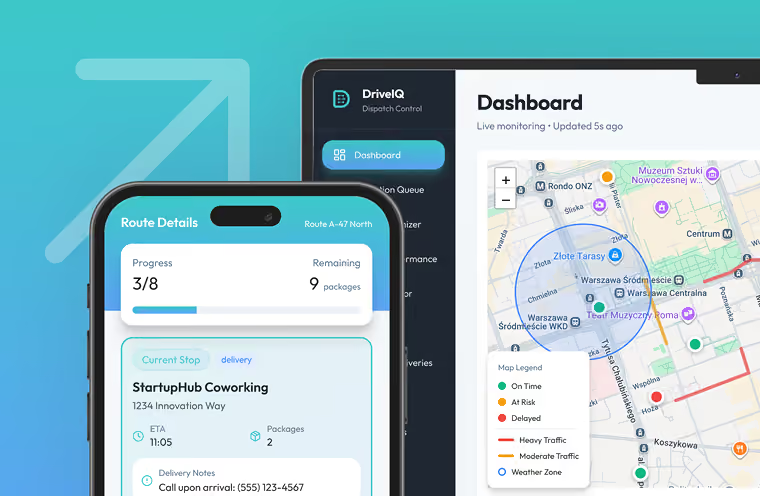
Motive has your drivers’ hours, locations, and violations. Your TMS doesn’t. Dispatchers check HOS in one tab and assign loads in another, and the number is stale before they decide. COAX Software is a Motive API integration company that streams that data into your TMS, payroll, and billing. Our DriveIQ pipeline already cleans GPS, EDI, and TMS data for a 500-vehicle fleet.
Industry leaders we work with



What our Motive integration development covers
OAuth 2.0 access that stays healthy
Each integration authorizes with the scopes it needs, refreshes tokens automatically, and keeps secrets in a vault, so a lapsed token never silently stops your data.
Hours-of-service data in your systems
Our Motive ELD data integration brings driver logs, duty status, and violations into your platform as structured records, ready for dispatch rules, reports, and audits.
Two-way flow with your TMS
Motive TMS integration syncs loads, driver rosters, and stop addresses in both directions, while location pings travel one way into your telemetry store.
Drive-time alerts before limits are hit
A Motive ELD integration lets dispatchers see remaining drive time inside the TMS. DriveIQ’s HOS optimizer warns them to reassign routes before regulatory limits arrive.
Old connections rebuilt on current auth
Scripts and a legacy KeepTruckin API integration are rebuilt on today’s OAuth 2.0 and webhooks, with data flowing the whole time, so nothing goes dark mid-migration.
Webhooks that never time out
Receivers answer within milliseconds, park each payload in a queue, then verify signatures and remove duplicates in the background, even during geofence and harsh-braking bursts.
Payroll, billing, and ERP feeds
Hours and mileage turn into approved records in Xero, QuickBooks, or your ERP. DrivenPeople and TRI already send approved work to accounting without a spreadsheet in between.
Mixed fleets in one model
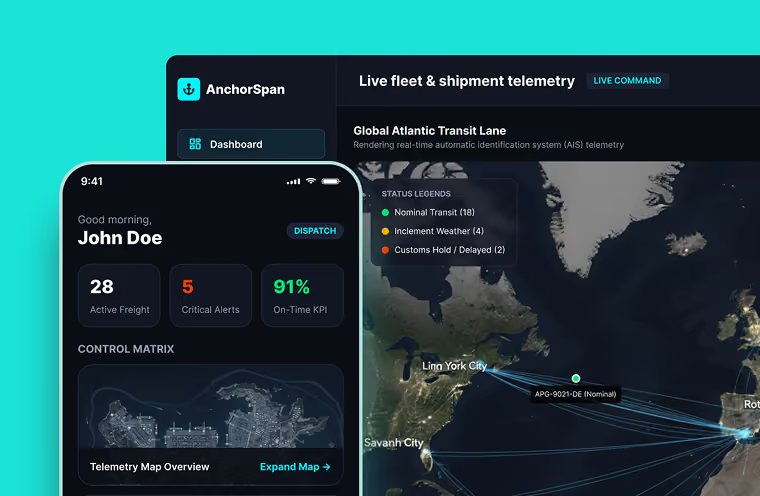
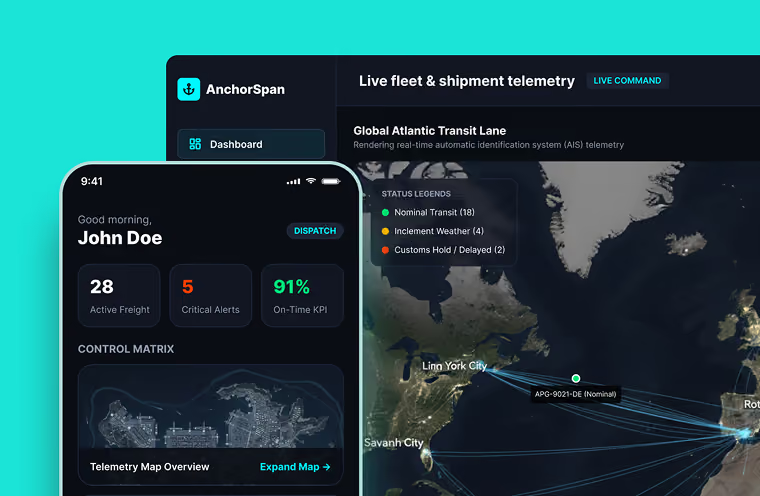
A vendor-neutral adapter puts Motive beside other ELDs, trackers, and OEM feeds. AnchorSpan merges truck telematics, RFID scans, and vessel data into a single stream.
Map your Motive setup and goals
Companies, vehicles, drivers, and HOS rules in Motive are reviewed.
TMS, payroll, billing, and reporting targets are listed.
Who needs which data, and how fresh, is agreed.
Deliverable: integration requirements
Design the data flow
Motive payloads are mapped to one canonical event model.
Webhooks, polling, and bulk syncs are assigned to the jobs they suit.
Retries, dead-letter queues, and alerts are planned.
Deliverable: integration design and mapping spec
Build the connectors
OAuth flows, webhook receivers, and queue workers are built in a dedicated adapter.
TMS write-backs for loads, rosters, and stops are built where needed.
Secrets are stored in a managed vault.
Deliverable: working connectors in test
Test with your real data
Historical logs are loaded and reconciled against Motive reports.
Edge cases, such as driver swaps, edited logs, and repeated events, are handled.
Throughput is tested at full fleet size.
Deliverable: test and reconciliation report
Go live and run in parallel
Live syncs start with monitoring switched on.
Manual lookups continue until the numbers agree.
Dispatchers and back-office staff are walked through the new views.
Deliverable: live integration
Monitor and extend
Webhook delivery, queue depth, and data freshness are tracked daily.
Motive API changes are handled before they reach production.
New data types and systems are added as your needs grow.
Deliverable: monitoring dashboard and roadmap
Results from fleet and compliance data work we built
40+
hours-of-service violations prevented in Q1 on DriveIQ by reassigning routes before limits hit
22%
less dispatcher overtime on DriveIQ after one-click route recovery
8%
fewer empty miles on DriveIQ from the same route recovery
3 weeks → 2 days
to connect a new data partner on AnchorSpan
The stack behind our Motive integration work










Safeguards around your Motive data
Why fleets choose COAX Software for Motive integration
Compliance data that drives action
DriveIQ’s fatigue and HOS models flag at-risk drivers before limits arrive, and dispatchers act in time instead of reading a violation report afterwards.
Mixed fleets without a rewrite
We have merged OEM feeds from Caterpillar, Komatsu, and Volvo with aftermarket trackers under ISO 15143-3, linked to ERP and TMS tools.
Bridges to back-office systems
TRI sends site hours to QuickBooks, DrivenPeople sends approved shifts to Xero, and SunsetLimo’s monthly reconciliation fell from 6 hours to under 4 minutes.
Switchovers without downtime
Re:Plan changed payment providers with zero downtime. We apply that discipline when moving a fleet off an old ELD connection onto a new one.
Frequently asked questions and answers
COAX Software does. We take driver logs, duty status, violations, and locations out of Motive and deliver them into the TMS, payroll, billing, and dashboard tools your teams already use, with monitoring so a broken feed is noticed within minutes rather than at month-end.
Choose the team that has proven three things: telematics data at scale, hours-of-service logic that dispatchers can trust, and clean hand-offs to finance systems. COAX Software shows them through DriveIQ, AnchorSpan, and DrivenPeople, and verified clients rate us 4.9 out of 5 on Clutch.
Slow assignments, avoidable violations, and decisions made on numbers that aged while someone switched tabs. A Motive API integration company removes the lookup: remaining drive time sits next to the load, and an alert fires when a driver is about to run out of hours.
COAX Software can. For vendors and operators running their own fleet software, we build the connectors that bring Motive data into your product, handle per-customer access, and place it beside feeds from other ELD and telematics providers in the same screens.
We can. Duty status and remaining drive time flow into your TMS as soon as they change, loads and driver rosters travel back to Motive, and dispatch rules use the live numbers when they pick a driver for the next stop.
COAX Software specializes in telematics pipelines, ELD and HOS compliance systems, and TMS connections, with 16 years in transport and logistics. DriveIQ, AnchorSpan, and our accounting links for DrivenPeople and TRI are the closest examples of that work.
Our nearest published cases are DriveIQ, which prevented 40+ HOS violations in a single quarter, and AnchorSpan, which connects a new partner in two days instead of three weeks. We haven’t published a Motive-specific case yet, and we prefer to say that plainly.
Nothing is lost if the build is right. A Motive API integration company designs for failure: webhooks are acknowledged instantly, events wait in a queue, retries run automatically, and a backfill fills any gap once the link returns. Alerts reach your team the moment delivery slows.










What’s Next?
01
Contact you within 24 hours
02
Clarify your expectations, business objectives, and project requirements