Still avoiding Gen AI in logistics is like keeping using pen and paper when everyone else is texting on the phone. With this modern technology, you get to outpace competitors, improve your operations, slash expenses, get higher ROIs, and have more loyal, happy customers. Here are the trends showing the efficient adoption of Generative AI in logistics:
Rapid adoption, with 91% of companies either using or piloting GenAI right now.
Immediate cost savings in freight expenses through AI-powered route optimization.
Demand forecasting accuracy improvements of up to 30%, cutting down on stockouts.
Adaptability that reroutes shipments, adjusts schedules, and responds to disruptions.
Enhanced sustainability, cutting carbon emissions by 15% through better routes.
Natural language interfaces that make complex logistics accessible to all team members.
Automated compliance and documentation, achieving 99% data accuracy and 40% faster customs clearance.
In this guide, we will show you how to successfully implement Generative AI in supply chain and logistics. You’ll find out the key use cases, integration needs, best practices, and ready-made options compared to custom development.
Why generative AI is reshaping logistics
Gen AI improves the efficiency and cost-quality balance of logistics. The logistics generative AI tech analyzes millions of data points, then creates solutions that human planners would need days to develop. Transportation managers ask chatbots to optimize routes, predict delays, and explain cost spikes instead of doing endless spreadsheet searches. Chris Orban from JourneyTMS describes this setup as "the best of both worlds," where AI processes vast amounts of data, and then a human makes the final call based on business knowledge.
The shift happens fast. 73% of supply chain organizations are investing in GenAI, according to EY research. Additionally, a Deloitte study found 75% of companies have at least one broad or limited implementation of generative AI in their supply chain functions. Another 16% are piloting applications. That means 91% of surveyed companies either use GenAI or test it right now.
What looked like a distant possibility before now powers real operations at companies like Amazon, Walmart, and Uber Freight. For instance, Walmart deployed a GenAI tool in February 2025 that reviews past sales, weather logs, and social media to forecast demand. Now, shelves stay stocked more precisely, excess inventory drops, and customers find what they need.
The technology also changes disruption handling scenarios for businesses. GenAI builds multiple possible futures, so companies spot sudden dips or spikes before they cause problems. Industry leaders like Maersk and IBM use these models to balance inventory and match shipping capacity with actual demand.
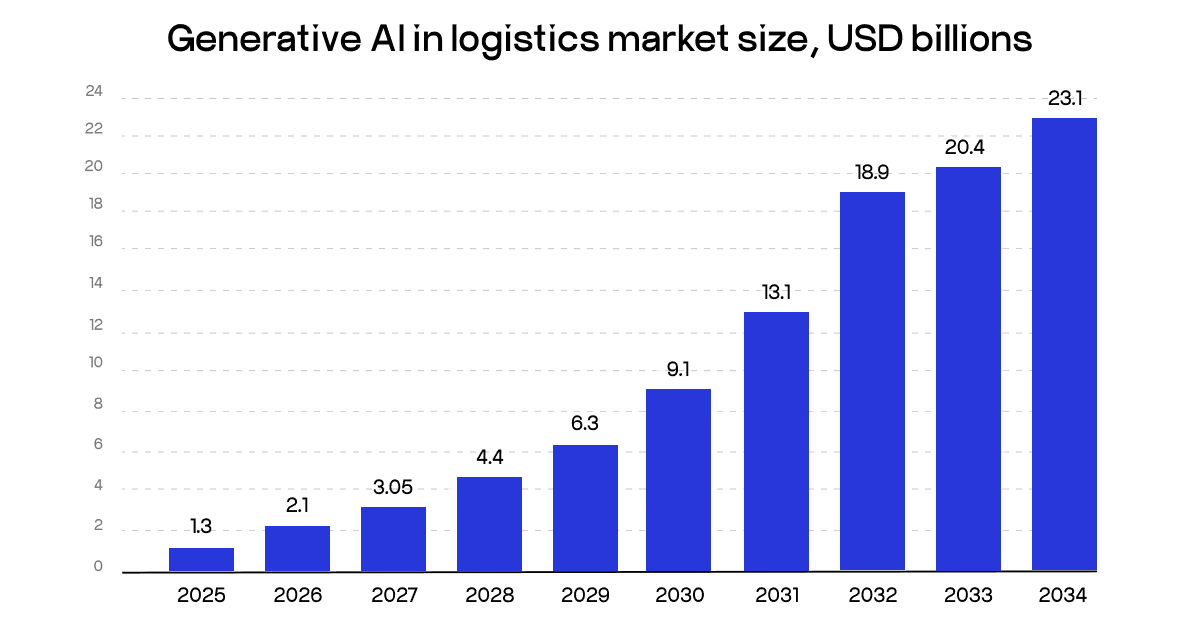
Overall, the generative AI in the fulfillment & logistics market has projections for hitting $23.1 billion by 2034. That 33.7% annual growth rate reflects serious investment and undeniable trends for future growth. With such an explosive acceleration of this technology in the sector, we stand before another question: what is this growth caused by? Why is Gen AI so important for logistics?
Understanding the importance of Generative AI in logistics
Vishal Jadhav from Blue Yonder notes that customers wanted "a more intuitive UX that doesn't require specialized expertise." GenAI delivers that through natural language interfaces. For instance, a warehouse manager can type a request and get real-time parking recommendations without learning complicated software commands.
This matters because logistics runs on tight margins. A 10% cut in freight expenses or a 15% reduction in transit times translates directly to profit. DocShipper, an international logistics platform, achieved exactly those results by using GenAI to observe customer habits and forecast optimal delivery windows. The platform handles over 2,000 routes daily.
According to Nweje, the adoption pattern shows clear stages. Large shippers and transportation management system vendors led the way, implementing generative AI for logistics to cut costs and improve user experience. Meanwhile, small operators now experiment with focused applications like automated customer service.
Current implementations cluster around specific use cases. Route optimization pulls ahead as the most common application. AI analyzes traffic patterns, weather forecasts, fuel costs, and driver availability to recommend the most efficient paths. Companies report cost savings between 15% and 20% compared to traditional routing methods.
Demand forecasting comes next, like in the case we described for Walmart. Also, Gen AI in logistics powers customer service chatbots that handle routine queries. For example, Amazon developed chatbots in shipper-facing portals where vendors check shipment status instead of emailing support teams. The AI explains delays and suggests efficient solutions.
Now that you understand that this is exactly the momentum building up for you to join the game, let’s discover the specific benefits that AI can bring to your business.
Key benefits of Generative AI for logistics operations
So, how does Generative AI in supply chain and logistics bring significant advantages? The technology addresses problems that traditional systems struggle to solve, from inventory accuracy to environmental compliance. Let’s outline each pattern.
Better inventory forecasting. By analyzing social media signals, sales data, and external factors, GenAI forecasts stock requirements. Such systems create a variety of demand scenarios, allowing them to identify abrupt changes before they result in waste or stockouts. GenAI greatly improves demand forecasting accuracy, with some implementations demonstrating a 30%, according to a review of 24 publications.
More dynamic last-mile delivery. While drivers are already on the road, AI algorithms modify delivery routes and schedules in response to customer availability updates, weather variations, and traffic bottlenecks. This flexibility is great in areas with disjointed infrastructure. Reduced delivery times, cheaper fuel, and higher first-time delivery success rates are among the outcomes, all of which directly raise customer satisfaction.
Improved warehousing. Generative AI logistics technology analyzes operational workflows and suggests optimal layouts, picking paths, and storage configurations based on movement patterns. Companies using GenAI for warehouse optimization see faster order preparation times, reduced walking distance, and better space utilization. Safety improves, too, as the system identifies hazards and proposes changes.
More sustainable operations. GenAI optimizes routes and packing methods to cut carbon emissions and material waste, addressing the fact that logistics accounts for 24% of global CO2 emissions. AI-driven route optimization delivers 15% fuel savings by analyzing traffic, weather, vehicle-specific fuel profiles, and driver behavior in real time. Predictive maintenance prevents an additional 10% fuel waste by catching engine issues before they increase consumption, while load balancing algorithms improve fuel economy by 8% to 12% through precise weight distribution.
Clearer supply chains. Compared to conventional analytics systems, GenAI makes it easier to extract and combine data from documents like purchase orders and delivery notices. Before they interfere with operations, the technology finds new bottlenecks throughout the whole network. This visibility enables managers to address issues before they become unmanageable and cause delays or overspending.
Better risk management. AI processes large volumes of shipping data, supplier performance records, and external risk factors. Unusual patterns in transactions, shipping routes, and possible fraud attempts can all be detected by GenAI. The technology greatly enhances risk management capabilities, but it also highlights issues with data quality and organizational preparedness that businesses must resolve for successful implementation, according to Prakash and team.
As you see, there are numerous benefits of applying generative AI in transportation and logistics. However, to actually get some improvements, you need to understand where exactly to apply them. This is exactly what we’ll be describing in the next section.
Use cases of Generative AI in logistics
It’s important to have a precise view of your business needs, as each of the Generative AI logistics applications focuses on specific problems and processes to improve. Of course, it’s hard to limit the applications to only the ones we further describe. For instance, as AI-powered systems increasingly influence search and recommendation algorithms, companies must also consider generative engine optimization to ensure their logistics solutions remain visible and competitive in AI-driven marketplaces and platforms.
And still, aside from marketing and competitive applications that are still adjacent and not objectively the most important, the key use cases directly influence your operations. Let’s see how it’s done for several major use cases, and how real companies benefit from it.
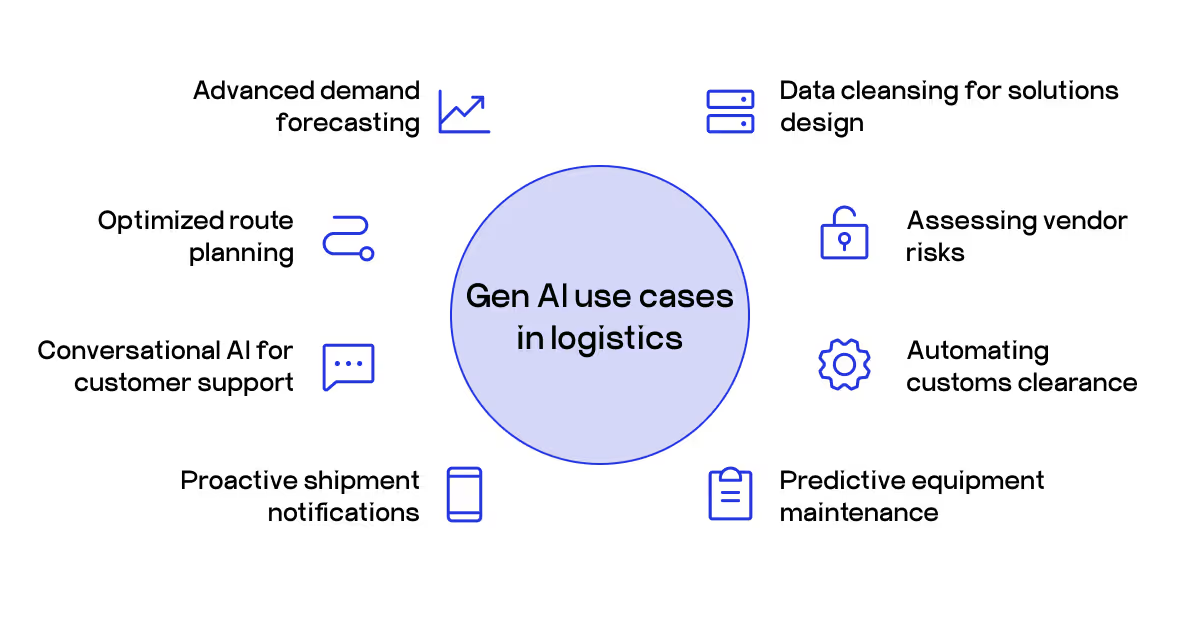
Advanced demand forecasting
By creating synthetic datasets that simulate various market scenarios, external disruptions, and consumer behaviors beyond the limitations of historical data, generative AI improves demand forecasting in logistics. By completing data gaps and simulating uncommon occurrences like supply shocks, this enables more precise forecasts.
For example, a global shipping leader, Maersk, uses generative AI to enhance demand forecasting, allowing for dynamic shipment rerouting and improved container utilization throughout its operations. Businesses reduce stockouts and overstock by achieving forecast accuracy improvements of up to 20–30%.
Optimized route planning
One of the most important Generative AI use cases in logistics is route planning and optimization. By creating several optimized route scenarios in real time and accounting for traffic, weather, and disruptions to reduce expenses and delays, generative AI powers dynamic route planning. It develops adaptive transportation strategies by simulating "what-if" scenarios.
Maersk also uses generative AI for route optimization, analyzing historical and real-time data to adjust delivery plans swiftly, cutting transportation expenses and improving efficiency. This results in 10-15% reductions in fuel use and delivery times for logistics providers.
Conversational AI for customer support
The importance of conversational AI in logistics also can’t be overstated. Artificial intelligence powers chatbots and voice assistants that handle complex customer queries in natural language, providing instant shipment tracking, delay explanations, and personalized advice. These systems generate context-aware responses by simulating human-like conversations, integrating with real-time logistics data for accurate updates.
As a real-world example, DHL employs conversational AI virtual assistants (like AIDA for global forwarding and Viva for European road/rail freight) to guide users through tracking, returns, and status inquiries across web, SMS, and voice channels, reducing support call volumes significantly.
Proactive shipment notifications
Generative AI creates tailored, proactive notifications by generating customized messages about delays, ETAs, or route changes based on predictive analytics and customer preferences. It simulates various scenarios to craft empathetic, informative alerts that prevent inbound queries.
Logistics providers use this for automated SMS or app updates, minimizing escalations. Results include higher customer satisfaction, as 73% of customers check their tracking notifications multiple times for one package, making this proactive and timely approach a must for modern service.
Data cleansing for solutions design
By automatically cleaning, organizing, and evaluating unstructured customer-submitted data for quick solution design, generative AI simplifies data preparation in logistics. It speeds up proposal development by extracting insights from disorganized datasets.
As an example of using Generative AI in the logistics market for this purpose, let’s refer to DHL. For its Solutions Design team, DHL Supply Chain uses a generative AI tool created in collaboration with Boston Consulting Group to clean up data so engineers can produce customized logistics concepts more quickly and precisely. This improves solution quality while drastically reducing time-to-market.
Assessing vendor risks
By creating risk profiles and predictive evaluations from massive supplier data, predicting delays or reliability problems, generative AI helps vendor management. It mimics possible interruptions associated with every vendor.
For instance, Lenovo employs AI-powered analytics to predict delivery risks across its suppliers, optimizing manufacturing and ensuring consistent demand fulfillment. Such systems help mitigate ripple effects, with enterprises reporting proactive risk handling.
Automating customs clearance
Making your customs clearance process easier and faster is another goal of another group of Generative AI applications in logistics - the ones regarding document management. By producing compliant documentation, forecasting clearance times, and identifying problems from regulatory data, generative AI automates customs procedures.
For instance, Metro Shipping automates customs administration using an ML-powered platform enhanced with generative capabilities, resulting in 99% data accuracy and a 40% faster turnaround. In general, you get a chance to cut down on delays in international trade as a result of implementing this technology.
Predictive equipment maintenance
By producing failure scenarios from IoT sensor data and developing maintenance schedules that avert malfunctions, generative AI facilitates predictive maintenance. For proactive planning, it simulates equipment wear under various conditions.
Frito-Lay deploys AI with sensors for real-time analysis, resulting in zero unexpected breakdowns in its first year, ensuring smooth production flows. Benefits include slashed downtime and resilient operations.
Now that we have broken down the key ways you can apply Gen AI in logistics, let’s focus on specific solutions to do it. We’ll focus on market-ready tools for now and then understand whether you should use them or build your own.
Best Gen AI tools for logistics
Numerous promising generative and conversational AI platforms created especially for logistics operations are available on the market. Through the use of natural language interfaces, autonomous decision making, and real-time adaptation to changing conditions, these tools go beyond traditional analytics.
Tool
Key features
Best use case
Pricing
Blue Yonder
25B daily predictions, AI agents for inventory/network/logistics, auto-rebalancing
Supply chain optimization, inventory mgmt
Custom/upon request
SAP IBP (Joule)
Unified planning, real-time simulation, AI copilot for non-tech users
Demand/supply/sales/inventory planning
Starts ~$29k/year; Joule €7/AI unit
GigaSpaces eRAG
Conversational intel, multi-step scenarios, real-time data pulls
What-if analysis, dynamic adjustments
Basic $2k/mo (10 users); Adv $5k/mo (20 users)
Oracle SCM
AI agents for fulfillment/risks, predictive procurement, ERP integration
End-to-end visibility, proactive mgmt
Usage-based, e.g., $0.0084/GB storage/hr; $50/user AI agents
Project44 (Movement GPT)
Predictive ETAs, carrier network, natural language queries
Shipment visibility, ETA accuracy
~$3/container or $6.25k+/mo
IBM (Watsonx/Sterling)
AI automation for onboarding/contracts, forecasts replace spreadsheets
Procurement/fulfillment/inventory
Quote-based
Microsoft Dynamics
IoT integration, Copilot for routes/inventory, Teams sync
Blue Yonder is the #1 tool for applying Generative AI in the supply chain. It runs over 25 billion predictions daily through cloud native, specialized AI agents for inventory, network, and logistics decisions. The system rebalances inventory, reroutes shipments, and adjusts plans with minimal human intervention, delivering a reduction in inventory costs and improvement in service. Its prescriptive analytics recommend specific solutions like expediting a shipment while showing the cost versus potential stockout.
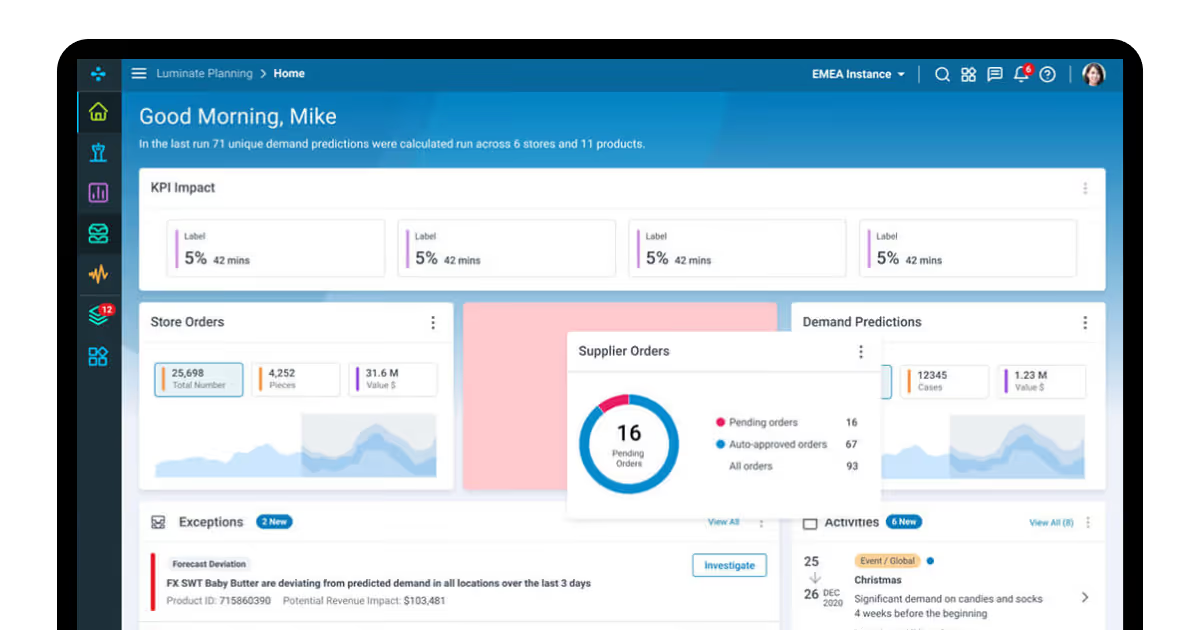
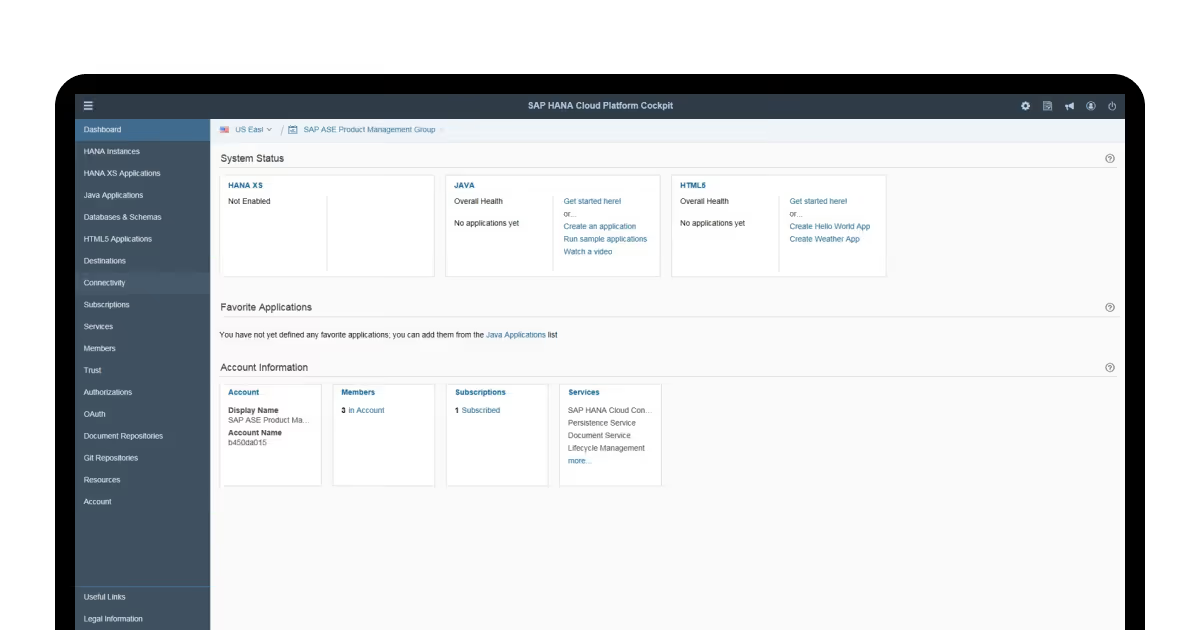
With the help of Joule, its AI copilot that enables users to ask questions and get insights, SAP IBP unifies planning across demand, supply, sales, and inventory on the HANA platform. Because of the platform's superior real-time simulation capabilities, leaders model disruptions and test results before taking action. Joule increases adoption across teams by making complex planning accessible to users without tech expertise.
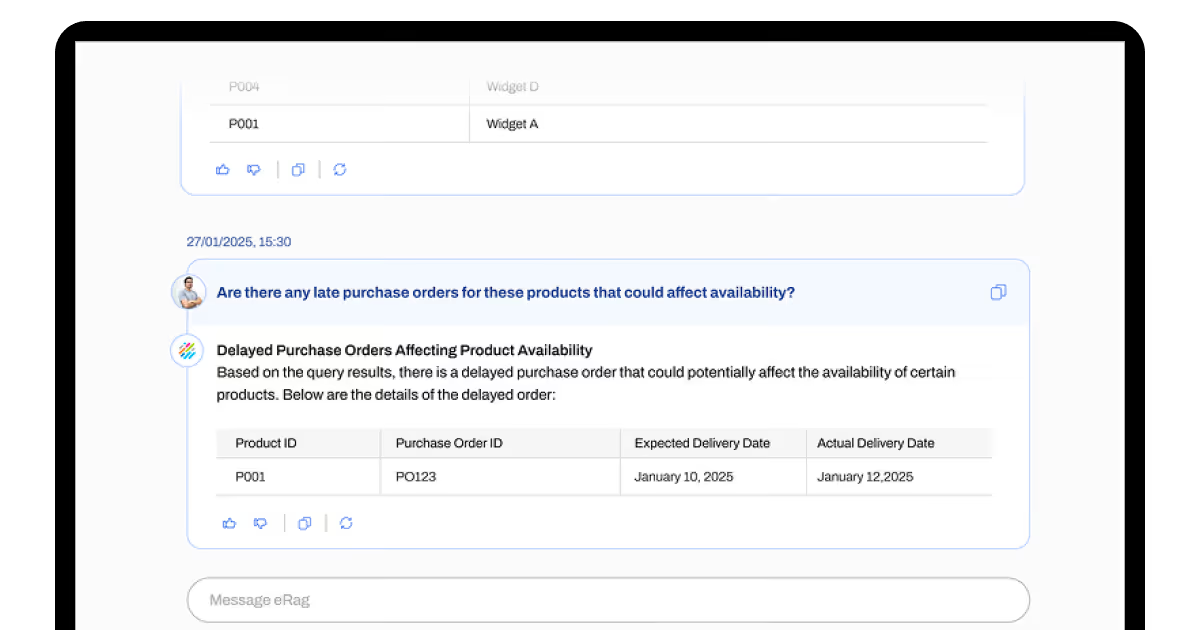
GigaSpaces eRAG allows employees to ask complex questions without the need for tech expertise by providing real-time conversational intelligence that maintains context. The agentic layer executes multi-step what-if scenarios, pulls real-time data from approved sources, and adjusts in a matter of minutes when factors like supplier lead times or tariffs change. eRAG keeps teams focused on the present rather than outdated reports because it runs in read-only mode and respects database security roles.
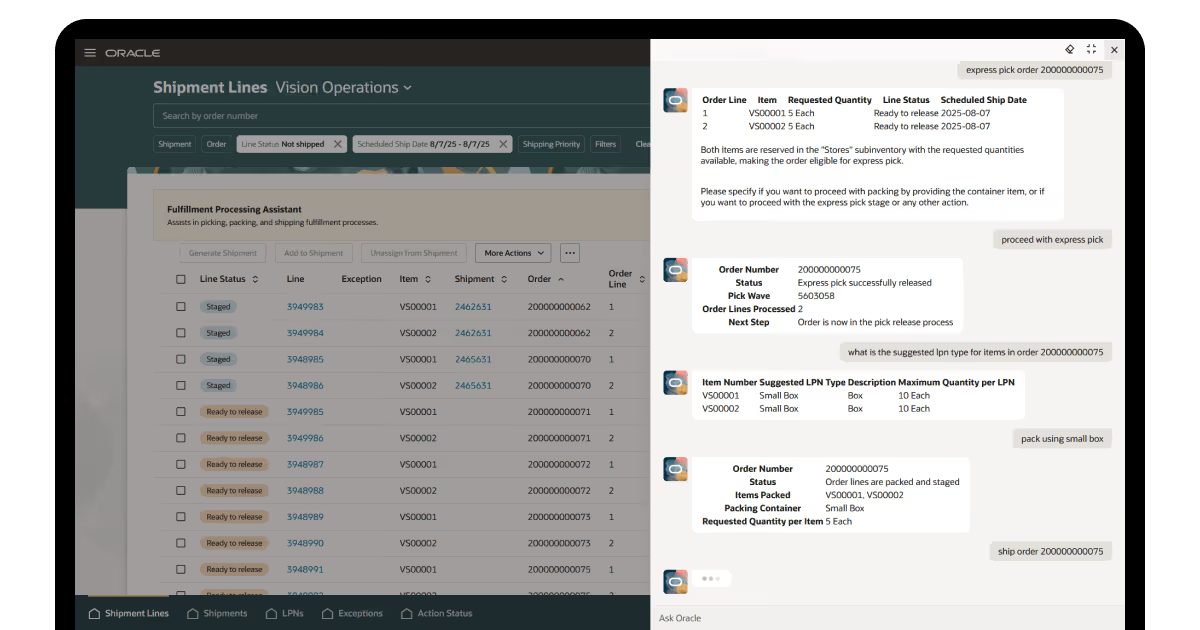
Oracle's platform employs AI agents to optimize fulfillment choices and scan supplier networks for hazards, while proactive procurement is made possible by predictive analytics. The Generative AI supply chain architecture automatically modifies working capital allocation and supplier relationships. Its native integration with Oracle Fusion Cloud ERP offers real-time visibility throughout the entire operation.
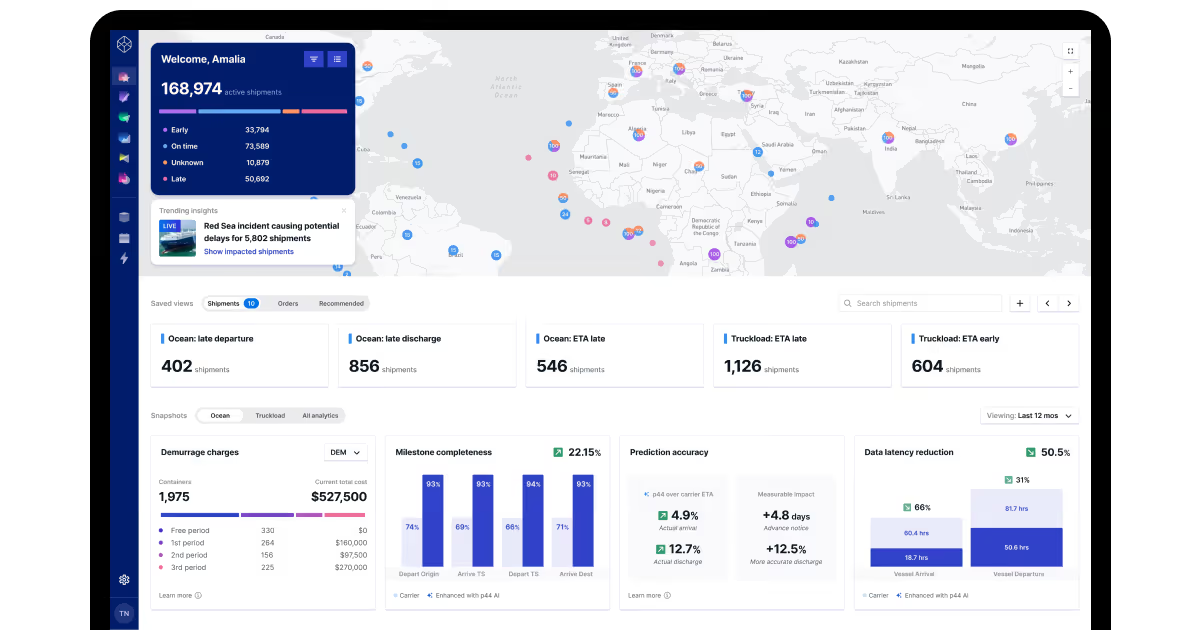
Project44 maintains the world's largest network of direct carrier data connections, providing highly accurate predictive ETAs through deep learning models that factor in real-time traffic, weather, and port congestion. Movement GPT allows users to ask natural language questions and get instant answers. Users report a decrease in late deliveries and improved customer satisfaction with this solution.
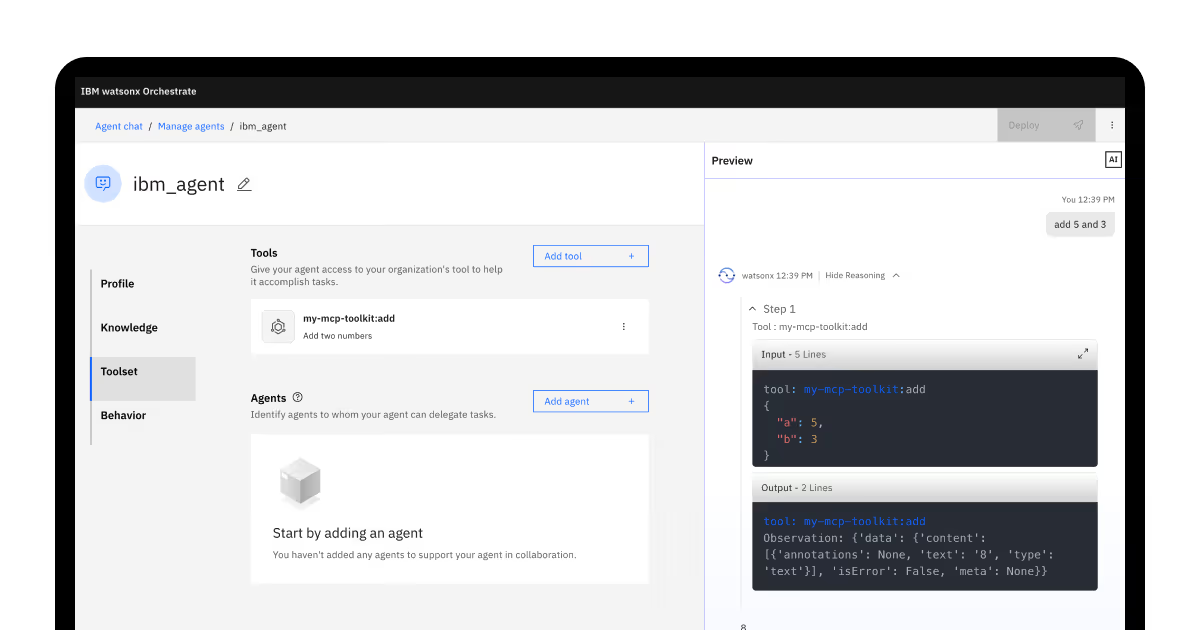
Watsonx Orchestrate serves as a digital assistant that automates supplier onboarding and contract monitoring, while IBM Sterling combines Watson's capabilities with AI agents for procurement, fulfillment, and inventory. The platform uses AI forecasts in place of spreadsheet forecasting. It performs consistently in a variety of operational contexts and is versatile across several industries.
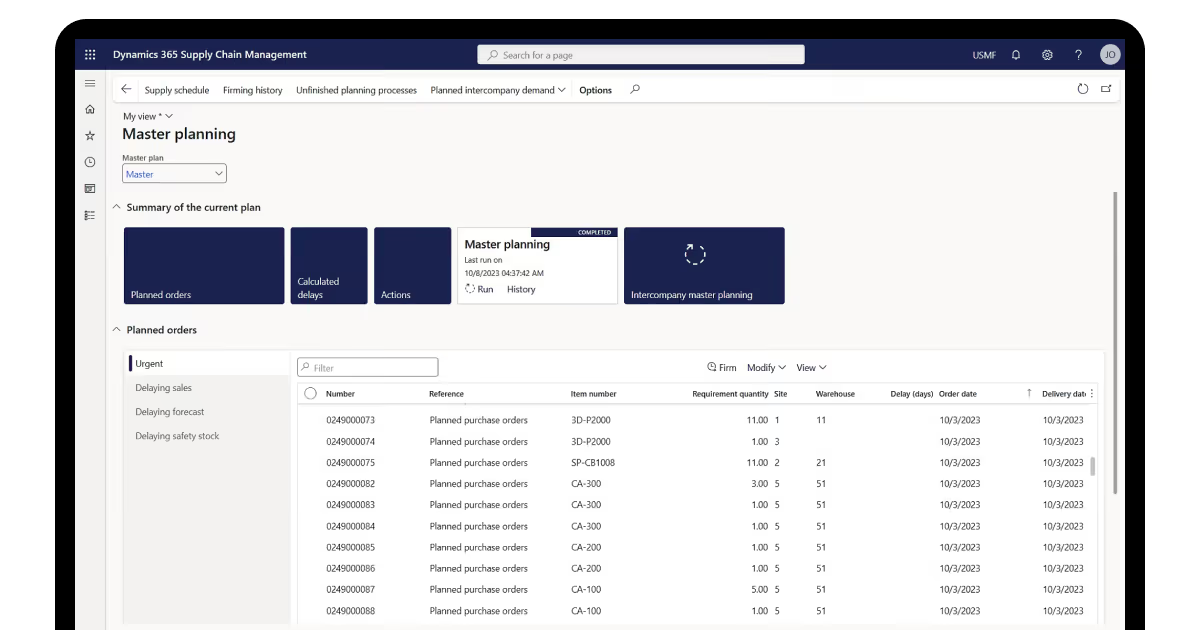
Microsoft has a different approach to Generative AI for logistics operations, as it incorporates IoT data into AI models that anticipate equipment failures, cutting down on factory and distribution center downtime. Copilot, Microsoft's GenAI assistant, optimizes routes, makes inventory placement recommendations, and integrates directly with Teams to provide managers and operators with the same real-time insights. Businesses that already use Office 365 and Azure can adopt the platform more easily.
Locus focuses on last-mile optimization with AI that plans efficient routes, allocates orders to drivers, and provides real-time tracking with proactive customer communication. The mobile-first driver app consistently receives praise for its intuitive interface, which simplifies onboarding and improves driver satisfaction and retention.
Google leverages Vertex AI and BigQuery to handle demand sensing, predictive maintenance, and fleet routing, while Visual Inspection AI scans for manufacturing defects and Document AI reduces logistics paperwork. Sustainability sits at the core, with tools that help reduce waste and manage carbon footprints. The platform works well for companies already using Google Cloud infrastructure and wanting to extend AI capabilities into supply chain operations.
Each of these solutions serves different Generative AI applications in logistics, so pay close attention to choosing the ones for your business needs and pain points. And surely, implementation should be phased and consider your existing business systems and modules. Luckily, you have three ways to perform it - let’s break each down.
Integrating Generative AI into logistics systems
Deciding how to implement GenAI in logistics operations comes down to three paths: building custom solutions, buying ready-made platforms, or combining both approaches.
Building custom GenAI solutions gives you control over your data and lets you design systems that match your workflows. This matters when you handle sensitive information or need features that off-the-shelf products don't offer. Companies with unique supply chain challenges often need this level of customization. However, building requires specialized AI talent, higher investment, and ongoing maintenance costs. You need data scientists, ML engineers, and infrastructure experts in both AI and logistics.
Buying pre-built GenAI platforms gets you up and running faster with lower initial costs. Commercial solutions come with built-in security features, vendor support, and regular updates. But you give up some control over your data and rely on the vendor's security practices. Customization options might be limited, and the solution might not fit perfectly with your specific needs. After all, pre-built logistics Generative AI solutions save time but often lack the flexibility for specialized requirements.
Hybrid approaches give you the best of both worlds. You can use commercial platforms for standard functions like route optimization or inventory forecasting while building custom modules for proprietary processes. This lets you move quickly on common problems while investing development resources where they matter most. For example, a company might buy a proven demand forecasting tool but build custom integrations with its unique supplier network.
The choice depends on several factors. Osborne emphasizes that scalability must be the basis of your decision. A tool that can’t grow with your business will lead to bottlenecks, inefficiency, and higher costs down the line. Consider your internal tech capabilities, budget constraints, timeline for implementation, and how critical AI will be to your competitiveness.
Teslim points out that if you're looking for supply chain Generative AI solutions that solve generic needs most enterprises share, you should consider commercial solutions. But if you have unique data and use cases, off-the-shelf commercial solutions are unlikely to support them adequately. Additionally, custom solutions do much better than ready-made ones in terms of integrations. Let’s outline each important one separately.
Integration with TMS, WMS, ERP, and CRM platforms
Let’s be fair - most of the solutions nowadays can be connected to any third-party provider through an API. You can link your AI tool to accounting or even logistics trackers separately. Yet, some integrations bring more value than others.
By improving carrier selection and routing, integrating GenAI with your TSM creates a massive impact. To recommend the best routes that human dispatchers might overlook, the AI examines traffic data, weather, fuel prices, and past delivery performance. Jackson discovered that Generative AI for supply chain improves risk management, inventory optimization, and demand forecasting. The AI can automatically modify routes when conditions change, reroute shipments around delays, and choose the best carriers based on performance patterns when it is connected to your TMS. Also, to make better recommendations in the future, the system gains knowledge from every delivery.
Connecting AI to your Warehouse Management System improves how you organize space, pick orders, and manage inventory. Gen AI in logistics studies movement patterns within your facility to suggest better storage layouts that reduce travel time for pickers. It can predict which products will be needed soon and position them closer to packing stations. Tsolakis showed how AI implementation in warehouse operations reduced the total distance traveled by loaded vehicles and improved environmental impact. This integration makes warehouses run more smoothly without requiring workers to learn complex new systems.
You get a full view of supply chain performance when you connect AI to your ERP, which links financial data, procurement details, and operational metrics. By identifying trends between purchase choices and delivery results, the AI can assist you in negotiating more favorable supplier agreements. It looks for ways to cut expenses by analyzing departmental spending. You can use the integration to model various scenarios, and instead of waiting for manual reports, you can finally make well-informed decisions fast. Additionally, the AI highlights irregularities in shipments or invoices that may point to issues that need to be fixed.
Linking GenAI with your CRM platform helps you handle customer inquiries more efficiently. The AI accesses shipping data to provide accurate delivery estimates and notifies customers about delays before they ask. It learns from past interactions to personalize communication based on each customer's preferences. Logistics Generative AI tools can also suggest solutions when problems arise. This integration reduces the load on customer service teams and results in faster, more accurate responses that improve customer satisfaction.
All these integrations help you achieve important business goals, but require significant resources and technical proficiency. Companies like COAX can help you with LLM integration into any internal part of your infrastructure - with secure connectors and fine-tuned models trained on your specific datasets and with your company- and industry-specific guardrails.
Practical tips for integrating Generative AI in transportation and logistics
Successfully implementing GenAI in logistics requires a well-developed, gradual approach that balances ambition with the constraints you might face in practice. Here's how to get started.
Outline and clean your supply chain data first. Teslim emphasizes that generative AI models depend on large volumes of high-quality data for training, and logistics companies may struggle to access and curate sufficient data. Integrate your ERP, CRM, TMS, and WMS systems to create a single source of truth. Use automated data validation pipelines to catch errors and inconsistencies before they corrupt models.
Find use cases that have a rapid return on investment. Not all Generative AI applications in logistics offer the same benefits. Start with high-impact issues that yield great outcomes in a matter of months, such as demand forecasting or warehouse layout optimization. Assess projects according to their cost-to-impact ratio, emphasizing initiatives that lower expenses while increasing productivity.
Select the appropriate infrastructure and model. While on-premises solutions are suitable for sensitive data requirements, cloud systems offer flexibility and lower upfront costs. For affordable experimentation, make use of frameworks like Python, AWS, and open-source machine learning tools. Use rule-based AI for structured decisions and machine learning for predictive tasks to match your model selection to the problem.
Build scalable integrations and automation. Connect AI systems to your existing platforms via APIs. Use orchestration tools to automate repetitive tasks like inventory replenishment and order routing. This ensures your AI works across different systems without requiring manual intervention.
Continuously train, monitor, and optimize. Generative AI supply chaintools improve through regular refinement. Track metrics like inventory turnover rates, order fulfillment accuracy, and predictive performance to ensure consistent results. Your focus should be to build transparent, explainable systems that stimulate stakeholder trust and encourage adoption.
This is exactly what you get with logistics software development that COAX engineers provide. We design custom GenAI solutions tailored to your specific operational challenges, whether you need demand forecasting systems, route optimization tools, or automated warehouse management. Our team handles the entire implementation process, from data integration and model selection to deployment and ongoing optimization. And of course, as the strictest obligation, we ensure your AI systems meet the highest security and quality standards.
Evaluating the ROI of generative AI in logistics
When you need to measure returns from GenAI investments, you need to count in both financial gains and any operational improvements you observe. What it means in practice - you need to track direct cost savings alongside faster decisions and better customer satisfaction. These can be traced from such evident improvements:
The cost-speed balance.Teslim notes that the practical application of Generative AI in logistics is capable of eliminating delays, considerably decreasing costs, and enhancing supply chain reaction time.
Cost reduction and efficiency gains. Automated document processing and compliance checking cut administrative overhead while reducing legal risks. Companies redirect staff time from repetitive tasks to strategic work. Also, warehouse optimization through AI analysis reduces space requirements and improves resource utilization, delivering measurable savings on real estate and operations.
Customer experiences improvements. Personalized tracking updates and proactive communication about delays increase satisfaction scores while reducing complaint volumes. Customers appreciate transparency, which builds loyalty and reduces service inquiries that consume staff time.
Decision speed enhancements. AI-driven supplier selection analyzes market data, performance metrics, and pricing trends to identify optimal partners faster than manual reviews. This accelerates procurement cycles and strengthens supplier relationships.
Resource management optimization. AI examines warehouse layouts, storage patterns, and material flows to suggest improvements that minimize downtime and maximize space efficiency. These changes produce ongoing savings without requiring major infrastructure investments.
Oncioiu emphasizes that operational transformation occurs when AI systems effectively participate in decision-making processes, from predictive modeling to adaptive optimization, rather than serving as simple automation tools.
Success depends on integrating GenAI into existing workflows where it can generate compound value across multiple functions simultaneously. Also, when introducing Generative AI for logistics, choosing the right development partner makes the difference between theoretical potential and actual results. To help you check these points fully, COAX delivers cost-efficient AI solutions by focusing on your specific pain points rather than building unnecessary features.
Our agile AI development services mean you see working prototypes quickly, allowing you to validate ROI first. We apply proven frameworks and reusable components to reduce development time and costs, while our ongoing support ensures your logistics Generative AI systems continue delivering value as your business evolves. This practical focus on measurable outcomes helps you achieve faster payback periods and sustainable competitive advantages.
FAQ
How can generative AI boost logistics?
Teslim found that generative AI models such as GANs simulate traffic patterns to enable real-time route adjustments, reducing delivery times by 15%. The technology generates new data points that represent future demand conditions, cutting stockouts by 20%. Oncioiu shows GenAI restructures decision-making through predictive modeling and adaptive optimization, enabling faster responses to disruptions while maintaining operational coherence across circular logistics networks.
What are the challenges of implementing generative AI for logistics?
Teslim identifies data privacy concerns, high implementation costs, and model interpretability as major barriers. Small firms struggle without external funding. Understanding AI decision rationale proves complex for dynamic pricing validation. Oncioiu and team note that organizational readiness, including employee training and process adaptation, determines success. The technology requires strategic alignment between resources, objectives, and internal structure adaptability to deliver transformation.
What are the best generative AI applications in logistics for small businesses?
As an SME, you might benefit the most from the following AI use cases:
Route optimization, analyzing traffic, weather, and loads for fuel savings
Demand forecasting, preventing overstocking through historical data analysis
AI chatbots providing 24/7 shipment tracking and delivery rescheduling
Automated document processing for invoices, customs forms, and labels
Predictive maintenance that monitors vehicle health via telematics
Real-time tracking systems enabling proactive disruption management
How does COAX implement efficient and secure generative AI in logistics?
COAX holds ISO/IEC 27001:2022 certification for comprehensive security management, risk assessment, and monitoring. Our ISO 9001 certification ensures optimal quality processes. We implement GenAI through secure data pipelines, encrypted storage, role-based access controls, and continuous security audits. Our approach balances AI innovation with robust governance frameworks that protect sensitive logistics data while enabling advanced analytics and operational transformation.












































































































_.avif)












%2520explained.avif)

We are interested in your opinion