This article could open with "In the fast-paced world of marketing..." It won't. And that’s because AI copywriting won't put you ahead of hundreds and thousands of competitors.
At COAX Software, we build software for logistics, travel, and transport brands. But we do more than just create tech things. We've watched clients test AI content, then come back for help.
One travel client swapped AI copy into booking pages last year. Within weeks, conversions slipped. When our team dug into support tickets, the copy never named the traveler's real worry: what happens when a booking changes mid-trip. AI never asked that question. A human did.
And our expertise goes beyond client projects. For every topic we write content about, we go past the surface. We ask what each fix meant for real people behind the client. We’ve known the pains and joys of building tech. We’re sharing a mix of tech knowledge and the human element behind it. That’s what AI can’t do.
This article covers what copywriting AI does on the “OK” level. It also covers where it fails, and what to do to avoid some common risks.
Can AI replace professional copywriters?
No. That's the answer, and it isn't changing anytime soon. AI is a tool, not a replacement. And there’s a good chance that you noticed it too. If you didn’t, let’s break down the reasons.
Copy that sells depends on judgment. It needs a feel for tone, timing, and mood. AI has no feel for any of that. Ask a model to write a joke sometime. You'll get forced puns and oddly specific vibes. Everything sounds exaggerated, like spilled coffee dramatized into a crisis.
A real writer knows a surprised sigh lands harder than a meltdown. AI copywriting tech doesn't know the difference between quiet and loud emotion.
This isn't only a creative-writing problem either. Ask a model to write an operator's reaction to a missed SLA. You'll get people who trip over chairs. And if it happens to be human, you know that real operators don't trip over chairs. They sigh, check a dashboard, then send a terse message. Then, they come home and doomscroll for hours before bed to shrug off the stress. That's the texture AI consistently misses.
We've built content-adjacent tools for engineering-heavy audiences for years. We've seen this often. Precision and voice consistency always come down to a human editor's call. Take our work with Shiji, a global hospitality tech company. Their product line had grown sprawling and disconnected. Their products needed one shared identity, not generic templates.
Only something genuinely brand-specific could unify that many products into one story. Copywriting with AI can't invent that specificity from scratch.
The same logic applies to any brand's copy. Generic prompts produce generic output, no matter how detailed your instructions get.
That's why AI copywriting still needs a human hand on the pen. Judgment, timing, and restraint aren't things you can prompt your way into.
What is AI copywriting?
AI copywriting means using tools like ChatGPT, Gemini, Claude, or Perplexity to draft marketing text. This can cover web copy, email sequences, product descriptions, or social captions.
The market backs up the hype with real numbers. Global spending on AI-powered copywriting hit $2.8 billion in 2025. Forecasts put that figure at $18.4 billion by 2034. That's a CAGR near 22.5% across the decade. Rising content demand and tighter budgets drive adoption further.
More numbers back this growth. 97% of marketers plan to lean on AI by the end of 2026 for daily creative tasks. Content saturation is already visible online. Ahrefs found 74.2% of new web pages sampled contained detectable AI text.
Google's AI Overviews now show up in roughly 25% of searches. That's nearly double the March 2025 rate, per Conductor.
None of that growth answers the real question people ask. Will AI replace copywriters once tools get good enough?
Growth in spending isn't proof of quality. It's proof that businesses want content faster, not necessarily better.
Here's what all those billions actually mean in practice. The internet is now crowded with faceless, AI-shaped text. Scroll any feed, and you'll blur past dozens of posts. Nothing sticks, because nothing sounds like an actual person.
And yet, here's a paradox nobody likes to admit. That same flood of generic content is still wildly attractive to businesses. Is AI copywriting worth it if everyone else sounds the same? For raw output speed, apparently yes, for now.
For anything meant to stand out, the answer gets more complex. Cheap and fast rarely equals memorable or trusted.
Why are teams drawn to copywriting with AI?
Teams reach for AI because it's fast and cheap. You skip the hiring process. You also skip the wait for a first draft.
We should admit that appeal is attractive. Nobody turns down faster, cheaper content on principle. The catch shows up once you measure results, not speed.
Those two numbers aren't necessarily contradictory. AI wins on speed. Humans still win on feeling.
We've watched this play out with one of our own clients. Our logistics platform client’s AI features help operators draft job posts fast. It uses AI-based copywriting for that first pass.
That single, narrow task works well. Operators still edit every draft before anything goes live.
Ask that same system to handle anything more layered, though. Nuance, negotiation, or brand tone quickly break down.
That's the honest limit of most AI copywriting tools today. They're strong assistants, weak authors.
How do large language models generate text?
Here's the mechanical truth behind every AI draft. None of it involves understanding your message.
First, the model breaks your input into tokens. Tokens are small chunks: words, word-parts, or punctuation marks. Each token becomes a list of numbers called an embedding. That's how a network processes meaning mathematically, not conceptually.
Next, the model runs self-attention across every token. This step checks how each token relates to the others nearby. That's how the system tracks context inside one sentence. It has no memory of your brand beyond this prompt.
Once it understands structure, the model builds a next-word guess. It scores every possible token in its vocabulary. Those scores become probabilities, then get filtered by sampling rules. Settings like temperature or top-p shape how bold the pick is.
The chosen token gets added to the output. Then the entire process repeats itself, one token at a time.
That's genuinely impressive engineering, and it deserves respect. It's also nothing like how a person writes. A writer starts with a goal, a reader, and a stake. A model starts with a probability table and nothing else.
We saw this trade-off play out with a driver-hiring platform we built. Operators there use AI copywriting software to draft job posts fast. It works precisely because the task is narrow and repetitive. Job titles, requirements, and shift details follow predictable patterns.
Ask that same engine to write something with real stakes. A layoff announcement, an apology, a brand manifesto, anything with weight. The seams show immediately, because prediction isn't persuasion. AI tools for copywriting are calculators, not communicators.
Good marketing needs someone who's felt the stakes personally. No amount of clever sampling replaces that.
Why AI content is a business problem now
AI-generated copy now carries real business risk. It can quietly damage search rankings, engagement, and trust, often before anyone notices the drop.
Search engines increasingly reward content backed by real experience and expertise. Text with no clear human authorship or insight tends to rank worse over time.
Trust takes a hit too. Marketing research consistently ties brand authenticity to purchase intent, especially among younger consumers who say authenticity shapes their buying choices.
These aren't hypothetical risks. Each one below reflects something we've watched happen with real clients, across different industries.
In ecommerce, description sameness kills differentiation.
In ecommerce, one AI phrase pattern repeats across thousands of listings. Buyers start judging products purely on price. We've seen this happen on marketplaces we've worked with. Once voice disappears, so does any pricing power. Our advice: use AI only for raw specs. Keep anything customer-facing in a human's hands.
In travel, generic copy erases your whole differentiator
In travel, generic destination copy blends into every competitor's site. Stay Altered's whole pitch was built to avoid OTA sameness. Generic AI copywriting drafts would have erased that difference instantly. Our advice: protect founder-voice language deliberately, sentence by sentence. Treat destination copy as brand strategy, not filler text.
For logistics, one wrong SLA phrase breaks trust.
In logistics, one wrong SLA phrase damages operator trust fast. DriveIQ's own messaging system risks this on every automated notice. A vague AI apology reads as corporate, not accountable. Our advice: script tone rules around specific failure scenarios. Review anything SLA-related before it reaches a customer.
In automotive communities, members spot inauthentic voice within seconds. RoadStr's whole user base is built on shared, specific culture. A generic AI post there gets ignored or mocked. Our advice: write from inside the community, not about it. Test any post with an actual member first.
In construction, vague specs read as inexperience.
In construction, technical readers notice a vague spec instantly. Our work with TRI Timesheets meant precision, not marketing fluff. Wrong terminology there reads as inexperience, not confidence. Our advice: have someone who's worked on-site review copy. Jargon needs a practitioner's check, not a guess.
For real estate, listings blur into one long scroll.
In real estate, every listing starts to read the same. Buyers scroll past ten identical "cozy, charming" homes in a row. Local knowledge is the only real differentiator left. Our advice: write from a specific street-level detail, not a template. One real fact beats five adjectives every time.
In fintech, imprecise claims become compliance risk.
In fintech, one imprecise claim can be a source of real AI copywriting risks. Financial clients we've supported treat every word as a liability. AI drafts often round numbers or soften disclaimers slightly. Our advice: route any financial copy through legal review. Never publish a compliance claim an AI invented alone.
In healthcare, confident phrasing creates real legal exposure.
In healthcare marketing, a confident-sounding AI claim can mislead patients. Overstated recovery timelines or vague guarantees create real legal exposure. We treat any health-adjacent copy with extra caution always. Our advice: verify every claim against a licensed source. When in doubt, cut the claim entirely.
For local retail, everyone's blog starts sounding the same.
In local retail, dozens of competitors now use the same AI tool. Their blog posts read as nearly identical to each other. Rankings flatten out because nothing stands apart anymore. Our advice: anchor content in one specific local detail. A named street, event, or supplier beats generic advice every time.
In professional services, hollow thought leadership loses deals.
In professional services, hollow thought leadership content gets noticed quickly. Prospects read three paragraphs, then quietly close the tab. That erodes trust before a sales call even happens. Our advice: always attach one real number or client story. Credibility comes from specifics, never from confident-sounding generalities.
AI copywriting tools aren’t going away, and it doesn't need to. Used as a first-draft assistant, it saves real time. Used as a replacement for a writer who understands your audience, it costs more than it saves. Trust, rankings, and voice are hard to win back once lost.
What are the biggest risks of AI copywriting?
The risks fall into a few clear buckets: rankings, trust, and brand identity. Each one compounds quietly if nobody's checking the output.
SEO decline: unedited AI content can get flagged as low-value and drop out of search results.
Trust erosion: readers increasingly recognize AI phrasing, and that recognition undercuts credibility.
Voice dilution: heavy AI use flattens tone until your brand sounds like every competitor's.
Factual drift: models can present confident, incorrect claims as fact without any warning.
Each of these risks feeds the others over time. A trust problem becomes an SEO problem, and both become a revenue problem.
We watched this pattern almost happen with a UK antique marketplace we've worked with. Their pages once loaded in six to eight seconds. That's three times slower than Google's recommended standard.
That slowdown alone tanked their rankings for years. Now picture generic AI blog posts piled on top of that. It would have been the worst possible starting point for SEO. Thin, AI-shaped articles rarely earn rankings on their own merit.
To be fair, AI descriptions aren't all bad news here. Project's own AI copywriting assistant drafts raw product listings. It works at real scale, listing after listing. That's a narrow, low-stakes job. It just names a material, era, or category. Thousands of similar listings back up each guess. Small-scale seed text like that works fine. Blog content meant to help sellers rank is different.
A tool fine for product tags can wreck your blog. Scale matters as much as intent here.
Search itself now splits into two distinct games. Both change what "ranking well" even means.
AEO (answer engine optimization): formats content into direct answers and schema markup.
GEO (generative engine optimization): builds topical authority so language models cite your brand.
Both formats reward depth and precision, not volume. Generic SEO copywriting AI drafts rarely survive either filter for long.
What are the most common AI copywriting mistakes businesses make?
Most copywriting AI-related failures trace back to a handful of repeat mistakes. None of them are complicated to name or to fix.
Skipping fact-checking: teams publish AI drafts without verifying a single claim or statistic.
Treating AI as a replacement: businesses cut writers entirely instead of using AI as a support step.
Ignoring audience intent: prompts describe a topic but never describe the reader's actual problem.
Reusing one prompt everywhere: the same generic instructions get applied across totally different content types.
Every one of these mistakes traces back to a single root cause. Nobody protected the brand's actual voice.
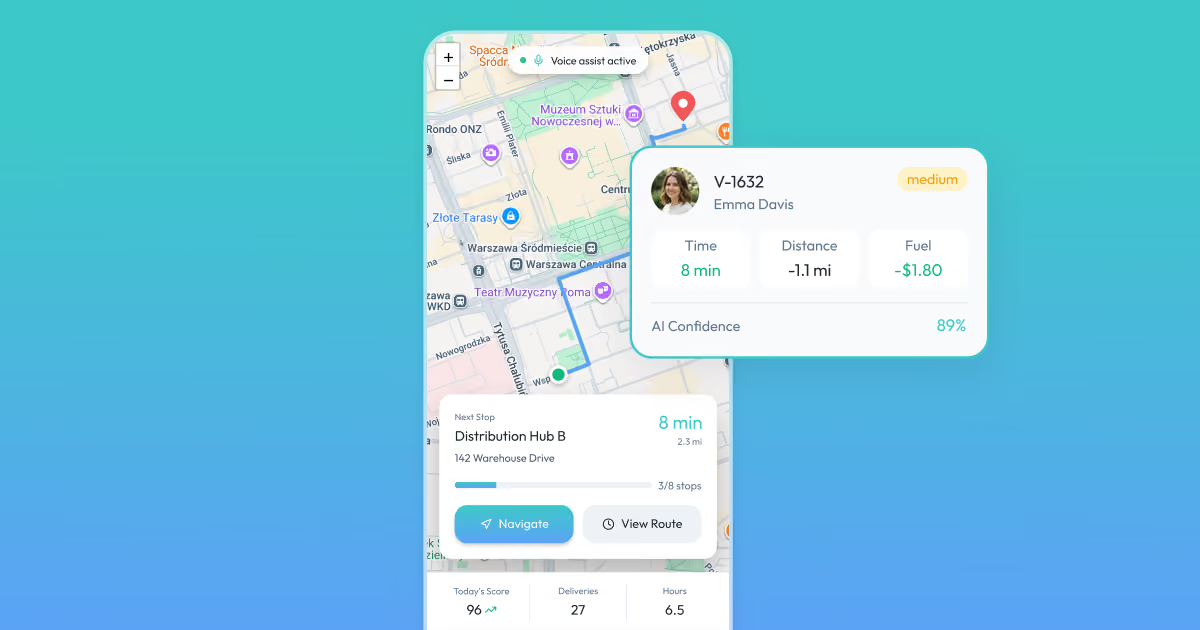
Take DriveIQ, our own logistics platform that automates driver messaging with AI. It drafts delay notices, revised ETAs, and recovery offers automatically. Left alone, that same system would create real problems fast. Wrong tone on a delay message damages driver trust immediately.
An overpromised ETA breaks an SLA nobody agreed to. Generic phrasing across three languages flattens every local nuance completely. That's why human review stays mandatory at every step. Someone still proofreads, adds context, and rewrites for genuine originality.
AI SEO copywriting faces the same trap across content teams. A tool can hit every keyword and still sound like nobody. That's the real difference between AI copy and copy that converts. Brand voice isn't a nice-to-have. It’s the whole point.
Skip that step, and every other fix becomes cosmetic. Fact-checking and editing only go so far without it.
Fixing these mistakes doesn't require abandoning AI for copywriting outright. It requires putting a human in the loop before anything ships.
This is exactly the kind of gap COAX Software helps clients close. We help integrate specialized SEO tools for eCommerce websites and travel marketplaces. Logistics systems get the same treatment too.
We also run conversion rate optimization audits alongside that technical work. Traffic that doesn't convert is just an expensive vanity metric. Need a CRO gut-check for your store or platform? We're happy to take a look. Our engineering roots span ecommerce, travel, logistics, and transportation projects specifically.
How to use AI for better content creation?
AI works best as an assistant, not an author. Used well, it speeds up your process without erasing your voice. At COAX Software, we treat this as a repeatable workflow, not a trick. It holds across blog posts, emails, and social captions alike.
A few concrete tactics form the base of our strategy:
Capsule content: write standalone sentences that directly answer one specific question.
Structured data: use clean headings and schema markup so machines can parse your page.
Ecosystem trust: earn reviews, mentions, and links across other publishing platforms.
None of these tactics work if the underlying copy sounds hollow. Substance still has to come first. A team leaning on any AI tool for copywriting needs shared standards. Otherwise, five contributors prompt in five different directions.
The steps below assume a team, not a solo writer. Coordination matters here more than most teams expect.
Define your goal and brief
Everything starts with a specific brief. Vague input produces vague, forgettable output every time.
A solid brief names the content type, audience, and tone. It also flags constraints like word count or target keywords. Teams that share one brief template stay consistent. Otherwise, every contributor drifts toward a slightly different voice.
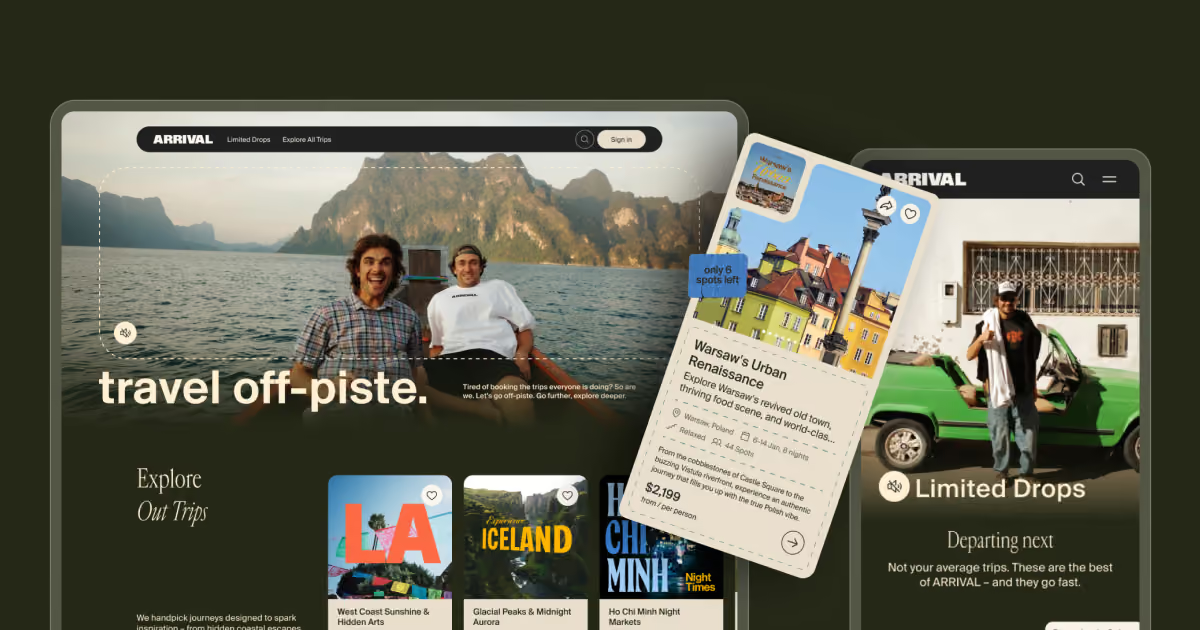
We learned this building ARRIVAL's storefront content, not just its booking flow. Their audience wanted culture-first stories, not generic travel copy.
Every brief we wrote had to protect that specific voice. Skipping that step would have flattened a brand built on personality.
Choose the right tool for the task
Different jobs need different tools, full stop. Long-form drafts, SEO structure, and visuals all call for something different.
This is genuinely the answer to how to use AI in copywriting without wasting effort. Match the tool to the task, not the other way around. We follow that same logic in our own engineering work. Off-the-shelf software fits standard jobs; custom builds fit unique ones.
Our own writing on logistics software makes that case directly. Generic tools work fine until your workflow becomes the differentiator. Content follows an identical pattern. A quick social caption doesn't need the same tool as a technical deep-dive.
Some workspaces now share brand context across a whole team automatically. That's convenient, but it still needs a human setting the rules.
Generate a real first draft
Once your brief and tool are set, generate a draft. Don't expect anything publish-ready at this stage. You're looking for solid structure and the right key points. Regenerate if the first pass misses the mark entirely.
Adjust your brief before you try again. A tighter brief almost always beats a longer editing session later.
A hint from our team: resist the urge to polish sentence by sentence here. That work belongs to the next step, not this one.
Add the parts only a human can add
This step decides whether content actually works. Review every draft for tone, accuracy, and originality. Cut generic phrases wherever you find them lurking. Fact-check any number, name, or claim before it ships.
Here's where the real difference shows up clearly. Add a real example, a specific insight, a company detail.
Take Stay Altered, a community-tourism platform we've been working on. Every feature serves one belief: local hosts deserve visibility, not middlemen.
That's not a marketing line; it's a build decision. Hosts' profiles, rewards, and the Collective program all point one direction.
AI-generated copywriting issues here are massive. An AI draft would never know that belief exists on its own. Only someone who's talked with those hosts writes it convincingly.
We bring that same instinct into our own technical blogs. Writing about a build-versus-buy decision needs real project scars, not theory.
That's the soul no model fakes convincingly. It gets earned through actual projects, not prompted into existence.
Publish, repurpose, and track results
A published piece isn't the finish line. Repurposing is one of the clearest wins AI genuinely offers.
One blog post can become a summary, an email, and three social posts. AI speeds up that repackaging step meaningfully. After that, track what performs across every format you publish. Feed those results back into your next brief.
This loop is exactly how our own content and SEO services stay sharp. We treat every published piece as a data point, not a finished task.
Good workflows compound over time, the same way good code does. Consistency beats speed almost every single time. None of these five steps need expensive tooling or a big team. Copywriting AI tools just need clear direction and honest review.
Specialized tools for AI-assisted copywriting
At COAX Software, even the marketing team has a very analytical background. This is why we evaluated each copywriting AI system the way we approach integration decisions on real client projects. Five dimensions, tested against real operational load.
The goal was understanding how each platform holds up under real content demands. Marketing claims rarely matter as much as day-to-day performance.
We assessed five aspects:
Brand voice trainability: can the tool actually learn a specific tone, or just approximate one?
Search alignment: does output map to what's already ranking, or ignore it?
Revision depth: how much editing does a draft still need before it ships?
Integration complexity: how cleanly does the tool fit an existing content workflow?
Scalability ceiling: does quality hold at volume, or degrade past a certain point?
We ruled out tools with no documented API, tools requiring long contracts with no trial, and tools that treat copy as a side feature inside a bigger suite.
Tool
Brand voice trainability
Search alignment
Integration complexity
Best for
Jasper
High
Medium
Medium
Brand and campaign copy at scale
Surfer
Low
Very high
Medium
SEO teams writing to rank
Anyword
Medium
Medium
Low
Performance and paid-media copy
Copy.ai
Medium
Low
Low
GTM workflows and sales sequences
Writesonic
Medium
High
Medium-high
SEO long-form with AI-search tracking
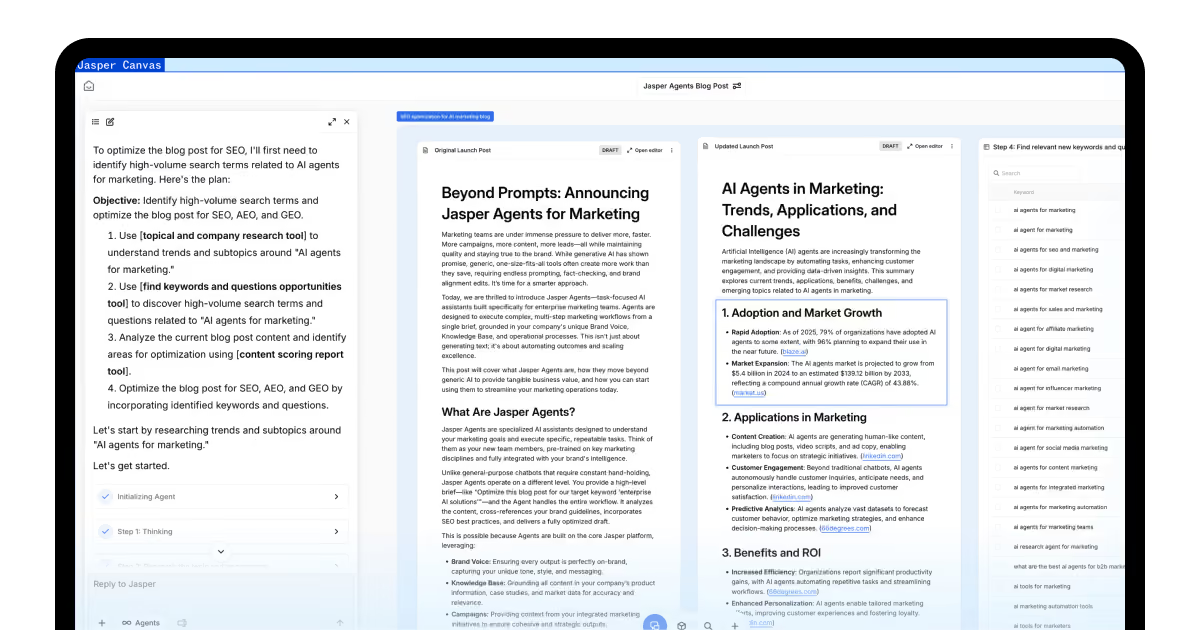
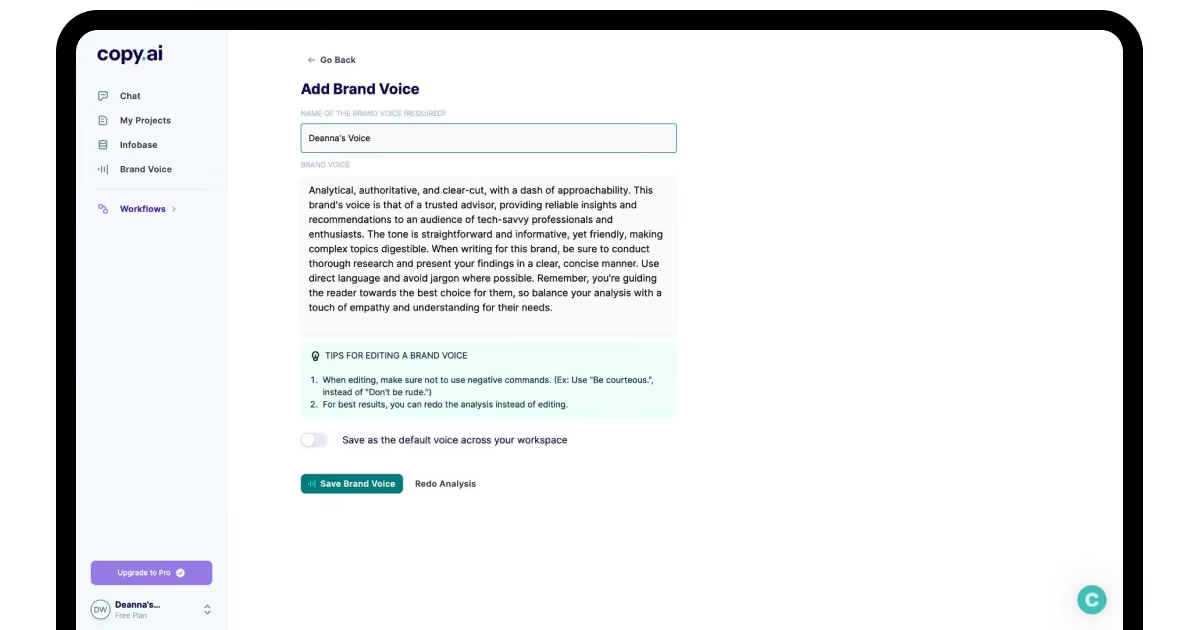
Jasper trains a specific brand voice from your own samples. That single feature separates it from most generic drafting tools. Our evaluation confirmed the voice training holds up under real load. Search alignment stayed weaker and needed a separate pass.
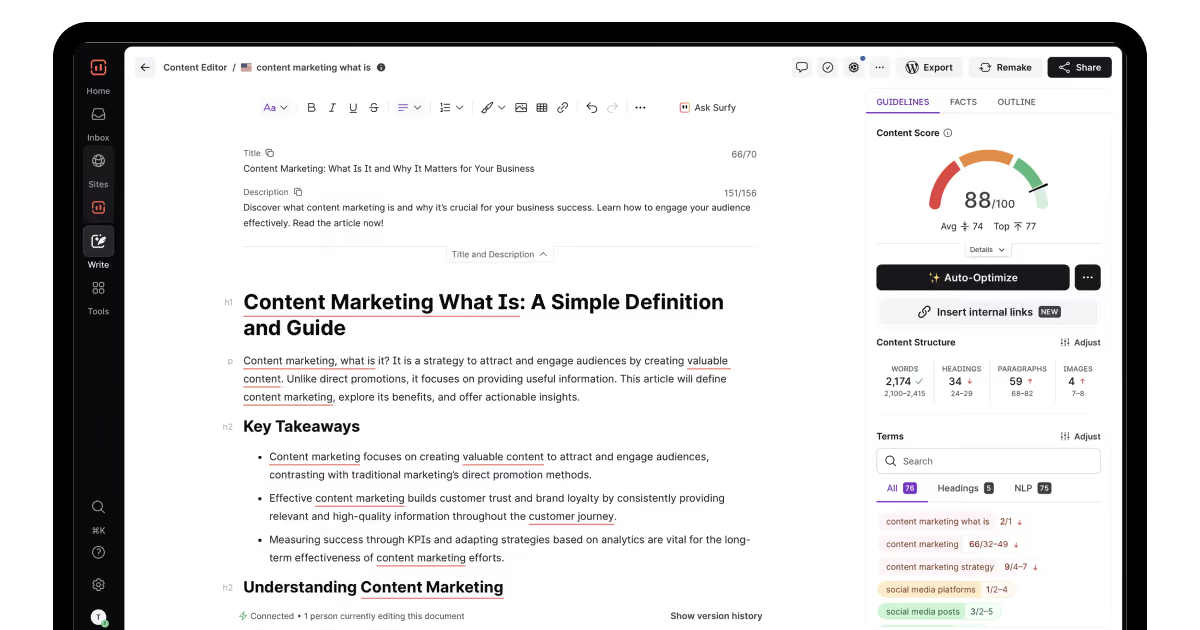
Surfer builds content against live search results directly. This AI copywriting tool’s scoring engine flags gaps against pages already ranking. Under our five-dimension test, search alignment scored highest by far. Brand voice trainability barely registered as a feature at all.
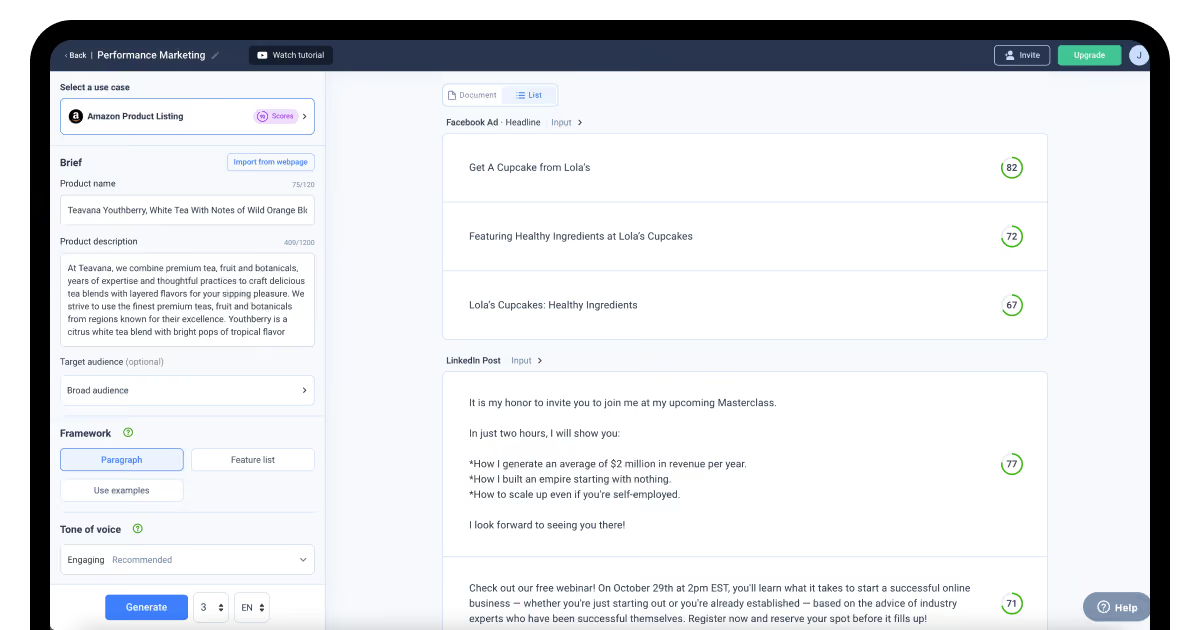
Anyword scores each draft on predicted performance before launch. That prediction layer sets it apart from pure drafting tools. Our testing showed strong integration complexity here, in a good way. It plugs cleanly into paid-media workflows most teams already run.
Copy.ai chains drafts directly into CRM and sales workflows. That's less a writing tool, more a copywriting AI software layer. Our evaluation flagged real scalability here, built for volume output. Revision depth stayed thin, especially on longer, nuanced pieces.
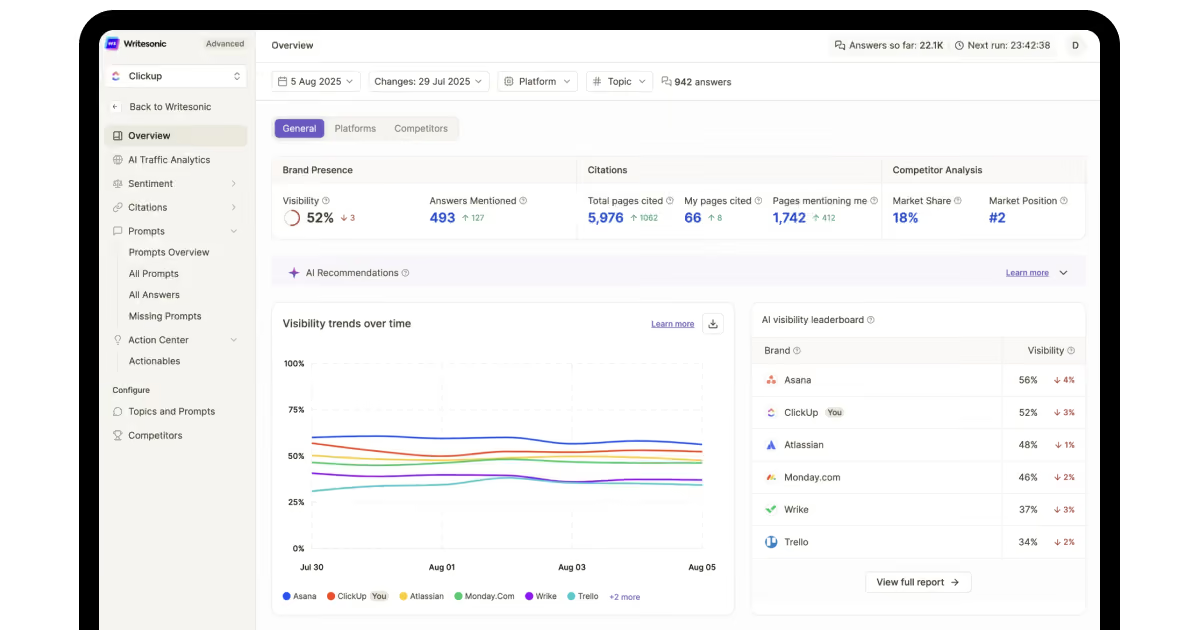
Writesonic pairs drafting with built-in SEO and GEO tracking. That combination makes it a genuinely capable AI copywriting software option.
Our scalability check held up well past typical publishing volume. Integration complexity increased once we layered in multiple content types. None of these five AI tools for copywriting hold up without a human final pass. Specialized tools still draft; they don't decide what matters.
Here's the practical test we'd suggest you take when deciding if you need AI copywriting in the first place.
If your content needs facts, structure, or scale, AI earns its seat. If it needs to earn trust or rank for years, that's different. Then you need a strategist, not just a prompt.
That's the main idea behind our own content marketing services. We don't replace your voice. Instead, we build the system around it.
Content works the same way for any niche audience you serve. Generic AI drafts get scrolled past; specific, earned voice doesn't.
Not sure whether AI or a real strategy fits? That's exactly where we help. We handle strategy, writing, and editing your brand needs. Reach out when you're ready to rank on purpose.
FAQ
What is AI copywriting, and how is it different from hiring a writer?
AI copywriting is text generated by tools like ChatGPT or Jasper. A writer instead offers judgment, research, and a distinct voice. The tool predicts likely words; a writer decides what actually matters. For a founder who must choose, the tool isn't the real question. It's whether this content needs to convert strangers or just fill space.
Will AI take over copywriting entirely in the next few years?
No, not for copy that needs to convert someone. AI gets faster and cheaper each year, not wiser. We've watched clients try full automation, then come back within months. They needed a human editor to fix the drafts. The pattern repeats across ecommerce, travel, and logistics clients we've worked with. Speed without strategy just creates more cleanup, not less work.
Do SEO copywriting AI tools actually improve rankings on their own?
Rankings depend on technical health first, wording second. A perfectly optimized paragraph still won't rank on a slow site. We've seen this exact gap on a client's own marketplace. AI tools can format text around keywords. They can't fix crawl errors or weak backlinks. Treat these tools as one layer, not the whole strategy. Fix the foundation before you fix the wording.
How to use AI for copywriting without losing your brand's tone?
Start with a short style guide, not a long one. Three real examples teach a tool more than ten rules do. Test any AI draft on a real customer first. If they can't tell it's yours, that's the actual failure. We tell every client this before launch. A tool matches patterns; only you catch a dead joke.
How is AI affecting copywriting jobs and hiring decisions right now?
Hiring hasn't disappeared. It's shifted toward editors and strategists. Fewer teams need someone to generate raw first drafts alone. More need someone who can judge, verify, and rewrite AI output. We've noticed this shift across our own client base directly. Job titles change faster than the actual skills underneath them. That's a shift, not a collapse.
How does AI copywriting work when it comes to matching my brand's tone?
Most tools don't truly learn your tone. They mimic patterns from examples you provide. That's called few-shot prompting, not real training. Feed it five strong samples, and results usually improve fast. Feed it one vague paragraph, and you'll get something generic instead. The quality gap traces back to your input, not the model. Input quality decides everything else.











































































We are interested in your opinion