A bad CRO doesn't just do a bad job of bringing your target users to a desired action. It actively costs you money, sends your team in the wrong direction, and makes bad decisions even worse over time. This guide shows you where optimization programs go wrong and what you should do instead. Let’s review the common mistakes in conversion rate optimization at a glance:
Without a plan, testing becomes costly and random guesswork.
Wrong KPIs improve metrics that don't really affect revenue.
Ignored user groups hide the real reasons why people leave.
Bias against existing customers makes you miss first-time visitor failures.
Using borrowed best practices can cause problems in your situation.
Data from a broken experiment design doesn't mean anything.
Results that aren't true send losing variants dressed up as winners.
Tracking gaps let money leaks go unnoticed and unaddressed.
Bad QA messes up tests before anyone sees them.
Tests that fail early kill ideas that might have worked.
In this article, we dissect each of these into the possible smaller errors we’re sure your team is already making right now. Surely, we’ll give you real website examples of companies not getting their conversion rate optimization tactics right (and you’ll be surprised by the well-known names). Then, we’ll find a solution for each to get the quickest wins possible.
Why is bad CRO so critical for your website?
Most websites convert between 1% and 4% of their visitors. That means for every 100 people who land on your page, up to 99 leave without doing what you wanted them to do.
You probably already know this. What you might not know is why.
The instinct is to blame traffic quality, product pricing, or market timing. But in most cases, the real problem is inside your optimization process itself. Bad CRO actively makes things worse. You invest time, budget, and developer hours into changes that worsen conversions, mislead your team, and send you chasing the wrong problems. Is it really that dangerous to your business? Let’s check some conversion rate optimization stats.
Only 22% of businesses say they are satisfied with their conversion rates. Yet fewer than 40% have a formally documented CRO strategy. Most teams are running on instinct, copying competitors, or testing whatever someone on the team once suggested.
The most common CRO mistakes share a pattern. Tests are running, data is being collected. But if the foundations are wrong, every decision built on top of them is wrong too.
This guide walks through exactly where that breaks down and what you do instead. Each section covers a specific category of CRO mistakes, why they happen, what they cost you, and how to fix them. If you want the full breakdown in a single reference, our detailed CRO mistakes guide covers every scenario with worked examples and decision frameworks.
For now, start here. From our experience, knowing where CRO goes wrong is the first step to making it go right.
No strategy, no results
Someone reads that red buttons outperform green ones. Someone else heard exit popups work. So the team runs a few tests, gets mixed results, and later wonders why nothing moved. This is what happens when you have no system. The common mistakes in conversion rate optimization almost always trace back to the action without architecture. You cannot optimize if you do not know what you are optimizing for.
A real conversion rate optimization strategy works differently. It defines the destination before picking the road. Every test connects to a thesis. Every metric earns its place. Here is where most teams break down.
Most teams run tests and move on to the next test with no thread connecting any of it. The problem is that each test lives in isolation. Look at what happens when there is no diagnostic thinking before the testing starts.
Wayfair's homepage is an example of a site where a team was clearly making changes, adding sections, layering promotions, stacking product categories, without a unifying theory of what the visitor actually needs at that moment. The result is a page where almost every element is the same visual weight, nothing directs attention, and the user is left to figure out the journey themselves. A team running isolated tests on that page would never solve the core problem because the core problem is structural. There is no hypothesis driving the work.
Wayfair
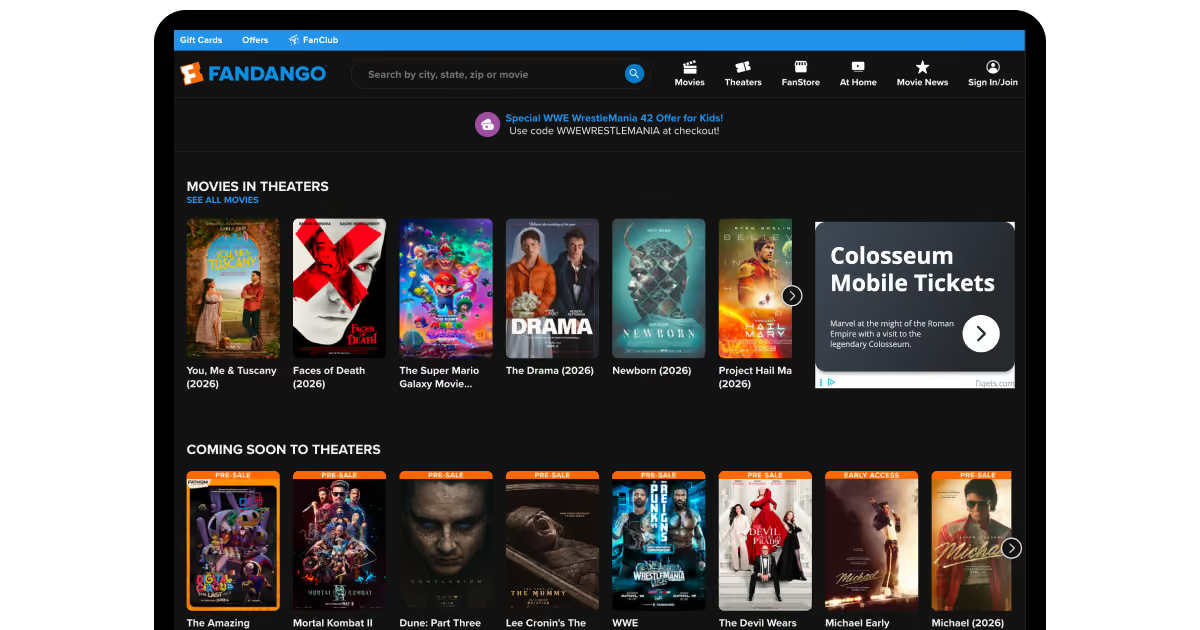
Fandango has the same issues, as we can notice. The primary action on the site is buying a movie ticket. But the CTAs are not visible anywhere on the page, and users click through multiple pages without a clear signal of what to do next. These are not things you fix with a single A/B test on button copy. They reflect an absence of a conversion thesis: where does this break, and why?
Fandango
The right approach starts with a research phase. You map your funnel, identify where visitors are stuck, build a hypothesis about why, and then design a test to validate or disprove that hypothesis. The test result either confirms your theory or forces you to refine it. Either way, you learn something that feeds the next decision. That is how conversion rate optimization tactics compound into a program that actually scales.
To sum up, your roadmap should answer three questions before any test runs:
What is the problem this test addresses?
What does a win tell us?
What does a loss tell us?
If you cannot answer all three, the test is not ready. Simple prioritization frameworks such as ICE (Impact, Confidence, Ease) help teams move from gut feel to structured decisions. But tools only help if the underlying thinking is already there.
Not having a clear understanding of KPIs
If you ask five people on your CRO team what success looks like and get five different answers, you have a KPI problem. This happens more often than you think. Teams pick metrics that are easy to measure - for instance, optimize for pageviews because pageviews are right there in the dashboard. They celebrate time on site because it went up after a redesign, without stopping to check whether revenue moved at all.
CNN is a useful illustration here. The site is a clutter of content, ads, videos, and interactive elements stacked on top of each other. From a pure engagement standpoint, a team could look at time on site or pages per session and feel good about the numbers. People do scroll and click between articles. But the actual user experience is exhausting. The sheer volume of competing elements makes it difficult to find what you came for. If the KPI is raw engagement, the site looks acceptable. If the KPI is task completion or return visit satisfaction, it doesn’t.
CNN
This is one of the most common conversion rate optimization mistakes: picking a KPI that is close to the real goal but not the real goal.Designing customer experience around the wrong metric can damage the very journey you are trying to improve. You shorten a form and get more completions from people who don’t buy. You add more content and drive engagement from visitors who don’t convert. No real impact is made in the long run.
The fix starts with mapping your KPIs to actual business outcomes. Your primary conversion metric should sit as close as possible to revenue or whatever the equivalent is for your model. Everything else should be framed as a leading indicator, something that predicts movement in the primary metric, not a substitute for it.
Ask the simple question: if this metric improves by 20% and nothing else changes, does the business win? If the answer is maybe or it depends, that metric is not primary. Move it down the hierarchy and find what sits above it.
Wrong primary metric, not tracking guardrail, and secondary metrics
A primary metric tells you whether you won. Secondary metrics tell you how and why. Guardrail metrics tell you if you won in a way that will hurt you later. All three matter, but most teams have only the first.
ZARA's website is a case study in what this costs you. The site is built around an editorial, magazine-style experience. But there is no clear CTA, the navigation is hidden behind a hamburger menu that does not reveal obvious category paths, and the mobile journey requires multiple steps that have no breadcrumbs or progress signals. A team measuring session engagement or time on site might look at those numbers and see visitors spending time on the page, and call it a win. But without tracking task completion rate, drop-off points in the product browsing flow, or mobile exit rate specifically, they would never see that visitors are spending time on the site because they are lost, not because they are engaged.
ZARA
A complete conversion rate optimization plan defines all three metric types.
The primary metric determines the winner.
Secondary metrics explain the mechanism.
Guardrails protect the business from wins that quietly damage the customer relationship.
For most teams, setting this up requires nothing more than a shared document that maps each test to its full metric stack before launch. The discipline is in the habit of asking: what could go right in this number while going wrong everywhere else?
COAX builds this structure into every engagement from day one. Before a single test runs, we map the full metric hierarchy across all three levels and define what a genuine win looks like versus a superficial one. That structure is what separates programs that compound from programs that spin.
Guessing instead of understanding users
For CRO, teams look at a low conversion rate and immediately start moving things around: the button, the headline, the layout. They are solving for aesthetics when the actual issue is understanding.
The core mistake is optimizing what you assume users want instead of what they actually do. Assumptions are faster and cheaper than real research, so many teams never question them. The result is a program built on fiction. You improve a page for a user that does not exist.
No research, not digging into segments
The most expensive conversion rate optimization mistakes are the ones that look like good decisions. A team sees that overall conversion is low, picks the highest-traffic page, and starts testing. But often, the overall numbers hide everything that matters.
Look at the SHEIN mobile experience. The homepage shows an unfiltered stream of products across completely different categories: jewelry, cotton pads, apparel, and accessories, all mixed and priced differently. There is a category bar at the top, but it does not freeze when you scroll. The moment a user moves down the page, they lose their navigation anchor and are left inside an endless scroll with no way back to orientation without scrolling all the way back up. The browsing experience essentially turns into noise fast.
SHEIN
A team looking at aggregate bounce rate on this page would see one number. But the behavior of someone coming in from a paid ad for a specific dress is completely different from someone browsing organically out of habit. One needs a direct path to a product. The other needs a browsable structure that keeps them oriented. The non-sticky category bar fails both, for different reasons, and aggregate data would never tell you that.
Digging into segments, by traffic source, device, intent, and first visit versus returning, is what separates a guess from an objective result. Without it, you are testing solutions to problems you have not confirmed exist.
As a part of our UI/UX audit services, COAX starts every engagement with a segmented behavioral audit before any test is proposed. Heatmaps, session recordings, and funnel drop-off data are always broken down by segment. The pattern that emerges from that work rarely matches what the client assumed going in.
Noise of existing customers
There is a specific trap that catches teams at brands with loyal, high-retention customer bases. They listen to their existing customers, and those customers are not representative of the people they are failing to convert.
Macy's is a useful example here. The homepage is built for someone who already knows the brand well. The hero banner announces a spring sale. Below it sits a Coach promotion with a loyalty points mechanic. Below that, a row of percentage-off tiles across multiple categories. For a returning customer, this layout is readable. But a first-time visitor landing on that page sees five competing messages above the fold, no single clear entry point, and no stated reason to shop here over a competitor. The experience isn’t designed for the person who is still deciding.
Macy's
The conversion rate optimization statistics reflect this blind spot across the industry. Most businesses spend $92 acquiring a new customer for every $1 they spend improving what happens after that customer arrives. That imbalance exists partly because the loudest feedback always comes from people who converted. They fill out surveys. They email support. They show up in NPS scores. The visitors who left on page two never say anything at all.
Existing customers never tell you what made new visitors leave. Those are different questions requiring different data: exit surveys, first-session behavior analysis, and user testing with people who have never seen your site before.
COAX separates new and returning visitor cohorts from the start of every engagement. The two groups behave differently, want different things, and respond to different interventions. Treating them as one audience produces averages that describe nobody accurately.
Over-reliance on best practices, under-reliance on testing
Best practices are other people's test results. They came from a different site, a different audience, a different context, and a different moment in time. They are bad as conclusions.
No conversion rate optimization tutorial will tell you whether removing that carousel would lift or hurt your specific conversion rate. Only a test on your audience will. The SHEIN example we reviewed compounds this: infinite scroll and algorithmic product feeds are a documented best practice in fast fashion mobile commerce. They work for some users and goals. For a user with a specific purchase intent who has already lost their navigation bar mid-scroll, the best practice actively works against them. The pattern from another context produces friction in this one.
The teams that get this right treat best practices as a starting point for a question, not a substitute for an answer. Your software testing plans should explicitly note which tests are borrowed from industry conventions and flag them as assumptions requiring validation.
COAX maintains a testing library that tracks not just what we tested, but the source of each hypothesis and whether the result confirmed or contradicted the conventional wisdom. That record, built across clients and industries, is what lets us distinguish patterns that travel from patterns that only work in the context where they were first found.
Broken experiments
A test that runs does not mean a test that teaches. Bad experiment design is probably the most quietly expensive problem in CRO because it produces data that looks real and means nothing. You make decisions on it anyway. Those decisions compound in the wrong direction.
No hypothesis, tests are too small
The most common CRO mistakes happen before anyone opens a testing tool. A team sees a page they want to improve, picks something to change, and ships a test. No documented hypothesis. No defined success criteria. No minimum sample size calculation.
Going's famous CTA test, "Sign up for free" versus "Trial for free," produced a 104% increase in premium trial starts. That result was meaningful because the team had a specific thesis: that directing attention toward the premium tier would change which option users chose. The test was designed to answer one question. The result answered it clearly.
Now imagine that same test run on a page receiving 200 sessions a week, with no hypothesis written down, stopped after 10 days because someone got impatient. You would get a number. It would tell you nothing reliable.
Conversion rate optimization testing requires two things before launch:
A written hypothesis that states what you expect to change and why.
A sample size calculation that tells you how long the test needs to run to produce a statistically valid result.
COAX does not launch a test without a documented hypothesis and a minimum runtime defined upfront. That single discipline eliminates roughly half the wasted testing effort we see in programs we inherit.
Ignoring UX
Conversion rate optimization UX is not a separate workstream from CRO. It is the foundation of it. When you ignore how the experience actually feels to navigate, you end up testing variations of a broken experience and wondering why nothing wins.
Broomberg discovered the UX side of conversion constructively. Their blog content was good, but embedded contact forms were invisible because users were focused entirely on reading. No amount of testing the form design would have fixed that. The insight came from heatmap analysis showing the reading behavior, and the solution was a timed pop-up that matched where users were in the experience. The UX finding unlocked the test worth running.
The conclusion is that if your tests keep producing flat results, the problem is often that you are testing the wrong layer. Fix the experience first, then test within it.
COAX runs a UX audit before building any test roadmap. Friction that is structural needs to be resolved before experimentation can produce a meaningful signal.
Sitewide redesigns
Sitewide redesigns are the most seductive of the common mistakes in conversion rate optimization. The logic feels sound: the site is underperforming, so rebuild it properly, and everything improves. In practice, a full redesign is an untestable experiment. You change everything simultaneously and have no way of knowing what caused good or bad results.
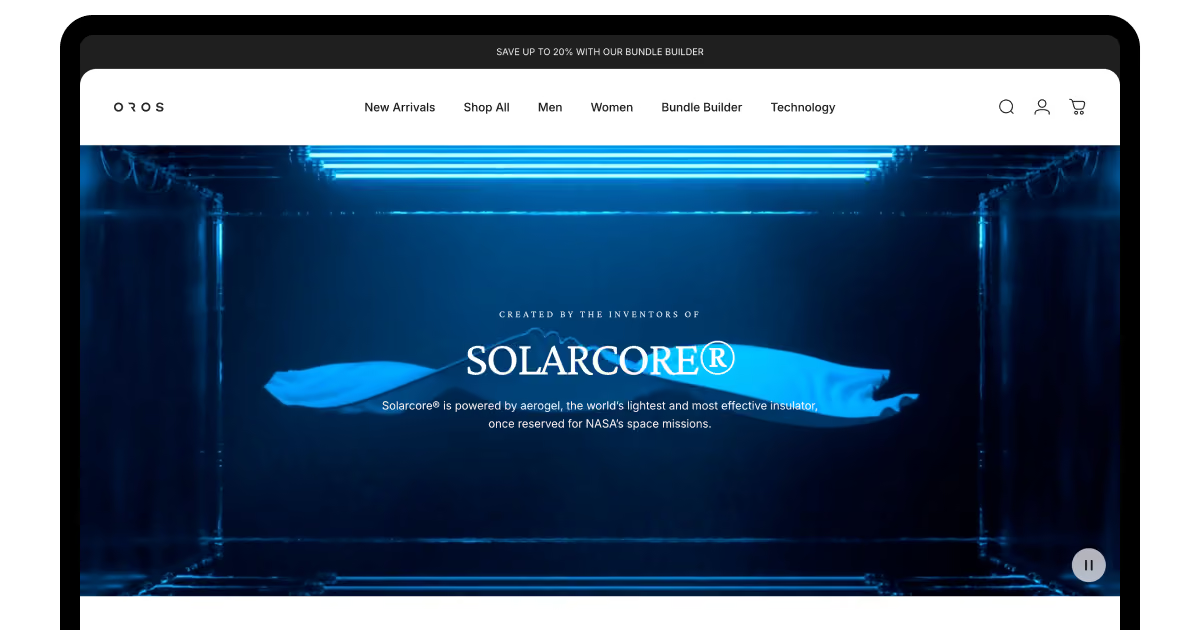
OROS increased sales by 60% by making targeted changes to its homepage. The NASA-grade tech claim serves as a big trust signal, replacing generic marketing fluff with scientific credibility. The Announcement Bar at the top acts as a modular "plug-and-play" space for guarantees or urgency-driven offers without touching the site's code. Even the Bundle Builder in the navigation is a good addition to spike order value by solving a specific friction point.
Now imagine the same team had decided the whole site needed a new look and launched a complete redesign instead. If conversions went up, they would not know which of the hundred changes drove it. If conversions went down, they would not know what broke. The redesign would have consumed months of effort and produced no transferable learning.
OROS
A redesign is not a CRO strategy. It is a reset that erases everything you learned about what was working. When a full site overhaul genuinely cannot be avoided, COAX breaks it into phases with isolated tests at each stage so that learning survives the process.
Misleading data
You ran the test. You got a result. You made a call. And it was wrong. This is the quietest way CRO fails. Not because the test was broken, but because the data was misread. Wrong conclusions feel exactly like right ones. You act, you ship, you move on. The damage compounds invisibly.
Three patterns cause almost every data misread in CRO.
Statistical misunderstandings
Your conversion rate optimization mistakes often start here, before you even look at the result.
Statistical significance is not a green light. It tells you the difference you observed is unlikely to be random noise. It does not tell you the difference is real, permanent, or worth shipping. A 95% confidence level means one in twenty "significant" results is still a false positive. Run enough tests, and you will ship losers that look like winners.
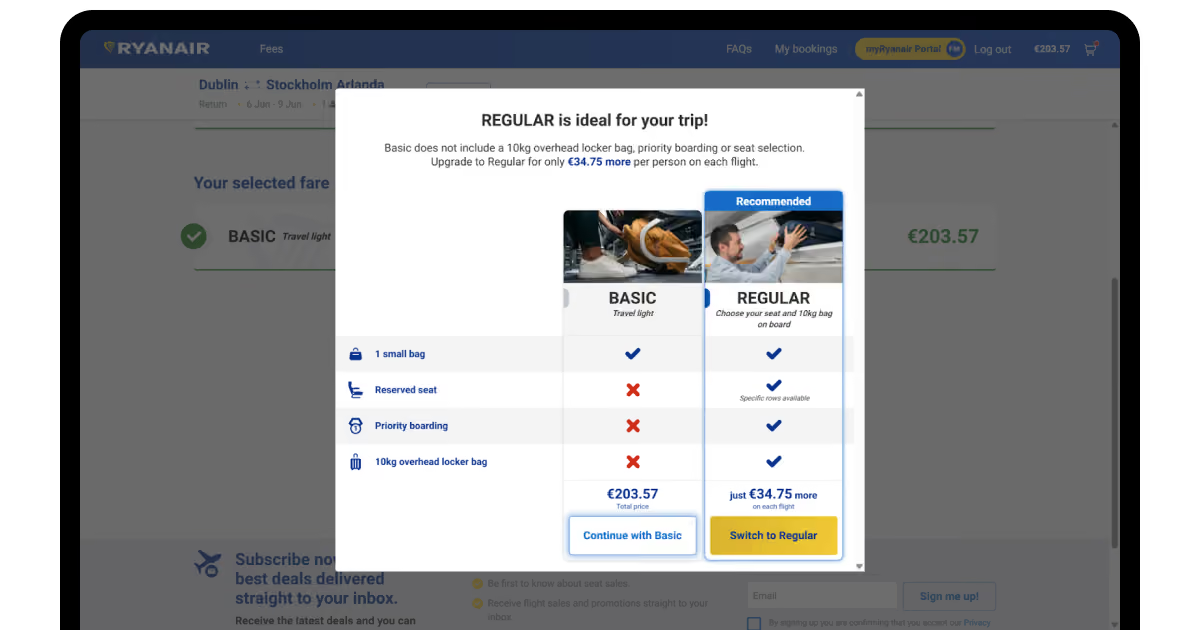
Look at how Ryanair tests and rolls out upsell patterns. Their checkout pushes a full-page pop-up urging you to upgrade from Basic to Regular luggage, with the Regular plan button deliberately high-contrast to grab attention. If Ryanair ran a test on that button color and saw a lift in clicks, that number would look like a win. But clicks on a misleading button are not the same as satisfied customers. Measuring the wrong thing with the right statistical confidence still gets you the wrong answer.
Ryanair
Statistical significance only measures one thing: whether the gap between variants is large enough relative to your sample size to rule out chance. Confusing that for a broader "this works" signal is where most teams go wrong.
As for COAX’s approach, we treat statistical significance as a minimum bar, not a conclusion. Every result gets reviewed for testing window, external events, and segment behavior before any shipping decision is made.
Pausing tests without waiting for results
Peeking kills conversion rate optimization metrics. It works like this: you launch a test Monday. By Thursday, variant B is up 18%. You pause it, call it a win, and ship. But you stopped the test before reaching your predetermined sample size, which means the result was not stable. That 18% was a temporary fluctuation.
Consider Microsoft Teams. Over the years, Teams has shipped UI updates that created real accessibility problems, like automatically truncating URLs shared in chat. Seeing the full link now requires hovering or clicking, which creates friction for users with mobility impairments. The redesign probably tested well in the short window, with a cleaner visual appearance, reading as a usability improvement. But a truncated test window would not catch the downstream friction. The accessibility damage only shows up in longer behavioral data.
Pausing tests early doesn’t show you how your tests perform in week three when real usage patterns emerge. COAX experts pre-calculate required sample sizes and lock test durations before launch. Results are reviewed only when the window closes, not before.
Misreading result reports
This is where common mistakes in conversion rate optimization become permanent. A result gets misread, the wrong version ships, but nobody notices because the headline number still looks fine.
WhatsApp's "delete for everyone" is a clean example of what happens when you read the surface metric and miss the real outcome. The feature registers as a completed action in the interface. Message deleted. Metric satisfied. But what actually happens is the recipient sees "This message was deleted," which creates curiosity and awkwardness, which means the user goal failed. If a team had tested this and measured only task completion rate, the result would look like a win. A proper result report would have included a guardrail metric around recipient experience, and it would have flagged the problem immediately.
WhatsApp
A good CRO guide (like the one we published recently) will always tell you to read primary metric, guardrail metrics, and revenue per visitor together. One number is never the story.
At COAX, every result report we review includes primary metrics, guardrail metrics, revenue impact, and segment breakdown. We flag any result where secondary metrics moved in the opposite direction from the primary.
Tracking gaps
You cannot improve what you do not see. Most CRO programs that plateau are not failing because of bad tests or weak hypotheses. They are failing because the measurement layer underneath them has holes. You are optimizing a partial picture and wondering why the results do not stick.
Three tracking gaps kill more CRO programs than bad test design ever will.
Optimizing without data
The most common conversion rate optimization mistakes don’t happen in the test. They happen before it, when teams start running experiments on pages they have never properly measured.
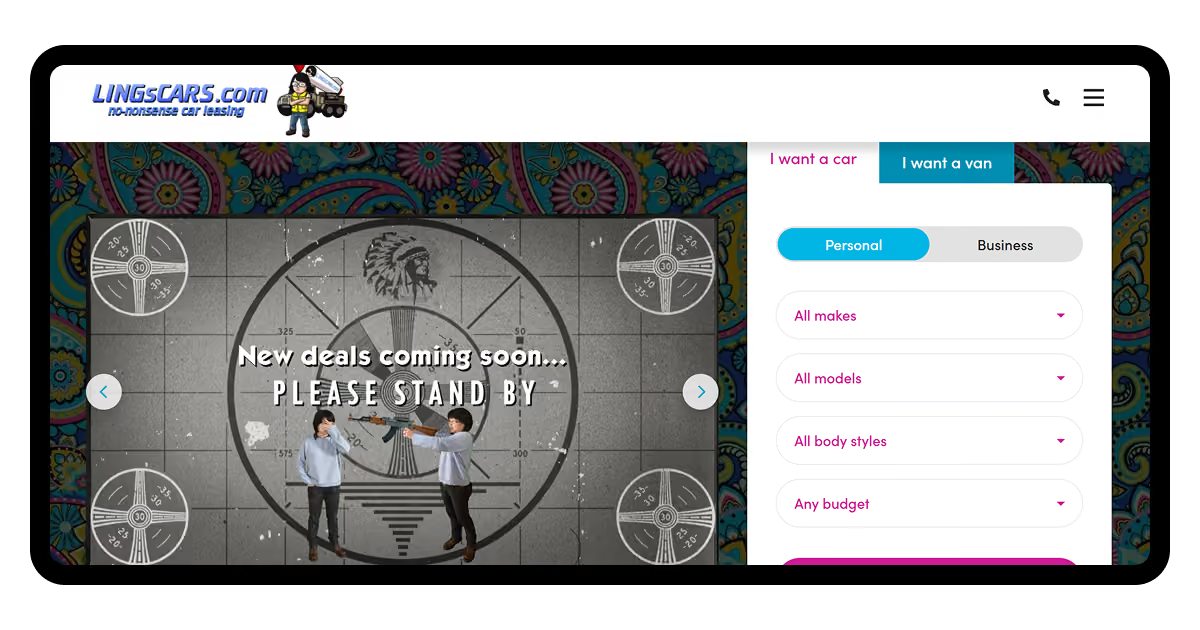
For instance, Ling's Cars, a UK car rental site, is famous for its chaotic design: psychedelic colors, competing GIFs, overlapping content, and zero visual hierarchy. A team that jumped straight to A/B testing button colors on that homepage would get noise. The real problem is structural and invisible until you actually instrument the page properly: where do users drop off, what do they scroll past, what do they click, expecting something to happen?
Ling's Cars
At COAX, we have an integral approach. Before any test is scoped, our custom website development team audits the full tracking setup. Heatmaps, session recordings, funnel drop-off points. If the measurement layer is broken, we fix it before a single experiment runs.
Not tracking micro conversions
Website conversion rate optimization strategies are often about the macro: purchases, signups, form completions. Micro conversions get ignored, but that is where most of the signal lives.
The Arngren website, a Norwegian website that looks lifted from a 1990s yellow pages directory, is a useful case to think through. It has no clear user path, no logical groupings, and no signal about what visitors are actually trying to do. A team measuring only "did they contact a seller" would see low conversion and have no idea why. But micro conversions, things like which category a user clicked first, how far they scrolled before abandoning, whether they engaged with any product image, would tell you exactly where the experience is breaking down.
Arngren
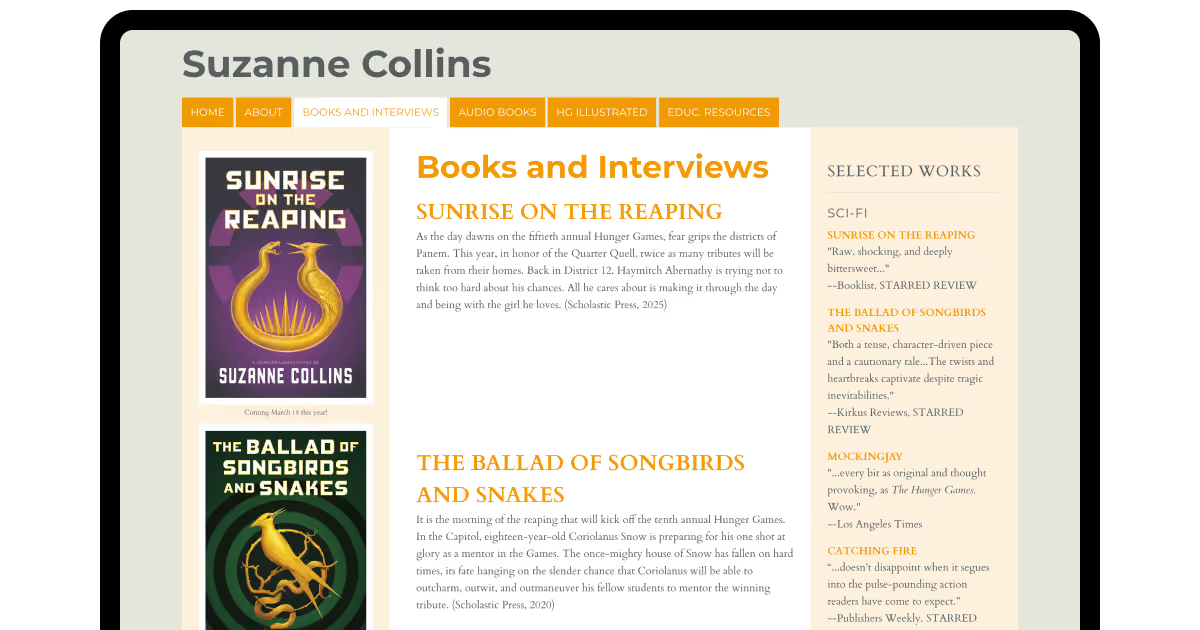
The same applies to the Suzanne Collins books website, where clicking on any book does nothing. No event fires. No data is captured. The interaction just disappears. You cannot optimize a journey you cannot see people taking.
Micro conversions are breadcrumbs. They show you the path users wanted to take before they gave up. This is why at COAX, we map micro conversion events during the discovery phase of every engagement. Add to cart, video plays, scroll milestones, filter interactions, and internal search queries. Every signal that touches the purchase path gets tracked before we touch the conversion rate.
Not tracking key metrics properly
A broken conversion rate optimization plan often traces back to this: the right events exist in the tracking setup, but they are firing incorrectly. For instance, mobile sessions tracked separately from desktop with no reconciliation, or revenue is attributed to the wrong source.
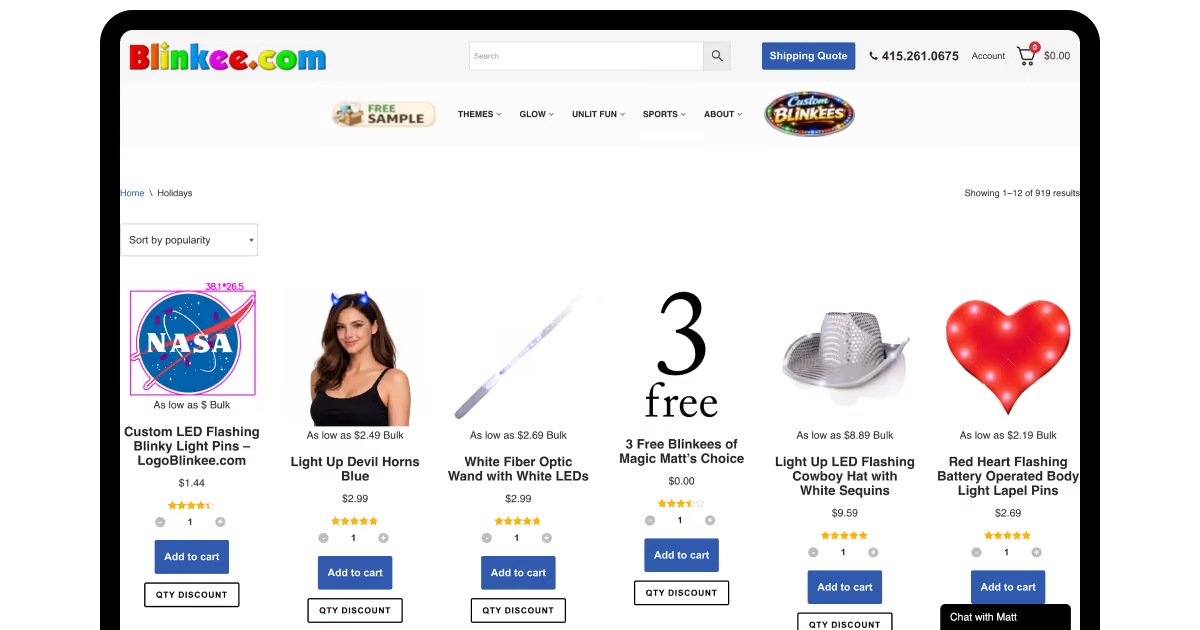
For instance, apart from an outdated visual concept, Blinkee has a UX problem. It sells products, but the navigation sends users to inconsistent pages: sometimes a product detail page, sometimes a category listing with no clear next step. If you are tracking "add to cart" as your primary metric and half your users never reach a page where that button exists, your conversion rate is not measuring your funnel. It is measuring a fraction of it.
Blinkee
Broken tracking actively misleads you. You make decisions based on a number that does not mean what you think it means. This is why COAX’s mobile development teams run tracking QA across device types as a standard step before any CRO engagement begins. We verify that every key event fires correctly on desktop, tablet, and mobile, and that the numbers reconcile across platforms before we trust them enough to optimize against.
Execution that kills conversions
A good hypothesis tested badly is worse than no test at all. It produces false negatives: ideas that could have worked, killed by poor implementation, and then crossed off the list permanently because the team thinks they already tried that. Most CRO execution failures are invisible, as nobody realizes the result was contaminated from the start.
Little or no quality assurance
Conversion rate optimization testing breaks in ways that are easy to miss and expensive to ignore. A tracking tag fires twice, or a mobile layout shifts in a way nobody checked before launch. The test runs for three weeks, produces a result, and that result is wrong, because the experience users actually had was not the experience the team designed.
The University of Advancing Technology website shows what happens when implementation is not validated before launch. The page takes over 20 seconds to load due to uncompressed high-resolution images and outdated code. The team clearly invested in visual design. But none of it was tested against real load conditions before going live. The idea was good, but the execution made worse.
University of Advancing Technology
The same failure mode happens in CRO tests constantly. A variation is built, looks fine in one browser on one screen size, and gets pushed live. On Android Chrome, a button overlaps a form field. On Safari, a font fails to load, and the layout collapses. Those users get a broken experience, their behavior contaminates the test data, and the variation loses, not because the idea was wrong, but because QA never happened.
Before any test goes live, COAX runs cross-device and cross-browser checks, validates that all tracking events are firing correctly, and confirms the variation renders as designed across every meaningful user segment. That step is not optional.
The flicker effect
The flicker effect is one of the widespread CRO mistakes that teams do not know they are making. It happens when a page loads in its original state for a split second before the testing tool swaps in the variation. The user sees a flash of the control, then the page shifts. It takes milliseconds. It is enough to destroy the validity of your test and, more importantly, enough to damage the actual user experience.
In testing, the flicker effect specifically undermines design on mobile, where slower load times make the flash between the original and variation more pronounced and more disruptive. A test that works cleanly on a desktop can produce a broken experience on mobile, and because mobile users represent the majority of traffic, the contaminated data overwhelms the real signal.
COAX resolves this by implementing tests at the server level or using asynchronous loading methods that eliminate the render gap. It is a technical fix that requires expertise in responsive web design across device types, but it is non-negotiable for any test where mobile traffic is significant.
Giving up after a failed test
A failed test is not a dead end. It is data. The conversion rate optimization tactics that compound over time treat every negative result as a question: why did this not work, and what does that tell us about the user?
For example, if a site has animated product images, a slider with non-functional buttons, and CTA buttons that visually dissolve into the background, it’s a result of either giving up on testing or not conducting any at all. If a team tested a new CTA color, saw no lift, and moved on, they would have missed the actual finding: that the entire visual environment is so noisy that no single element can create contrast. The failed test was pointing at a structural problem. Treating it as a verdict on the CTA idea specifically means the real diagnosis never happens.
When a test fails, document the result alongside the hypothesis and the possible explanations for why it failed. That record builds the context for the next test. A loss with no documentation is just lost.
Most teams never build that context because they are too close to their own funnel to see where the real problems sit. That is usually where an outside perspective pays for itself. COAX's conversion rate optimization audit maps your funnel, identifies where drop-offs are happening, and builds the diagnostic foundation that makes every subsequent test worth running. If you are not sure where your program is breaking down, that is a reasonable place to start.
FAQ
Where do I start with conversion rate optimization?
Start with a free CRO audit from COAX. You will get critical conversion blockers flagged, revenue leaks mapped across your funnel, and a short report with key metrics, delivered in 2 to 5 business days. If you need deeper work, the CRO potential audit builds a full A/B test roadmap from there.
How can I define the exact conversion rate optimization mistakes my team keeps making?
Follow this algorithm:
Map your full funnel and mark every drop-off point.
Segment data by device, traffic source, and new versus returning visitors,
Run heatmaps and session recordings on your highest-traffic pages,
Audit your tracking setup for misfiring or missing events,
Review your last 10 tests: was there a hypothesis, sample size, and guardrail metric for each?
Interview your team separately and compare what each person considers a conversion win.
What is the best way to document a conversion rate optimization strategy?
According to researcher Sneha Dingre, effective CRO frameworks require structured behavioral mapping and defined decision criteria before testing begins. In practice, document your funnel stages, hypothesis per test, primary and guardrail metrics, minimum sample size, and test results with explanations for wins and losses. One shared document reviewed before every test launch is enough.
How does COAX achieve conversion rate optimization and UX improvements?
COAX runs UX audits before any test roadmap is built, using heatmaps, session recordings, and segmented funnel analysis. With 16 years of experience, an ISO 9001 and 27001 certified team, and a 4.9 on Clutch, the team handles strategy, design, development, and QA under one roof, with no handoff gaps between research and implementation.












































































We are interested in your opinion