If you’re a business traveler, you suffer a lot from flight prices changing all the time. If you own a travel business or your employees are involved in corporate travel often, you suffer enormously from light prices changing all the time and losing your profit margins. The good news is that you need no guessing or long research these days.
Modern flight price prediction technology gives you a real advantage:
Fare bucket systems that move prices before you even notice the change.
Time-series models that read booking patterns the way a chart reader reads markets.
LSTM and GRU architectures that catch seasonal cycles months in advance.
Route-specific datasets that separate signal from noise across thousands of corridors.
Real-time travel APIs that feed live fare data into prediction engines continuously.
Confidence scores that tell you how certain a recommendation actually is.
Price alerts that fire when a fare crosses a threshold that matters, not just any threshold.
Corporate tracking infrastructure that monitors entire route networks, not single trips.
Custom ML systems that learn your carriers, your contracts, and your pricing logic.
In this guide, we describe the principles and workflows of how a flight ticket price is formed and walk you through flight price prediction software and its features and models. Then, we will break down the best options you can get from vendors and define whether you need to create your own solution.
What is flight price prediction?
Flight price prediction software is a system that analyzes historical fare data, booking patterns, and real-time market signals to estimate what a flight will cost, and whether that price is going up or down. At its simplest, it’s a tool that turns a constantly shifting number into something you can reason about.
But the definition understates what's actually happening in the deep. Meepaganithage and team describe flight pricing as a time-series problem with strong temporal dependencies embedded in every fare. In other words, today's ticket price is not a random number. Trying to see the right number is much like looking at a river flowing through a deep, layered landscape. The surface is visible, but it’s hard to see what’s happening underneath. Why so? Much because it’s shaped by everything that happened before it, and the best prediction systems treat it that way.
So, not to drown in this river (and the stream of longer explanations), let’s review the workflow that keeps airline price predictors going.
How flight pricing works
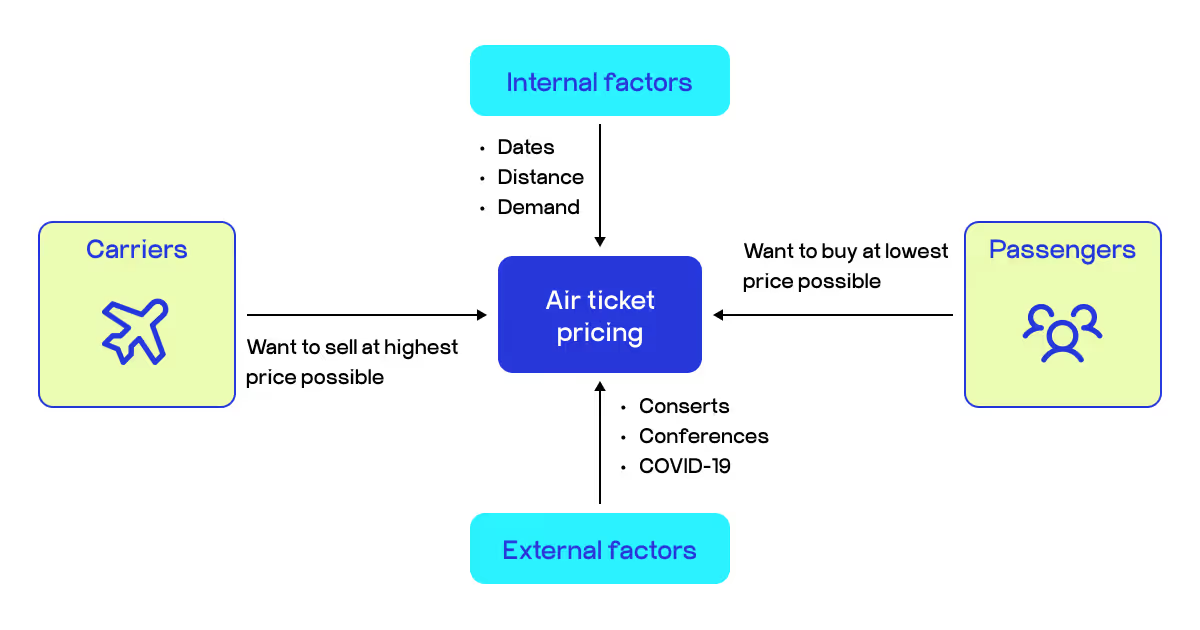
Airlines do not set one price per seat and leave it there. They use a system called nested booking, where seats are grouped into fare "buckets" ranked by price. As one bucket fills up, the next opens at a higher rate. It adjusts automatically based on demand, date, and route.
It all starts the moment a route goes live. The airline sets a base price using distance, expected demand, and season. Seats are then distributed across multiple fare tiers, anywhere from 24 buckets on American Airlines to 77 on Delta, according to Kiera Shepard, who analyzed how airfare algorithms work. When demand rises, the system pushes seats into a higher bucket. When demand drops, it moves them down to stimulate sales. You never see the bucket - you just see the price it lands on.
Several factors drive that movement. Booking timing is one of the most reliable: prices step up predictably at 21, 14, and 7 days before departure, regardless of how full the plane is. Day of week matters too, with weekend flights blocked from entering low fare tiers even when demand is soft. Seasonality pushes popular routes into higher buckets during holidays and peak travel periods. Competition plays a role as well, since fewer airlines on a route generally means less pressure to keep fares down.
This is where a flight price predictor enters the picture. It watches these patterns across thousands of routes, learning when buckets tend to shift and by how much. The data comes through travel APIs that supply live fare information directly from airline and booking systems. That data feeds a trained prediction model, which produces a recommendation: buy now or wait. Most tools also support price alerts for flights, which notify you automatically when a specific fare crosses a threshold you set, turning a one-time search into continuous monitoring.
The result is that what feels random to a traveler is actually a learnable pattern, and that pattern is what good prediction software is built to find.
Why flight prices are so hard to predict
Ask ten travelers what they paid for the same route, and you will get ten different answers. Many complain that this is an imperfect system. Ironically, though, it’s a deliberately imperfect system working exactly as designed.
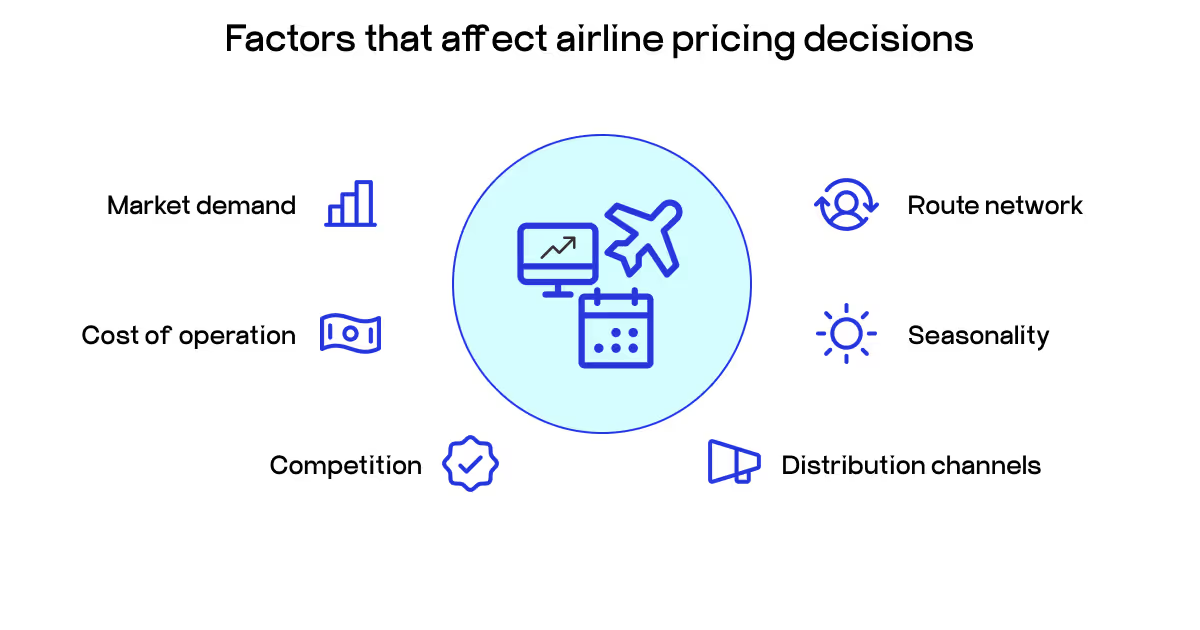
The core problem for any airline price predictor is that flight fares are not driven by one variable you can track. They are the output of at least six forces pushing against each other simultaneously, and each one can shift independently at any moment.
Key factors that influence flight prices can be divided into several categories.
Market demand is the biggest mover. Airlines price seats the same way stock markets price shares: when more people want them, the price goes up. McKinsey analysts note that a single flight from London to New York can generate around $174,000 in total revenue, but only when demand on that route stays strong. On a weaker route, the same aircraft running the same costs produces a very different result. Demand also fluctuates by hour, day, and week in ways that are partly predictable and partly not.
Cost of operation sets the floor. Fuel alone accounted for roughly $51,000 of the operating cost on that same hypothetical London to New York flight, making it the single largest cost item. Add aircraft leasing, crew salaries, maintenance, air traffic control fees, and airport charges in two cities, and the total operating costs reach $153,000. Airlines cannot price below that for long, so any spike in jet fuel or airport fees flows into fares.
Competition compresses prices on busy corridors and inflates them on thin ones.Pegasus Airlines CEO Güliz Öztürk described how choosing a less congested hub airport gave the carrier a structural cost advantage that allowed it to undercut legacy carriers on price. Where that kind of competitive pressure exists, fares stay lower. Where it disappears, airlines have room to charge more.
Route network shapes what connecting passengers pay. McKinsey's analysis points out that passengers connecting through a hub typically pay 20 to 30% less per segment than point-to-point travelers, because yield on connecting itineraries is inherently lower. The same seat on the same plane can carry a very different fare depending on where the passenger started their journey.
Seasonality moves entire fare tiers up or down on a calendar schedule. Holiday periods and school breaks push routes into higher fare buckets regardless of how full the plane actually is. Winter travel outside holiday windows is often the cheapest time to fly, while summer and Christmas periods push prices to their annual peaks.
Distribution channels add a final layer of complexity. Whether a ticket was bought directly through an airline, through a third-party booking site, or through a corporate travel program affects both the fare shown and the ancillary fees attached to it. Ancillaries, things like baggage fees, seat selection, and in-flight purchases, added an average of $30 per passenger on that McKinsey example flight, bringing in an extra $6,600 beyond the base ticket revenue.
Put all six factors together, and you see why flight ticket price prediction is genuinely hard. You are not predicting one number. You are predicting the outcome of a dynamic auction where the rules change based on time, geography, competition, and costs that the traveler cannot directly observe. Guessing is a losing game here. So instead, prediction models learn the patterns to tell you whether the number you see right now is likely to go up or down before you fly.
Airfare datasets
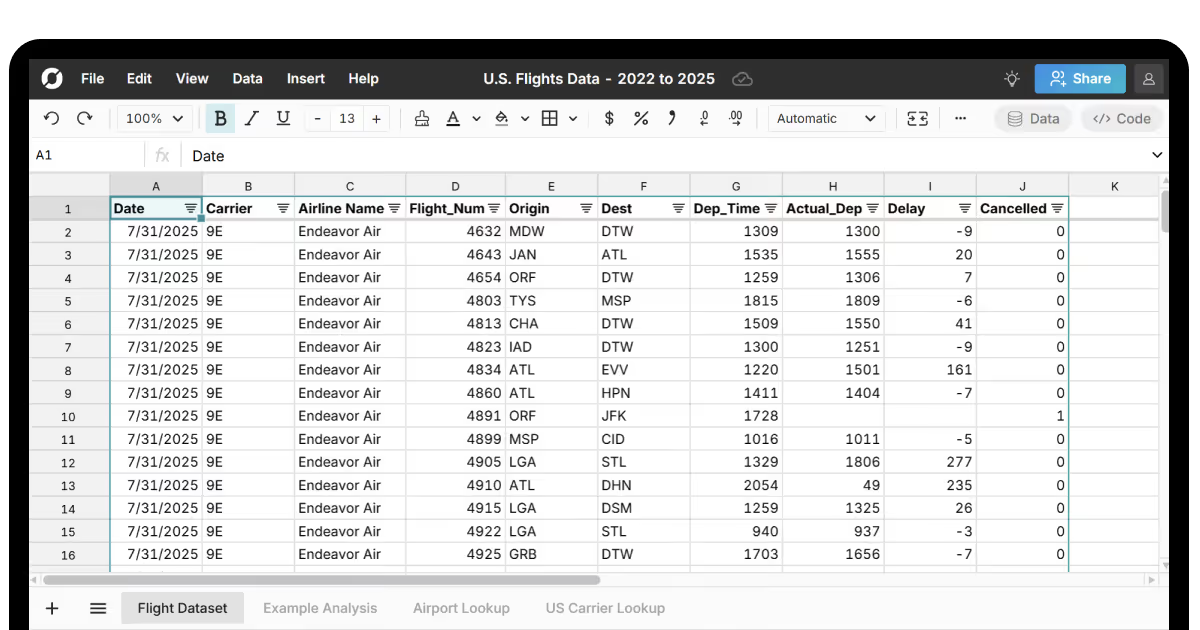
Garbage in, garbage out. Every airline price predictor is only as good as the data it was trained on, and flight pricing data is some of the messiest, most volatile data you can feed a machine learning model, like the kind of billion‑row U.S. flights datasets that AWS now explores at scale with Row Zero.
So, why is data quality so important for prediction accuracy?
A price recorded yesterday is not the same signal as a price recorded three weeks before departure on a holiday route. The timestamp, the booking window, the route type, the cabin class, the competing carriers, and whether there was a flash sale running that day change what that number actually means. Feed a model clean, well-labeled, historically deep data, and it learns real patterns. Feed it incomplete or poorly timestamped data, and it learns noise.
Meepaganithage and team ran into this when building their airfare forecasting system. They collected their own flight price prediction dataset from scratch by scraping Google Flights over seven months, tracking fares across six major US airports. They then structured it using a windowed approach, splitting data 80% for training, 10% for validation, and 10% for testing based on flight date. That design choice matters. A random split would have let future data leak into training, making results look better than they actually are.
The result of that clean methodology was a Bi-LSTM model that hit a Mean Absolute Error of $46.70 on average. That is a meaningful result, but it required seven months of consistently collected, properly structured data to get there. With a noisier or shorter dataset, the numbers would have looked very different.
A high-quality airfare price predictor needs data across several dimensions at once.
Pricing history is the obvious one, but route-level context matters just as much: how many airlines compete on this corridor, what the typical load factor looks like, and whether the route skews toward business travelers or leisure travelers. Without that context, a model sees a price drop and cannot tell whether it signals an opportunity or a structural feature of that specific route.
The booking window dimension is especially critical.According to Google Flights, domestic US fares tend to bottom out between 23 and 51 days before departure, with 39 days being the single cheapest day to book on average. International fares follow a different curve, generally staying flat until about 50 days out and then climbing. Any system that ignores the booking window as a feature is missing one of the strongest signals in the dataset.
Time of week adds another layer. Historical Google Flights data shows Tuesday is the cheapest day to fly, while Sunday is the most expensive, with a roughly 13% spread between them. Models trained without day-of-week encoding will miss that pattern entirely.
To collect each of these scattered threads into one tapestry, you need to know exactly where to take your data from and in what order.
Main data sources for flight price prediction
A disclaimer at once: there is no single authoritative database for airfare history. Researchers and product teams pull from several different sources, each with its own tradeoffs.
Direct scraping from booking platforms is the most granular approach. Meepaganithage and team used this method, pulling live fares from Google Flights at regular intervals over months. The advantage is freshness and depth. The disadvantage is cost: it requires infrastructure, consistent scheduling, and careful deduplication to avoid counting the same fare multiple times at different scrape intervals.
APIs from Amadeus, Sabre, and Skyscanner give access to live and historical fare data without the maintenance overhead of running your own scraper. These feeds are what most commercial flight price prediction products use as their primary data backbone. The tradeoff is cost and access restrictions: comprehensive historical data through a travel API is not cheap, and coverage varies by region and carrier.
Aggregated historical datasets from sources like the US Bureau of Transportation Statistics cover ticketed fares on domestic routes with a lag of several months. This data is clean and standardized, but it reflects what passengers actually paid, not what fares were available at each point in the booking window. It matters for training prediction models, which need to learn the shape of the pricing curve over time.
Publicly shared research datasets have also become a resource for academic work. Several studies have published their collected fare datasets on platforms like GitHub and Kaggle, giving other researchers a baseline to benchmark models against. Meepaganithage and team made their dataset and full implementation publicly available at their project repository exactly for this reason.
What’s important is whether the training data captures all of these dimensions together: route, booking window, day of week, cabin class, competing carriers, and seasonal context. Collect only some of them, and the model learns a partial picture. Collect all of them consistently, and you have the foundation for an air flight price predictor with credible recommendations.
ML models for flight price prediction
Some prediction models are fast and interpretable. Others are slower but catch patterns that simpler models miss entirely. For flight pricing, a time-ordered, seasonally influenced, route-specific problem, the choice of model architecture makes a real difference.
Recurrent Neural Networks for sequential data
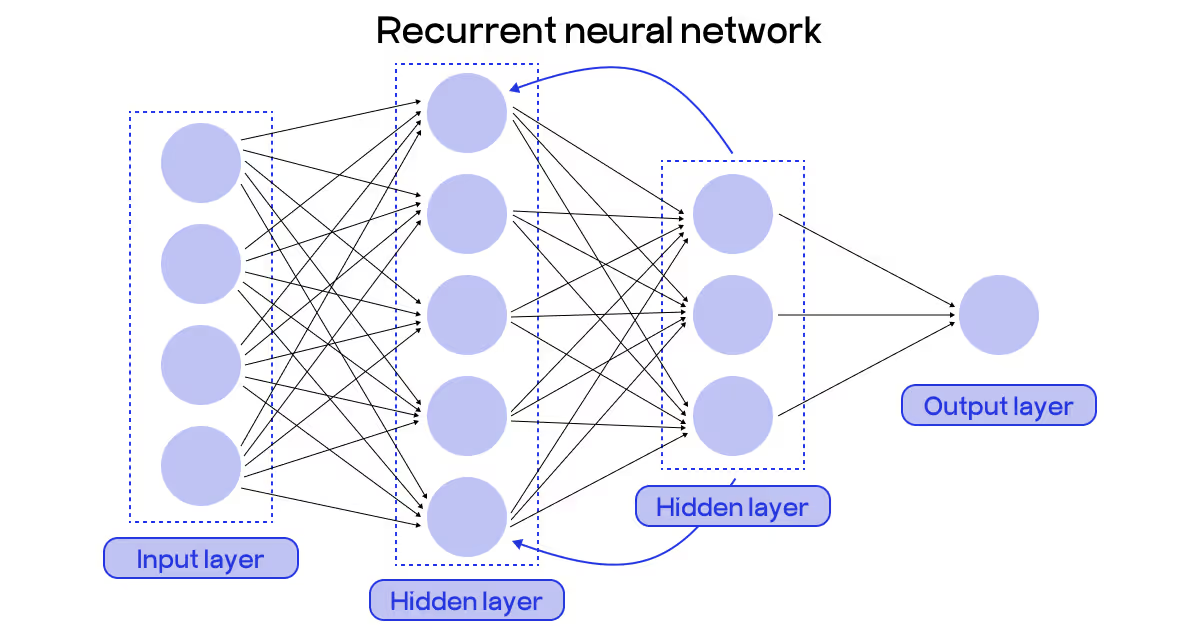
A standard RNN reads data the way you read a sentence: one word at a time, carrying forward what it has already seen. For flight prices, that means the model processes fares in chronological order, using past prices to inform its prediction of the next one. According to IBM, the key feature is a hidden state that acts as memory, passing forward context from each time step to the next. A fare recorded 30 days before departure informs the prediction at 29 days, which informs 28 days, and so on.
For any airfare predictor built on sequential data, this matters because flight prices do not exist in isolation. A fare today is partly a function of where the airline's fare bucket system was yesterday and how demand has been trending over the past week. A model that treats each price as an independent observation throws away that structural information.
The limitation of standard RNNs is that the memory degrades over longer sequences. Context from 60 days ago fades before the model reaches the prediction date. For short-term fare movements, this is manageable. For longer booking windows, it creates a ceiling on accuracy that more advanced architectures are designed to address. Kaggle notebook benchmarking 10 ML models on flight fare prediction confirmed this: simpler sequential models perform well within tight time windows but are outpaced when the prediction horizon extends.
LSTM models for long-term price patterns
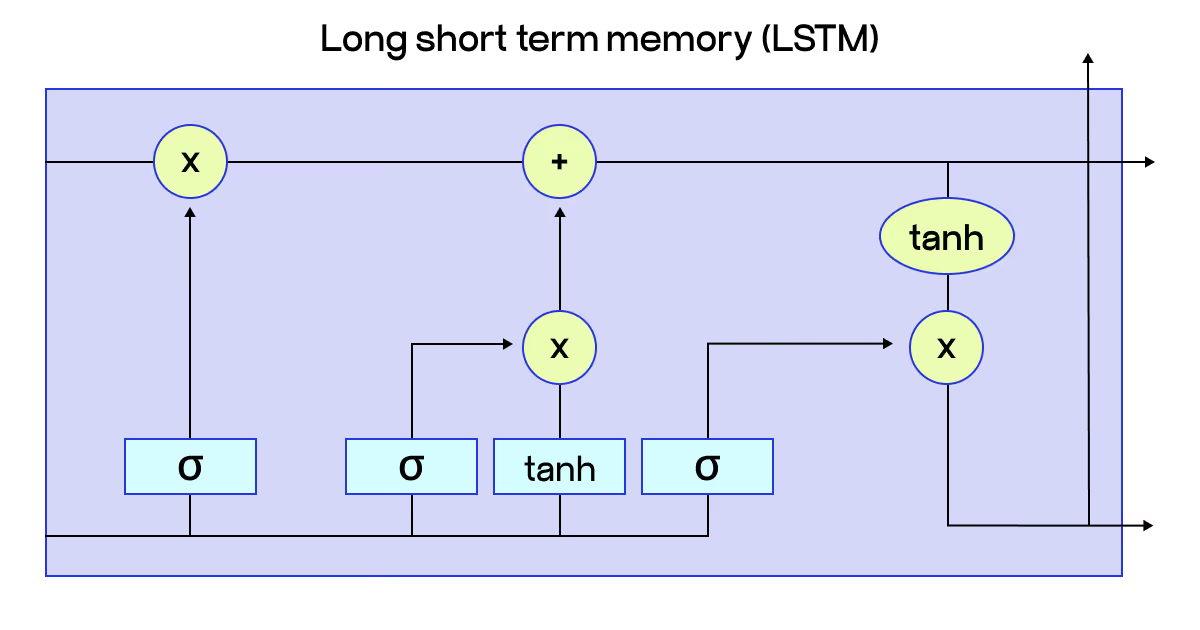
Long Short-Term Memory networks were designed specifically to solve the memory problem in standard RNNs. IBM's documentation explains that LSTMs add three gates to the basic recurrent structure: an input gate, an output gate, and a forget gate. These gates let the model decide what historical information to keep, what to update, and what to discard at each time step. The result is a model that can connect context from weeks or months back to a current prediction without that context degrading.
For flight pricing, this architecture wins in benchmarks. Meepaganithage and team tested RNN, GRU, and LSTM variants across short, medium, and long-haul routes. The Bidirectional LSTM came out on top in every distance category.
This is the core architecture behind any serious flight price prediction software today. The ability to retain booking-window patterns, detect seasonal cycles that span months, and connect events like holiday demand spikes to fares weeks in advance makes LSTM the natural fit for the problem.
Regression and gradient boosting approaches
For structured tabular data with well-defined features, regression-based approaches and gradient boosting methods are quite competitive. Many choose them for their speed, interpretability, and lower data requirements.
Korkmaz compared multiple ML algorithms on Turkish Airlines and Pegasus Airlines fare data across 962 records and 19 variables. The best-performing model was Gaussian Process Regression. That result tells you that a well-tuned regression model on clean, feature-rich data can deliver strong predictive accuracy without the training overhead of a deep learning system.
Gradient boosting, meanwhile,builds decision trees sequentially, with each new tree trained to correct the errors of the ones before it. The model starts with a simple mean prediction, then adds trees one at a time, each focused on the residual errors that remain. Popular implementations like XGBoost and LightGBM have made this approach standard.
Gradient boosting handles booking lead time, day of week, cabin class, and route type well. These are categorical and numerical features that decision trees can split on cleanly, as Korkmaz's study also found.
The practical picture across all three model families is this:
If you are building an airhint flight price predictor or evaluating one, LSTM-based architectures are the current standard for accuracy on time-series fare data.
Gradient boosting is the right choice when you have rich, structured features and need a model that is easier to explain and faster to retrain.
Regression methods work well on smaller, cleaner datasets where the relationship between features and price is relatively stable.
Most systems combine elements of all three, using gradient boosting for feature-heavy routing decisions and LSTM layers where temporal pattern recognition matters most.
What features should you look for in flight price predictors?
Most flight price prediction tools look similar on the surface. They show you a price, maybe a "buy now" badge, and a calendar. The difference between a tool that actually saves you money and one that just looks like it does comes down to what is running underneath.
So, how to define the first one from the second one? Focus on the following features.
Real-time data connection
A prediction built on stale data is not a prediction. It is a guess about a market that has already moved. Jangid describes the first requirement of any functional flight price predictor as a live fare connection: current price, route, airline, fare class, days until departure, and time of day, all pulled fresh. Without that baseline, the model is comparing today's fare to yesterday's snapshot and calling the difference a trend.
The simple and easy-to-remember test for any tool you evaluate: does it tell you when its data was last updated? If you cannot find that information, the freshness of the underlying data is probably not something the product wants you to think about.
Historical depth and pattern recognition
Real-time data tells you what a fare is right now. However, Bülbül, whose study tested seven ML algorithms on route data, found that flight distance, operating carrier, passenger volume, and market competition concentration were the four most predictive features for fare levels. A tool that surfaces only the current price, without contextualizing it against historical norms for that specific route, is missing most of the signal.
Good flight cost trackers store fare history over time, building a route-specific baseline that makes the current price meaningful. A $340 fare on the Boston to Chicago corridor means something different in February than it does in July, and it means something different at 60 days out than at 7. Tools that flatten all of that into a single number are throwing away the most useful information in the dataset.
Confidence scoring and booking window guidance
A prediction without a confidence level is just an opinion. Any credible airline price predictor should tell you not only which direction it expects prices to move, but how confident the model is in that direction.
Most consumer tools will not publish their accuracy metrics, to be honest. But the presence of a confidence indicator at all is a sign that the product is treating prediction as a measurable claim.
Booking window guidance is the other output that matters. Marla and team describe the end product of a well-built predictor as a clear, actionable recommendation: prices are likely to rise, prices may drop in the next 48 hours, or this is a good time to book. That framing only works if the tool knows where you are in the booking window relative to the historical cheapest point.
Route-level rather than global averages
A tool trained on aggregate fare data across all routes will give you average predictions. Average predictions are wrong more often than route-specific ones. As we already discussed, route distance and operating carrier are the top two determinants of fare level. That means a predictor that treats a leisure route to Cancun the same as a business corridor to New York is generating predictions from a model that does not understand the market it is predicting.
The better travel booking engines with prediction features segment their models by route type, carrier, and market concentration. A route served by one dominant carrier is priced differently from a contested route with low-cost carrier competition. A model that knows the difference will outperform one that does not.
Flight price alert functionality
Monitoring fares manually across multiple search sessions is unreliable. A flight cost predictor worth using automates that process: you set a threshold or a route you want to watch, and the system notifies you when the fare moves past a point you care about. Alerts also serve a business function beyond consumer use, triggering email campaigns when fares drop, helping agents close bookings faster.
The quality of an alert system depends on two things: how frequently the underlying fare data refreshes, and whether the alert logic accounts for the booking window. An alert that fires every time any price drops on a route is noise. An alert that fires when a fare drops below the historical average for that route at that specific booking depth is a signal.
Transparency about model limitations
The best tools are honest about what prediction cannot do. Bülbül's study, which used one of the cleanest publicly available datasets, still noted that temporal and day-of-week variation was missing from the BTS data, and that global coverage would improve accuracy. Any flight price prediction tool that presents its results without nuances is either working with perfect data (which does not exist in this domain) or is not telling you the full picture.
A tool that explains why it is recommending what it recommends, which features drove the prediction, and what its historical accuracy on that route type looks like, is one you can put your trust in. One that shows a green price label with no logic is asking you to trust a black box.
Popular flight price prediction tools
The market for flight price tracking has consolidated around platforms that each take a different approach to the same core problem. Some prioritize search breadth, while others focus on prediction depth. Here is a concise breakdown of the main players and how they compare.
Tool
Free to use
Paid options
Prediction accuracy
Best for
Google Flights
Yes
Free
Historical trend indicators, no stated accuracy
Flexible date research, route overview
Hopper
Yes (app)
Premium $9.99/mo; Price Freeze ~10% of fare
Claims ~95%
Buy/wait recs, mobile users
Kayak
Yes
Free
Price Forecast since 2013, no stated accuracy
Price calendars, OTA comparison
Skyscanner
Yes
Free
Trend graphs, no stated accuracy
Global routes, budget carrier coverage
Momondo
Yes
Free
Fare insights with booking window guidance
Full-cost view including baggage fees
AirHint
Yes
B2B pricing on request
Claims 80%+ with airline-specific models
Carrier-set predictions, confidence scores
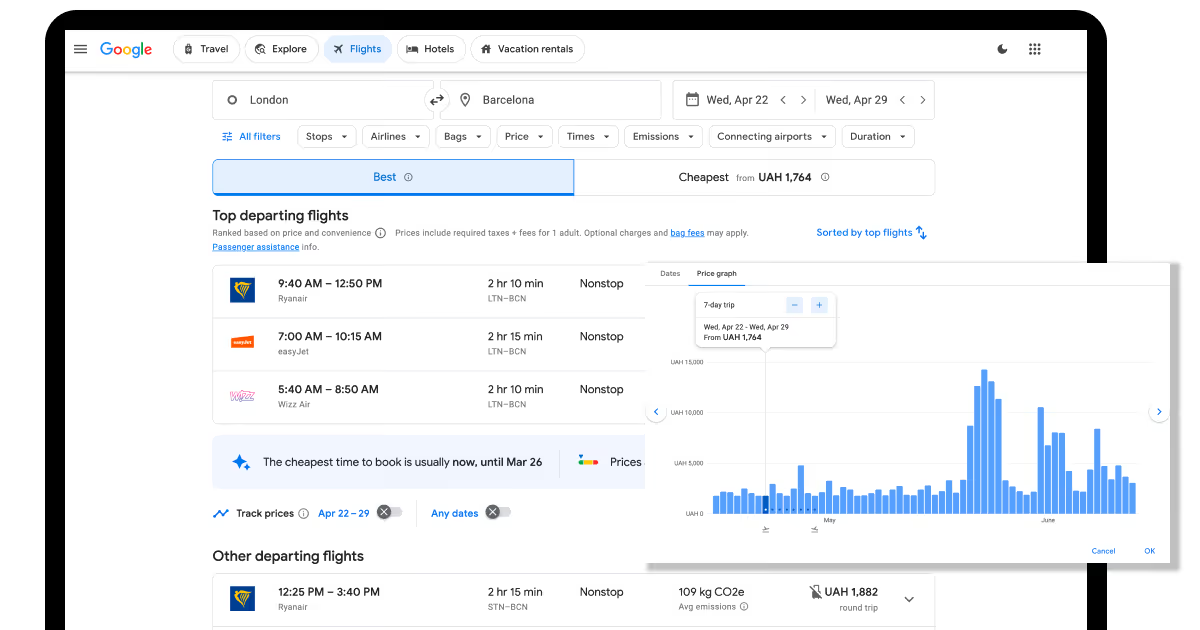
Google Flights is the most widely used and often referred to as the best flight price predictor for general travelers. It shows historical price data, surfaces nearby airports and flexible date options, and displays trend indicators on whether fares for a given route are typical, high, or low. Its prediction guidance is grounded in Google's access to enormous volumes of search and booking data across years. The main limitation is coverage: budget and low-cost carriers are sometimes missing, which matters where routes compete on price.
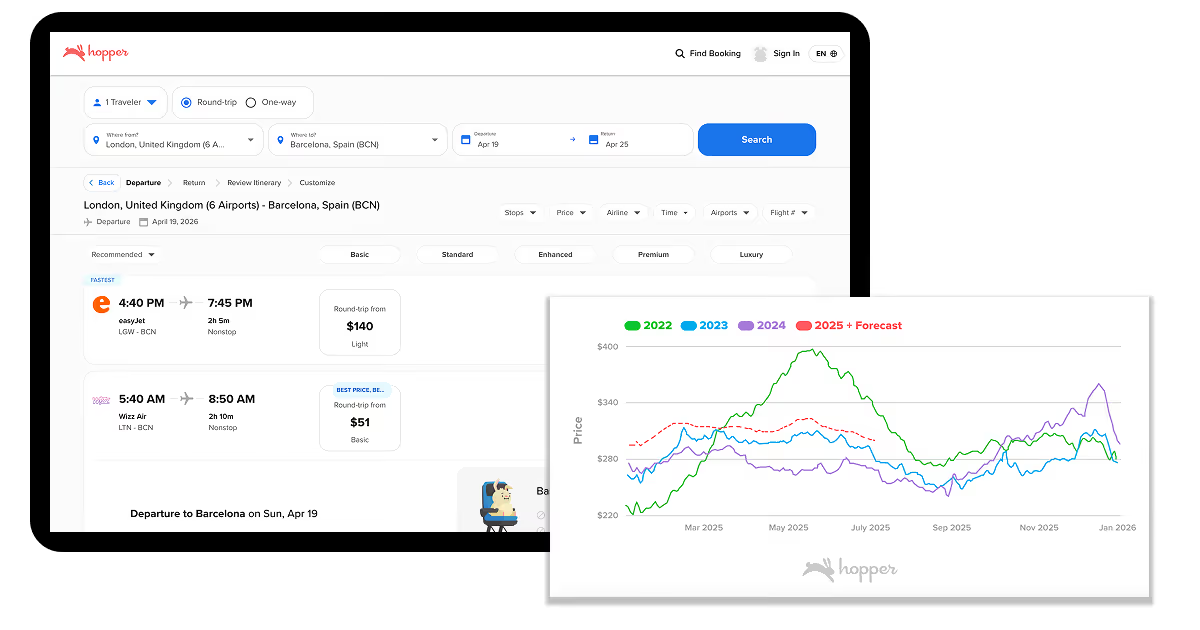
Hopper built its reputation on a single promise: to tell you whether to book now or wait, with a claimed near-95% accuracy on its price movement predictions. It uses ML trained on historical fare data and pushes alerts when prices drop on routes you are watching. The price freeze feature, which locks in a fare for a set number of days for a fee, reflects confidence in its own predictions. Hopper is mobile-only, which limits it for users who prefer a desktop workflow.
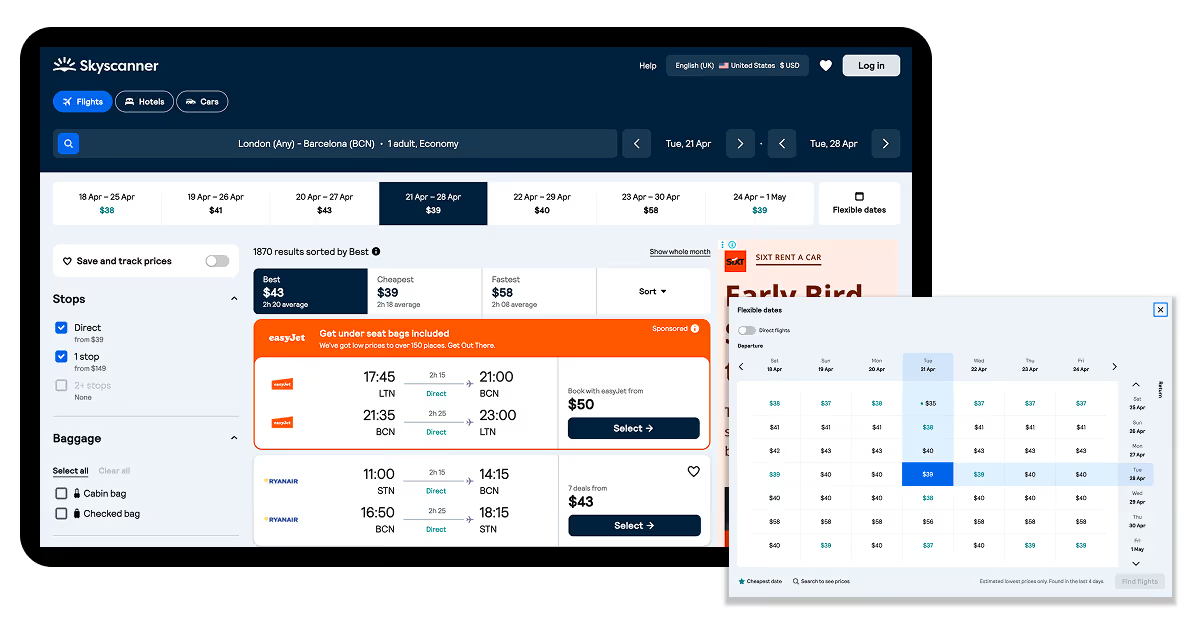
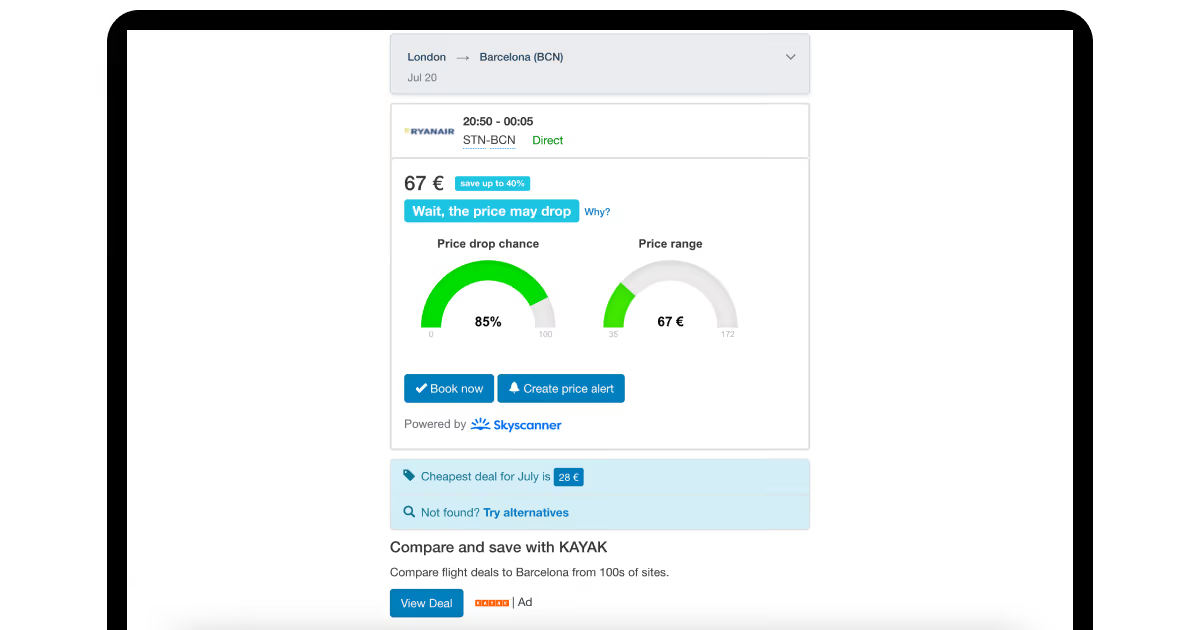
Skyscanner functions as a meta-search engine with prediction layered on top. Its "Best Time to Book" feature shows price trend graphs over weeks or months, and its alert system notifies you when fares change on saved routes. The airline coverage is broader than most competitors. The trade-off is that prediction accuracy, as a flight predictor, is less precise than tools that focus exclusively on forecasting rather than search aggregation. Skyscanner's Drops feature in the mobile app flags routes from your home airport where fares have fallen by 20% or more, which is a practical shortcut.
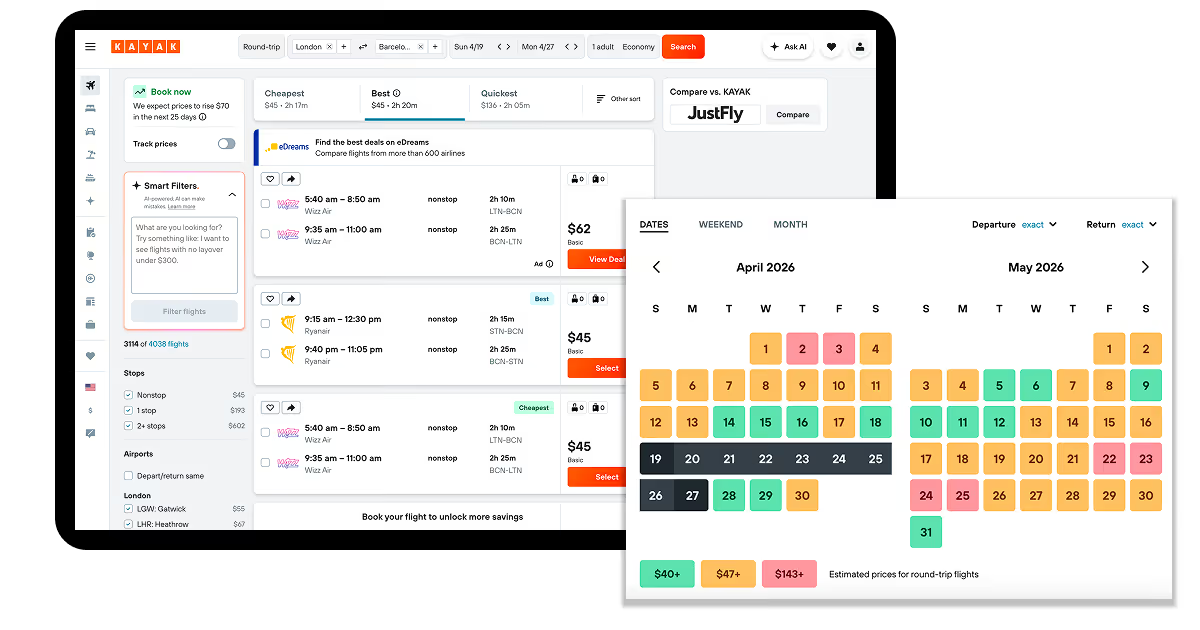
Kayak offers a dedicated Price Forecast tool that has been running since 2013. It analyzes search data and historical prices to give a buy or wait recommendation. Kayak also integrates forecast signals directly into its price alert emails, so when it has high confidence in a route, it flags that context alongside the fare change notification. The platform covers budget carriers more consistently than Google Flights, and its price calendar makes it easy to compare fares across an entire month.
AirHint takes the most technically focused approach of the group. Rather than applying a single model across all routes, the AirHint flight price predictor trains separate neural networks for individual airlines, on the premise that each carrier has distinct pricing behavior. The platform claims over 80% prediction accuracy and shows users a confidence score alongside each recommendation. AirHint supports dedicated predictors for major European, North American, and Asian carriers, with higher accuracy on airlines where it has trained deeper models. It also offers B2B integration for travel businesses that want to embed fare prediction into their own platforms.
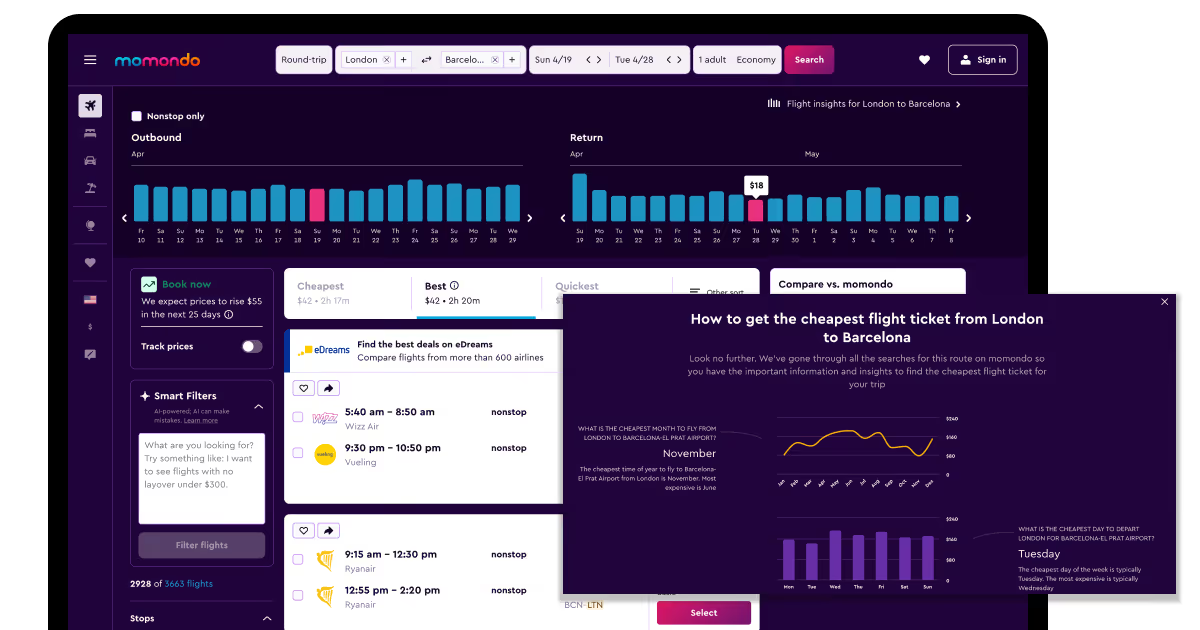
Momondo is the most visually straightforward of all the options. It aggregates fares from multiple sources, provides price prediction alerts, and presents pricing breakdowns with less clutter than the larger platforms. The airline coverage is narrower, and prediction accuracy is generally considered less robust than Hopper or AirHint on specific routes, but for travelers who find the larger platforms overwhelming, the simpler interface is a real advantage.
Now that we outlined the key ready-made options, let’s see how this type of technology is used in real-world cases.
Real-world implementations
The most instructive example of how a prediction tool gets built in practice comes from Kayak's own description of its Price Forecast. The system analyzes search behavior on Kayak itself, not just historical booking data, which gives it a demand signal that booking records alone cannot provide. When many users are searching for a route but not yet converting to bookings, that pattern informs the model's confidence in a "wait" or "buy" recommendation.
AirHint represents a different choice: instead of one model with broad coverage, a portfolio of airline-specific models with narrower but deeper training. This mirrors what the academic research supports. LSTM models trained on route-specific data outperform models trained on aggregated data across routes, and AirHint's approach applies that principle at the carrier level rather than the route level.
On the corporate travel side, Paul de Villiers, SVP at Amadeus, recommended that travel buyers use price optimization and tracking tools to stay ahead of supplier pricing, noting that airlines and hotels increasingly use continuous and dynamic pricing algorithms to adjust fares in real time. For corporate flight price predictor use cases, the implementation is less about booking one trip at the right moment and more about monitoring entire corridors over time, spotting patterns in when fares on key business routes tend to soften, and building that intelligence into procurement decisions. That application requires tools with an API and historical data depth.
The common thread across all real-world implementations is that prediction accuracy scales with data depth on specific routes and carriers. A tool that has seen ten million fare changes on the London to New York corridor will outperform one that has seen a thousand on that same route, regardless of the sophistication of the underlying model.
How to choose the right flight price predictor
The best starting point is understanding what you are trying to solve. A leisure traveler booking four flights a year has completely different needs from a travel management company monitoring 200 corporate routes. Whenever you are at this gradation scale, the following approach will be useful.
Match the tool to your booking window. Degife and others, testing a GRU model on over a million fare records, found that prediction accuracy holds well across 7, 14, and 30-day horizons, but degrades depending on route type. If you are mostly booking short-haul routes within a tight window, a tool trained on long-haul international data will mislead you. The moral of the story - ask the tool what it was trained on.
Check whether the tool is route-specific or generic. A best flight price predictor that shows you a "prices are rising" banner based on aggregate market movement is less useful than one that tells you fares on your specific corridor are 12% above their 30-day average. Generic signals act on noise. The difference: Google Flights shows historical price context per route. Hopper applies its model per route per airline. A plain "good time to book" indicator with no route context is a very rough guide.
Treat accuracy claims with skepticism unless they come with a methodology. Hopper claims around 95% accuracy. AirHint claims 80%+. Neither means much without knowing what baseline it is measured against, on which routes, over which booking window, and in which market conditions. The question is: does the tool show a confidence score too? If it only shows directional arrows, you are flying blind again.
Do not ignore coverage gaps. If you frequently fly budget carriers, verify the tool actually covers them. For instance, AirHint covers specific budget airlines with dedicated models, which matters if Ryanair or Wizz Air are part of your regular routing. Missing a carrier in the search results means missing the fare.
For business use, price tracking needs to be systematic. Corporate buyers need tracking infrastructure, not just occasional lookups. If your team is manually checking fares on a booking platform, you are always behind the algorithm. Set up alerts on multiple routes simultaneously and review the data at a consistent cadence, not just when someone notices prices have jumped.
Think about what you do with the prediction after you get it. A flight cost predictor that gives you a buy or wait recommendation is useful for one booking. A tool that exports trend data, integrates with your travel management system, or feeds into reporting is useful for running a travel program. Consumer tools are built for the first use case. Enterprise and custom solutions are built for the second.
When a ready tool is not enough
Consumer and semi-professional prediction platforms are designed around the median use case. When your use case is not the median, the cracks show up in some ways.
You are processing routes that are outside major market coverage. Most prediction tools are built and validated on US domestic and transatlantic routes where data is abundant. If your business operates on regional Asian corridors, African domestic routes, or thin-frequency European charter markets, the models behind mainstream tools have seen very little of your pricing environment. They will give you a prediction, but it will not reflect the actual dynamics of your market.
Your data cannot leave your environment. Airlines, corporate travel platforms, and government travel programs often cannot pipe route and passenger data through third-party APIs for compliance reasons. A tool that requires you to share booking intent or search behavior to generate predictions is a non-starter in those contexts.
You need prediction embedded in a product, not sitting beside it. If you are building a booking engine, a corporate travel platform, or a fare comparison tool, you need prediction as a native feature. Integrating a consumer prediction tool into a product creates UX gaps, dependency risks, and data inconsistencies that compound over time.
Your pricing logic is unusual. Corporate negotiated fares, loyalty program pricing, multi-leg itinerary optimization, and group booking dynamics all require models that understand the specific pricing rules in play. A generic airline price predictor trained on public fare data does not know that your airline contract has a 15% corporate discount on certain fare classes, and it cannot factor that into its output.
You need the prediction layer to evolve with your business. Consumer tools update on their own schedule. A custom model updates when your data does, trained on your routes, your carriers, and your customers' actual booking behavior.
Each of these is the type of problem our company works with.
COAX has 15 years of experience in travel, transport, and logistics software. Our team is 90% mid and senior level, which means the people on your project have already solved a version of your problem before.
ML solutions for travel are not a new practice area for us, either. COAX builds custom flight price prediction systems and fare monitoring infrastructure from research through to production support, full-cycle, including QA, DevOps, and ongoing iteration.
Travel software development services at COAX run with project managers, developers, designers, QA, and DevOps under one roof, with no agency handoffs or accountability gaps. The integrations tend to be the complex ones: travel APIs with inconsistent data formats, legacy booking systems, multi-carrier fare aggregation, and real-time alert infrastructure built to survive demand spikes. That is not the exception in this industry or for us. It is the norm.
The flight price prediction software you launch on day one is designed for where you are going, not just where you are now. If the available tools are not answering your actual question, that is the right moment to talk.
FAQ
How to track flight prices for business travel?
Set route-specific alerts on Kayak or Google Flights for your most-used corridors. Monitor fares at consistent intervals rather than ad hoc. Use a travel management platform that logs historical fare data per route so you can benchmark new quotes against what you actually paid before. For high-volume programs, integrate a flight cost predictor via API to automate monitoring across all active routes simultaneously.
What is the average accuracy of flight price prediction tools?
It varies significantly by tool and market conditions. Google Flights targets 90% accuracy but reduces predictions during high volatility periods. Kayak's best flight price predictor runs around 85%, though Giorgos Zacharia, Kayak's president, acknowledged it periodically dipped during the pandemic. Hopper claims 95%, achieved by weighting recent data more heavily. Accuracy also drops on thin routes, regional markets, and during demand shocks.
What are the challenges of using airfare predictors?
The core problem is that prediction models learn from historical patterns, and those patterns break when the market does. As Degife and team note, analysts are essentially observing a black box, airline pricing systems, and inferring behavior rather than reading it directly. Models also struggle with low-frequency routes, carrier-specific pricing anomalies, and sudden external shocks like fuel spikes or geopolitical disruptions that have no historical precedent to learn from.
How does COAX develop secure and efficient flight cost trackers?
COAX delivers in agile sprints with full transparency at every stage, from architecture decisions to QA sign-off. Data is protected through strict access controls, encryption, and NDA agreements signed on every project. Additionally, COAX is ISO/IEC 27001:2022 certified for comprehensive management of security, risk assessment, and monitoring risks, and holds ISO 9001 certification, ensuring optimal processes for quality across all flight price prediction engagements.
















































































































.avif)




%20for%20hotels.avif)


.avif)
.avif)


.avif)





.avif)

.avif)





.avif)


.avif)

We are interested in your opinion