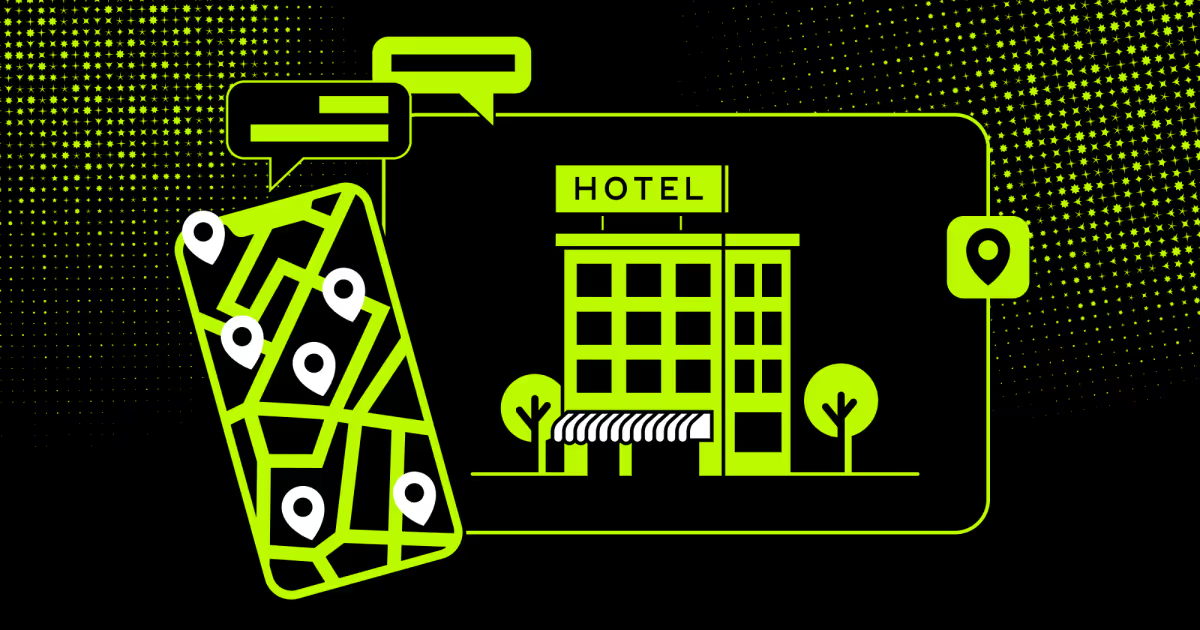
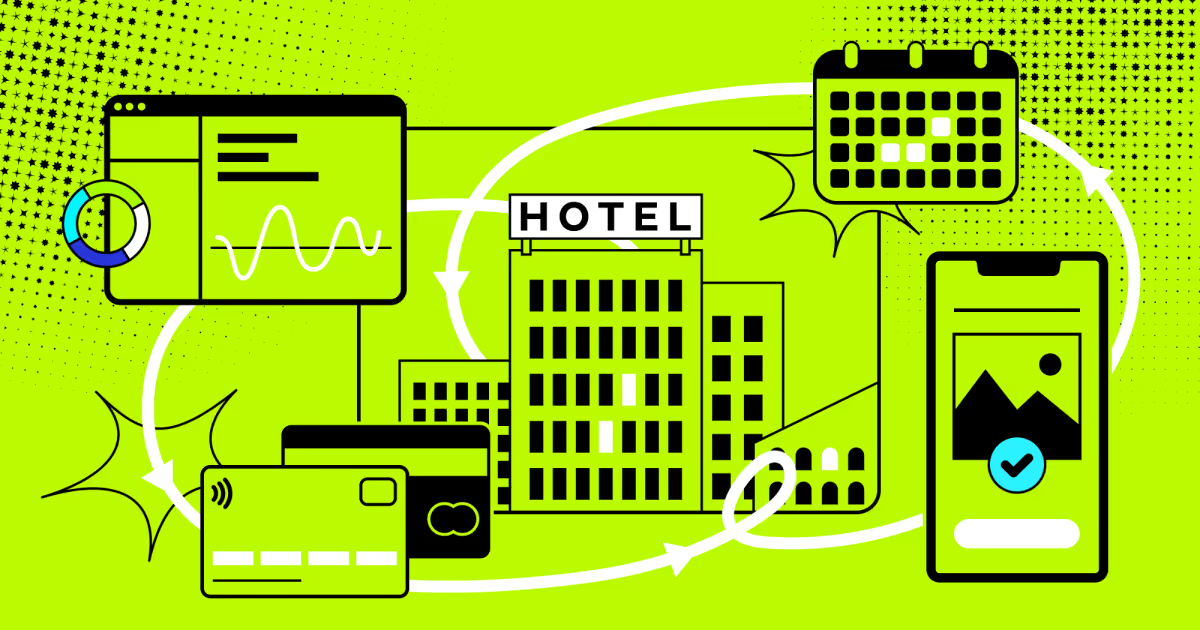
Operating a hotel with disconnected systems is no longer possible if you want to succeed. Today’s hospitality must have a connected digital ecosystem, where every platform, every device, every touchpoint works together to deliver a smooth experience from the moment a guest searches for a room, to long after they check out and go home with the lingering taste of connecting with your brand. What supports this hotel connectivity experience?
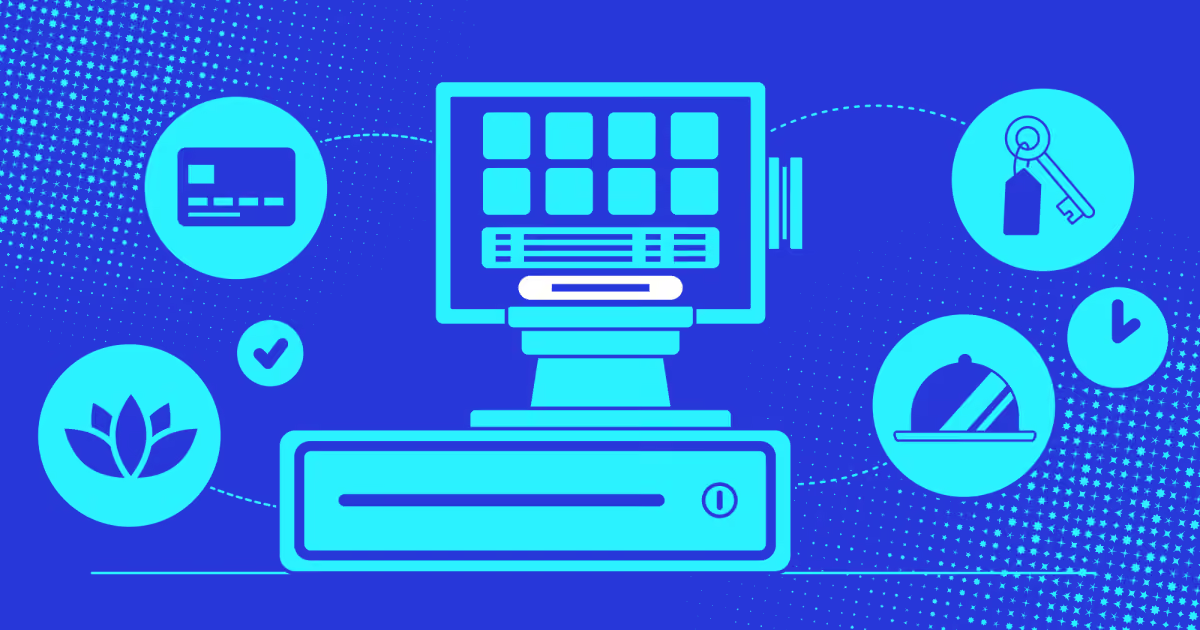
Property Management Systems (PMS), centralized systems that connect reservation management, front desk operations, housekeeping, revenue management, and every distribution channel.
Guest acquisition and engagement solutions like CRSs, Internet Booking Engines, channel managers, and RMSs that distribute inventory, optimize pricing, and convert searches into bookings.
Guest retention technology, like CRM systems, online reputation management platforms, and loyalty programs that track preferences, monitor sentiment, and reward frequent visits.
Guest service solutions like smart room systems and communication management platforms that enable guest journeys with contactless check-in, environmental controls, and real-time messaging.
In this guide, you will discover the different types of systems and integrations, the leaders in each category, and how to implement a seamlessly connected property.
What is hospitality connectivity?
A hotel experience is often scattered. Booking through an OTA, waiting in line for check-in, finding someone to repair a broken door lock, and guessing where to go for dinner - this is what a typical guest journey looks like.
With connectivity in place, it doesn’t have to.
Hospitality connectivity integrates digital technology with physical infrastructure to enable continuous communication between guests and staff within operational systems. This ecosystem allows for interconnectivity of people, systems, and products via Internet of Things (IoT) devices and technology, as highlighted by Mercan et al.
Why implement it? Anwar et al. observed that such technologies, though presented through digital ways, help hotels provide guests with a more responsive and humanly personalized experience, while bringing you operational benefits and gains in ROI and loyalty.
What is a connectivity provider?
The connectivity provider is the company that offers the technology infrastructure that enables hotels to deliver a reliable internet connection and smart device integration in each property. As Anwar et al. state, while this provider supports the infrastructure and reliability of various connected devices, they also establish the network that engages connected technology.
Hotel connectivity vendors typically provide a robust and reliable wireless network, allocate bandwidth through coverage maps, and manage secure data transmission across all connected devices and services in the hotel. Throughout the relationship with a hotel, the provider also arranges help for cloud-based management systems and integrated device support that together aid the hotel's operational and guest satisfaction priorities.
Connection between hotels and multiple sales/distribution channels
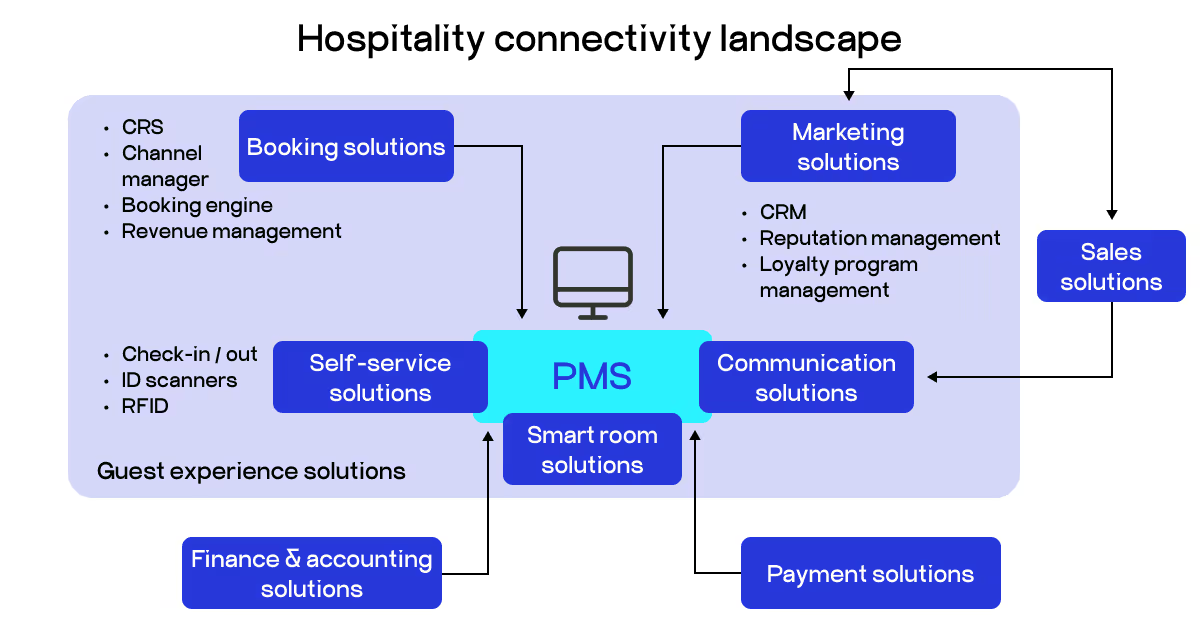
The relationships in these ecosystems aren’t linear. To establish a reliable connectivity network for any hotel, you need to create complex connections to various distribution channels. The connections typically begin from Property Management Systems (PMSs).
This workflow begins with booking solutions - represented by Computer Reservation Systems (CRS), channel managers, booking engines, and revenue management systems.
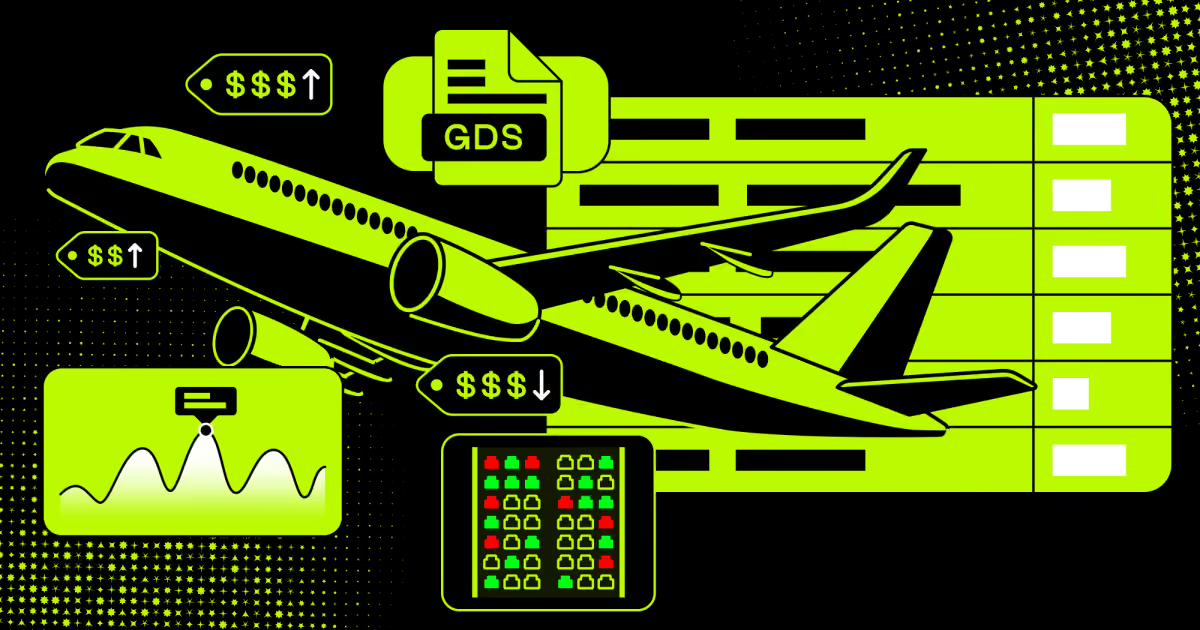
These systems connect hotels to various distribution channels, including OTAs like Expedia and Booking.com. They also connect to metasearch engines like TripAdvisor and Google Hotels, and global distribution systems (GDS) such as Amadeus and Sabre.
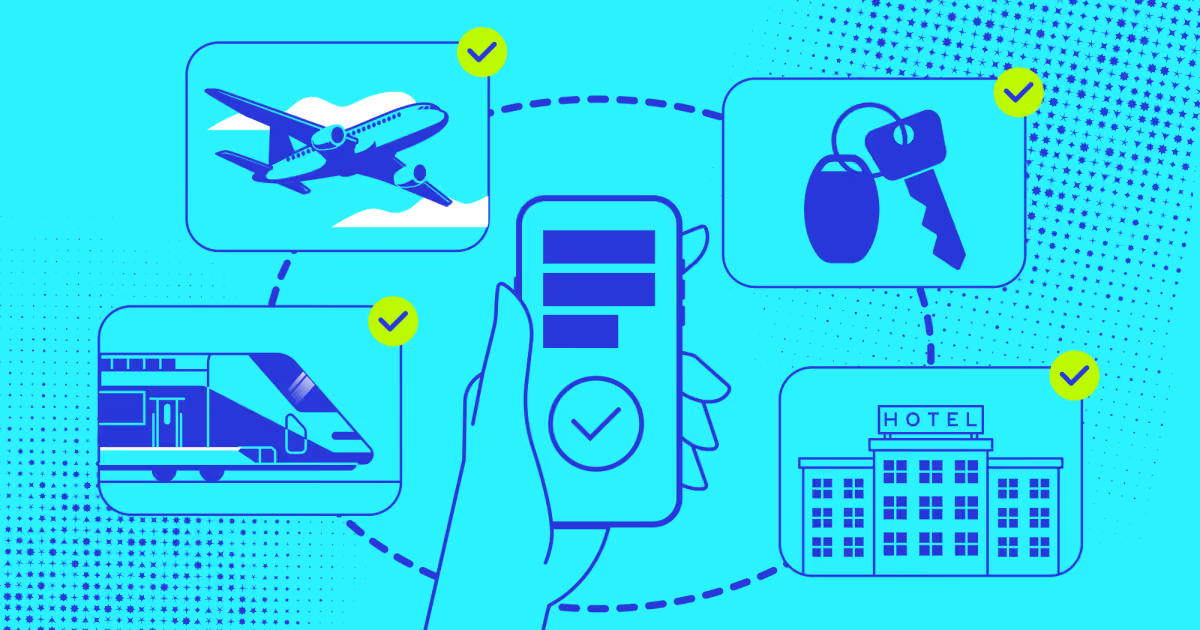
To provide reliable guest-facing technology, a PMS for hotels usually gets connected to self-service software solutions that come with contactless check-in/out features, along with ID scanners and RFID technology. Anwar et al. note that this is growing in importance as guest perceptions of safety and comfort evolve. Smart room solutions integrate IOT devices for controlling the climate and guest settings, while communication solutions engage and assist.
Lastly, marketing solutions connect travel CRM solutions, reputation management solutions, and loyalty programs to the sales channel to create an ecosystem. Payment and finance solutions finish the workflow by managing the ordering process across all touchpoints, paying attention to data management and operational efficiencies.
Why is connectivity important?
Apart from having your property a part of an ever-evolving global ecosystem (which sounds promising already), there are numerous benefits of hospitality connectivity.
First, you get better operations.Anwar et al. claim that having your PMS as a centralized hub for other solutions increases operational efficiency by 30% and manages all interactions among multiple platforms. Administrative workflows become faster as with connectivity, you cut down data entry by up to 70%. This allows staff to spend less time on repetitive actions and more time on guest-facing work. And to onboard new employees, too - like Zero Hotels that incorporated an integrated PMS solution across their connected platforms, and later reported a 50% reduction in staff training time.
Also, you gain an increase in bookings. Properties with integrated hotel connectivity solutions get impressive booking growth of up to 20% in year one of implementation. Again, Zero Hotels’ integrated platform was a significant influencer in bookings. Zero Hotels' bottom line indicated a 25% increase in rooms sold and improved operational metrics. And post-booking, the check-in and check-out wait times improve greatly - in many cases, up to 20% lower.
Increased profits are another advantage. Dynamic pricing driven by integrated revenue management systems can increase profits through real-time updates based on current demand and market conditions. The travel connectivity is fruitful, as revenue management systems, POS, and PMS combos are reported to increase non-room profits by 25% by using dynamic pricing, real-time updates, and guest independence to increase chances for upselling.
You also improve the experience for your guests. Real-time synchronization across all booking channels can reduce overbookings by 85%, improving guest satisfaction and the reputation of your business. Also, engaging integrated CRS systems leads to improved synchronized availability across all booking platforms, avoiding ultra-expensive errors that occur from isolated systems.
As you see, the more complex and robust the connectivity mixes you employ in your ecosystem, the more diverse are the results you can achieve. So, let’s now start with the core of this infrastructure - the PMS.
What is a hotel PMS?
A Property Management System (PMS) is an end-to-end software that supports a hotel's reservation management and operational efficiency. According to Moyeenudin et al., PMSs have progressed from their predecessors that used paper-based registers to a modern-day tool made up of software modules that are automated to support varied front- and back-end hotel operations. PMS connects all of the key functions within the hotel, along with its distribution channels external to the hotel property.
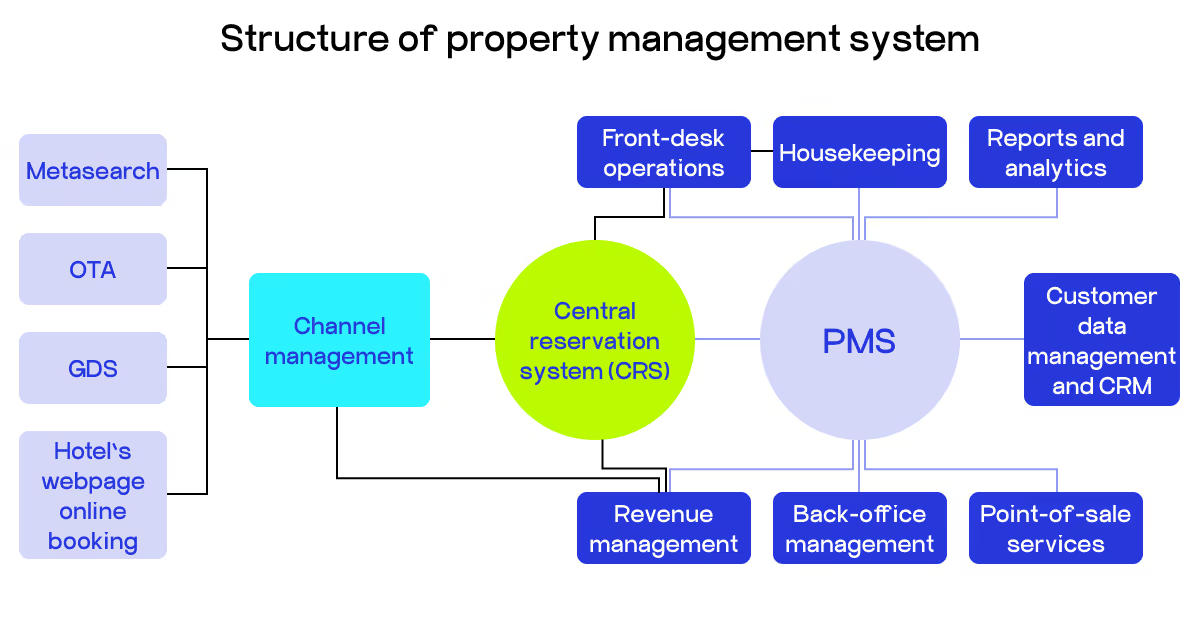
PMS is integrated either with a CRS or with a Channel Management system that is connected to distribution channels such as the hotel's own web booking engine, OTAs, metasearch, and GDS.
The modules connected to PMS include front-desk operations, housekeeping, revenue management, reports and analytics, customer data and CRM, point-of-sale, and back office. The integrated framework allows data to flow seamlessly between each department of a hotel operation, as well as to an external system of distribution channels.
Hotel system connectivity is perfectly clear here. Data entered in one area is automatically reflected in other relevant modules. This reduces data silos and allows hotels to use real-time synchronized data, enhance accurate inventory, improve guest experience, and make informed business decisions supported by vast operational data available through and central to PMS.
Main functions of a hotel PMS
Not every hospitality business fully uses the capabilities of a PMS (and many hotels lack one altogether). As a result, hotel connectivity providers are trying to separate their solutions as standalone systems that address specific problems, simultaneously connecting to hotel PMSs through APIs and allowing properties to define the technology stacks they require operationally.
The PMS modules assist with the management of the following functions.
Inventory distribution management maintains real-time control of room availability through all distribution channels, with the system automatically modified to maintain inventory as a booking is placed or cancelled. According to Moyeenudin et al., the system ensures that occupied rooms, checked-out rooms, and under-maintenance rooms are automatically updated, avoiding overbooking and maximizing revenue.
The reservation module yields full room status records that spell out the guest's check-in and check-out times, room type, and meal plan selection. This module enables hotels to speed up room requests that generate revenue forecasts automatically, and provide acknowledgement of booking confirmation via email or through other media.
Contemporary PMS solutions simplify the check-in and check-out process by automating workflows to minimize wait times and increase guest satisfaction. The system allows for effective guest registration, room assignment, and payment settling.
The front-desk function provides the staff with immediate access to guest information, room status, and service needs, allowing for an efficient approach to cross-departmental coordination. As mentioned by Moyeenudin et al., this module balances the current room status and assists front office staff in cross-referencing guest services.
Revenue management enables you to monitor and change room rates based on the market and demand. The system allows for flexible rate structures that convert toward rapidly changing pricing, supported by analysis of the occupancy rate and revenue per available room to increase profitability.
Marketing and customer relationships are other perks of building connectivity through a PMS. The system collects and stores guest preferences in a centralized database, allowing hotels to conduct guest-oriented marketing campaigns and deliver personalized service to guests during their stay.
Housekeeping management enables staff to record the status of rooms (clean, dirty, or under maintenance) in real time. Moyeenudin et al. state that this function ensures guests have rooms ready for occupancy upon check-in while optimizing the housekeeping schedule according to the occupancy level.
Reporting gives you insight into revenue trends, occupancy trends, and operational performance metrics, producing reports on key performance metrics, such as RevPAR and ADR, which builds on the management's ability to make reasonable decisions.
Back-of-house functionality tracks receivables, payables, profit and loss statements, deposits, assets, and liabilities, all on one platform. This module also covers accounting, HR, payroll, performance evaluation, and inventory control, which improves coordination and reduces errors.
The functions are numerous and diverse - and are all ensured by connectivity. Here’s how it’s going on.
How PMS connects with CRS, RMS, IBE, and third-party platforms
The PMS is the centerpiece of the intricate picture. Let’s outline the threads connecting it to the other elements of it.
The PMS interfaces with the CRS using bidirectional APIs that allow reservations to be synchronized across multiple properties. This allows the CRS to deliver reservation information generated by tour operators and travel agents directly into the PMS to provide instant updates of guest bookings, room assignments, and rate information.
The PMS provides the RMS (revenue management system) with occupancy information, booking patterns, and historical performance through automated data exchange processes. The RMS uses the information, typically based on predictive algorithms, to offer dynamic pricing recommendations to the PMS, which then can automatically adjust room rates for all connected distribution channels.
The digital connectivity between a PMS and Internet Booking Engine (IBE) enables diversity and synchronization of reservations. Any time a guest completes a reservation using the IBE, that booking data is sent to the PMS in real-time, which updates room inventory, creates guest profiles, and sends confirmation messages.
PMSs are also closely linked to third-party platforms (OTAs, GDS, and metasearch) using a channel management system, which serves as a middleware layer distributing inventory and rate data using XML or APIs. Global Distribution Systems have the capacity to understand, digest, and forward bookings to the hotel PMS, while Internet Distribution Systems connect to the property management system through a GDS or CRS so that every booking on every external site updates the entire inventory.
Now, you have a more detailed comprehension of the key element of hotel connectivity. Starting with the center, let’s move to the other parts of this complex puzzle. Let’s start with the solutions to help acquire and engage guests.
Software for guest engagement and acquisition
Let’s face it - you can no longer wait for passers-by to find your hotel on a ride to a different city. The road-roaming romance is left in the last century - now hotels are dependent on software solutions that can attract, engage potential guests, and convert them to confirmed bookings.
These systems put the “connection’ into the very connectivity meaning, linking you to the world of internet users that want a place to stay.
Central Reservation System (CRS)
A Central Reservation System is a piece of software that connects a hotel’s property management system to every distribution and sales channel in which the property has invested. They are bi-directional - the CRS can push the most up-to-date rates and availability to distribution channels with guests booking to ensure inventory is consistent over all marketing channels.
Dadić et al reaffirm that the core functionality of a typical CRS allows hotels to collaborate and structure teams around a centralized mechanism. However, the role of a CRS goes far beyond the reservation management side of the business. A CRS prevents data fragmentation and therefore saves hotel operators time, money, and energy while offering more detailed visibility. A CRS also aids hotels in identifying patterns in guest purchasing behaviors and manages the difficult process of tracking reservation data from multiple sources manually.
CRS systems are especially valuable for certain types of hotel operations. The hotel groups and chains benefit from a CRS as it makes managing multi-property operations easier through a single platform. Independent hotels can benefit from a CRS platform, especially where hoteliers are managing multiple OTAs and other booking channels.
Among the strongest CRS vendors, we can distinguish several managed connectivity services providers:
Cloudbeds connects hotel operations by combining its PMS, hotel channel manager, commission-free booking engine, customizable booking engine, automated invoicing, and deep analytics.
Little Hotelier provides an easy-to-use platform with a property management system, channel manager, and direct booking engine with full synchronization across 450+ booking channels in real-time.
Clock PMS+ has robust integrations and an open API architecture that connects with third-party applications to provide real-time syncing across platforms.
Hotelogix unlocks managing multiple locations from a single dashboard with group-wide policy establishment, performance metrics at the property and group level, roles and permissions for users across properties, automated night audits, and integrated POS management.
How to choose a CRS solution? Think about your needs in terms of number of properties, breadth of distribution channels, priority of direct bookings for the hotel or hotel group and integration with existing systems, where possible.
Internet Booking Engine (IBE)
An Internet Booking Engine, or IBE, allows customers to book rooms directly from a hotel's website in real time. This connectivity technology shows real-time rates and availability, processes secure payments, and interfaces with CRM or PMS on the back-end, and websites or channel managers on the front-end. Hussein et al. state that contemporary IBEs are increasingly being used as part of a digital ecosystem. The IBE's purpose is to convert website visitors into commercially viable reservations through a seamless booking experience.
The core functionality of a robust IBE typically allows for:
Multiple room bookings and a content management system for existing inventory.
Panning for high margin upselling of upgrades and packages.
The ability to support multiple languages, currencies, and payment options.
Personalization of bookings allows customers to select specific options per guest.
Reporting that delivers insights on conversion rates and revenue.
IBEs can be useful for nearly all accommodation typesdesiring control over direct distribution. Small and boutique hotels are able to independently manage booking without OTA fees, and mid-size hotels alternate between the two distribution methods based on demand in their market. Hotel chains need IBEs to help maintain brand consistency and to manage campaigns across properties from a central dashboard. Also, residential type properties can take advantage of IBE functionality with pricing models and longer booking windows.
Among the key hospitality connectivity solutions of this type we can distinguish SiteMinder for its robust channel management and direct booking engine integration, and Mews, offering attractive tools that position the property in a more visible state and enhancing the booking journey. Additionally, Net Affinity is strong for mobile optimization of its booking engine, and
Avirato has a straight forward design and conversion friendly features to assist in the guest flow.
Channel manager
Channel managers allow hotels to access numerous types of distribution sources simultaneously, creating aconnection from a the CRS to many distribution channels. A channel manager works both ways, by linking a hotel’s booking engine or PMS on one side of the channel and linking to metasearch engines and OTAs on the other side. Avan et al. suggest that channel managers are a fast and simple way to disseminate the required information, photographic images, daily activities, and price information across multiple distribution platforms.
The key purpose of a channel manager is to keep all platforms synchronized and current so that revenue is not lost. Channel managers typically have three key functions. First, they keep the inventory and the booking dates updated in real-time across all connected distribution channels. Second, a channel manager is able to update the pricing in real-time to keep it consistent, so pricing updates are reflected immediately across all platforms with live distribution. Third, a channel manager is helpful in cutting overbooking and rate parity.
With centralization of control with a channel manager, hotels do not have to log into multiple OTAs to check the availability across the platforms and have one consistent view of information.
For hotel chains, channel management solutions are important because they assist in preserving brand consistency, provide centralized governance of properties under a management agreement.
Large independent hotels and resorts value the efficiencies achieved by updating dozens of channels at once vs. manually managing each relationship.
For small and mid-size hotels, the savings and reduced risk of overbooking provide a solid justification, especially once distribution extends beyond two or three channels.
What vendors provide such a hotel seamless connectivity? SiteMinder has great automation features and processes close to 100 million hotel bookings each year while serving over 41,600 hotels across 150 countries. RateGain is recognized for its dynamic pricing capabilities and is used in more than 100 countries and for over 3,200 hotel customers due to the advanced functionality of dynamic pricing.
When selecting a channel manager, you should consider how many and the types of channels it supports, how quickly it can sync in real time, how its pricing scales to your properties size, and whether it will integrate or support your current PMS.
Revenue Management Systems (RMS)
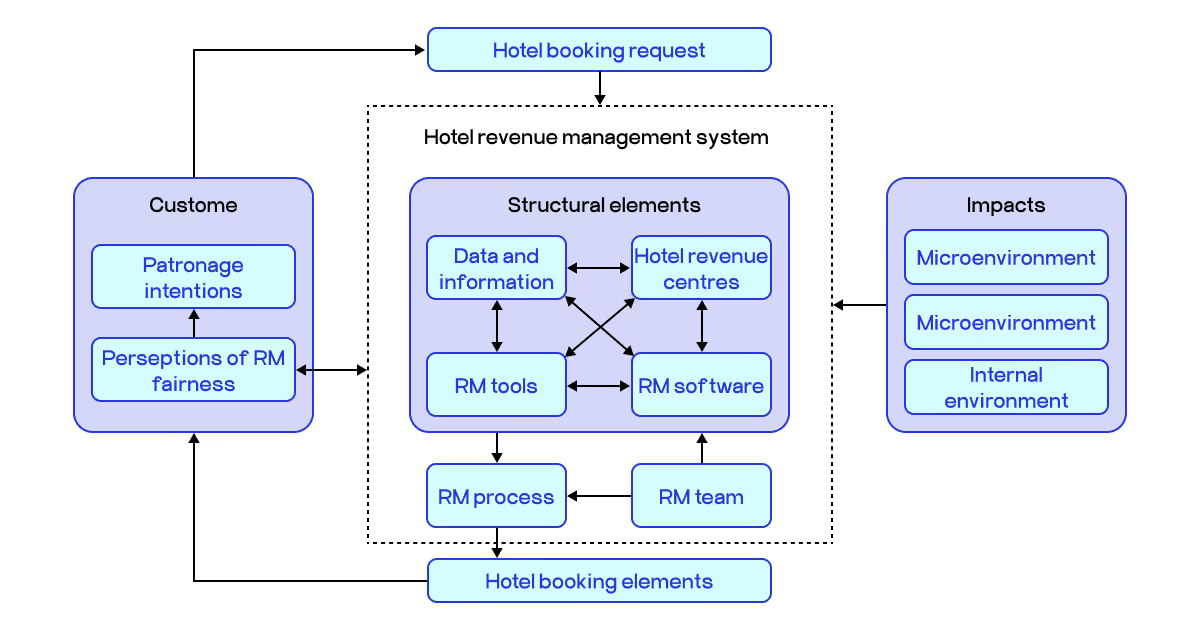
In an RMS package, bookings and revenue sources are analyzed in a cohesive manner to allow hotel owners to determine pricing strategies for profitable revenue management. Revenue management is a unique strategy to match supply with demand through capacity management, dynamic pricing, and customer purchasing intention segmentation according to Zhechev. The RMS has control over distribution channels, dynamic pricing strategies, and all the analytics is consolidated to one dashboard for easy access.
Typically AI-based, RMS will contain demand forecasting to predict future booking methods, collect historical data for analyzing trends, and conduct lost revenue evaluations to identify missed revenue opportunities.
Revenue distribution analysis by customer type and channel indicates where to look for the highest profitability, while evaluations of performance show success against targets and competitors' performance.
Rate point detection also identifies price points, while reporting features distill data into resourceful knowledge applicable to strategic planning.
RMS connectivity services are extremely valuable to properties with complex pricing and distribution strategies. Hotel chains need to have a granular RMS for maintaining pricing consistency while allowing for local market variances. Large independent hotels and resorts rely on RMS systems for pricing sophistication in order to compete. Residential properties also win with RMS functionality to improve the pricing of longer-stay bookings with dynamic pricing based on seasonal demand patterns.
As to the best providers, Duetto uses predictive analytics and open pricing methods to help hotels accurately forecast demand, and Atomize provides an AI powered system focused exclusively on automating pricing decision. Also, ZettaRMS provides a full suite of AI-enabled features including dynamic pricing, market forecasting, and a focus on multi-property management features
Hotels evaluating and using an RMS solution should be focusing on forecast accuracy, ease of integration to existing PMS and channel management systems, and automation versus manual override capabilities.
Software for guest retention
Another key area for hotel connectivity is engaging the way hospitality businesses retain their customers - improving their experiences, tracking their reviews, and making sure they stay loyal with your brand.
Customer Relationship Management (CRM)
Hotel CRMS effectively manage the communication and relationship building with hundreds or even thousands of guests. Surely, it often requires automation in your messaging. CRM systems facilitate this while maintaining a personal touch with guests throughout their stay.
The fundamental functionality of such solutions include several directions:
Storing guest profiles.
Tracking booking behavior,
Management of pending leads.
Performance reports.
Marketing communications
Automated notifications.
Each platform should vary in the sophistication of its user interface, and the even greater variability comes from the optional features with some advanced integrations such as calling or delivery.
This type of connectivity technology is recommended for all properties managing regular databases of guests that are looking to build relationships with guests that last longer than a single stay.
Among the best vendors, you can choose between Dailypoint that specializes in consolidating guest information (for instance, with its AI driven guest profiling), Salesforce that provides full guest visibility, with superior analytics, for major hoteliers, or Revinate that integrates relationship management, guest sentiment analysis, and online reputation monitoring.
Cendyn can be also helpful as a provider who's able to run their guest profiles and automatically run campaigns.
Online Reputation Management (ORM)
While direct contact with guests can provide valuable insights, monitoring public perception across digital delivery channels offers deeper insights into the larger narrative about your property. ORM systems encourage and automate the capturing of guest sentiment from review sites, social and booking channels, while eliminating the need to monitor multiple sources manually. ORM harnesses feedback from platforms like TripAdvisor and OTAs - enabling properties to acknowledge concerns, respond to commentary, and identify potential improvements to operations. Many sophisticated ORM platforms employ algorithms to help filter authentic guest reviews from illegitimate postings.
This expands connectivity management to the relationship between your guests and your hotel brand, helping you see what needs to be improved through the following features:
Tracking online sentiment mentions across social sites.
Prescribing responses and activities to online reviews.
Benchmarking reputation against competitor properties.
Flagging service issues impacting internal properties.
Alerting staff to new online sentiment feedback.
Capturing multi-language environments.
Analyzing images shared by guests in posts.
Providing performance metrics and trends among metrics.
There are ready-made solutions to help you keep an eye on your guest sentiment. GuestRevu specializes in automating post-stay surveys, while ReviewPro is focused on tracking and optimizing visibility across the most popular review sites. Also, Reputation.com is designed for multi-property businesses needing more robust reporting capabilities, and Famepilot gives you a modern AI based SaaS product, managing customer experience, with an easily navigable and usable interface.
Loyalty programs management
It is invariably more cost effective to retain a customer, than acquire a new one. Loyalty programs allows repeat customers to be rewarded for their loyalty, which can mean reduced rates, or special benefits which leads to developing relationships for the longer term.
According to research conducted by Xie and Chen, it has been shown that perceived value of the program is a deciding factor in operating loyal guests, and that value appears to have stronger implications for psychological benefits.
An effective loyalty program allows hotels to curate a comprehensive history of guest preferences to anticipate their needs and personalize program of services for guests to earn and spend their loyalty currency.
The key target audience is midscale properties, chain hotels, or larger independent properties and aiming to achieve a repeat visitation strategy.
There is some basic functionalities needed for these solutions:
Management of distinct memberships and status levels.
Ability to track transaction patterns and utilization of rewards.
Ability to maintain a profile which lists guest preferences.
Ability to communicating electronically using systems and email and texting.
There are several types of business connectivity solutions for managing loyalty. The first one is
third-party options like LoyaltyLion, built to integrate and support hospitality repeat business concepts and implementation, and Open Loyalty, an adjustable platform which is formed on customized set requests. Apart from these systems, Cloudbeds and OPERA PMS by Oracle Hospitality include built-in loyalty functionality.
Software for guest service
To ensure global connectivity with your guests at every stage of their journey, from pre-stay to post-visit, you also need to integrate specific solutions that provide the communication and independence of your customers.
Self-service guest technology (SSTs)
Self-service technologies allow guests to carry out transactions and access services independently, without support from staff. Research from Fu et al. shows that SSTs change users into both consumers and the service actors, creating value by engaging directly with a hotel system.
The development of hospitality technologies began with basic hardware and hotel cellular connectivity and later evolved into information technologies - self-service kiosks and websites in the early 2000s, and mobile-based with numerous applications in the 2010s. Today, self-service technologies are used across the entire journey of a guest, from booking through departure.
Common examples represent a global shift in the STT range:
Digital booking systems that allow guests to book accommodation independently.
Mobile check-in and check-out offering reduced lines at the front desks.
Smartphone room entry functionality that replaces physical key cards.
In-room tablets as digital concierges that facilitate guest requests for service.
Contactless payment systems are integrated into hotel apparatus and apps, and kiosks.
These technologies provide benefits to both guests and properties. Guests experience faster and more convenient transactions. Properties also save operating costs and allow staff to refocus on guest needs requiring personal delivery or attention from staff.
Among the leading connectivity solution providers are:
Ariane Systems that deploy automated arrival and check-in/out kiosk systems for indoors and outdoors.
Canary Technologies that guilds guest management system with kiosk integration across major property management systems.
Kiosk.eu is an end-to-end European provider offering self-service kiosks and point of sale systems with personalized options.
Posiflex provides smooth and easy self-check-in devices for smooth integration into existing digital infrastructure.
Such solutions are great for properties that strive to modernize their potential service delivery, provide a reduction in wait times, and satisfy the travel expectations.
Smart room technology
Integration with the Internet of Things has already brought a fresh wave of digital transformation for guest rooms. It allows for advanced environmental control and personalized entertainment experiences. Hospitality IoT connectivity enables guests to link their own streaming accounts to in-room TVs, use voice assistants like Alexa for Hospitality, and control amenities such as coffee preferences through the app directly.
Smart room technology integration continues to evolve, making hotel TV solutions an essential part of the connected guest experience rather than a separate system. By connecting in-room entertainment with IoT-powered controls, hotels can create a simpler and more user-friendly environment where everything works together. This approach helps keep personalization, convenience, and control consistent throughout the guest journey.
In a study by Mbarushimana, it’s shown that smart room technology improves guest satisfaction and operational efficiency. The automated operational features, such as lights, climate control, and voice assistants, improve guest convenience and personalization, which results in better satisfaction with their stay. These types of technology also reduce energy consumption and labor costs, improving operational efficiency.
Voice command operation for adjusting lights, temperature, and window treatments.
Mobile application interfaces for managing room settings and requesting service.
Intelligent adjustments based on guest occupancy behavior patterns, time of day, and natural light for energy maximization.
Mobile app-based digital key accessibility or biometric authentication.
Stored preference profiles that automate room configuration for repeat guests.
Entertainment control unified through voice command or a single application.
Leak detection assistance through sensors that automatically notify staff immediately.
The integrated hospitality platforms allow for benefiting from all-in-one solutions. Among them, there is Inelity, which provides guest applications and tablets for room control and service.
SuitePad, which provides a digital concierge and controls for the room, and ZAFIRO, an IPTV system that utilizes Google TV and Chromecast infrastructure. Kipsu also provides a real-time guest communications platform that integrates with the hotel's automation system.
The hospitality industry IoT connectivity is best suited for hotel chains, large independent hotels, resorts, and boutiques seeking to enhance guest experience.
Communication management systems
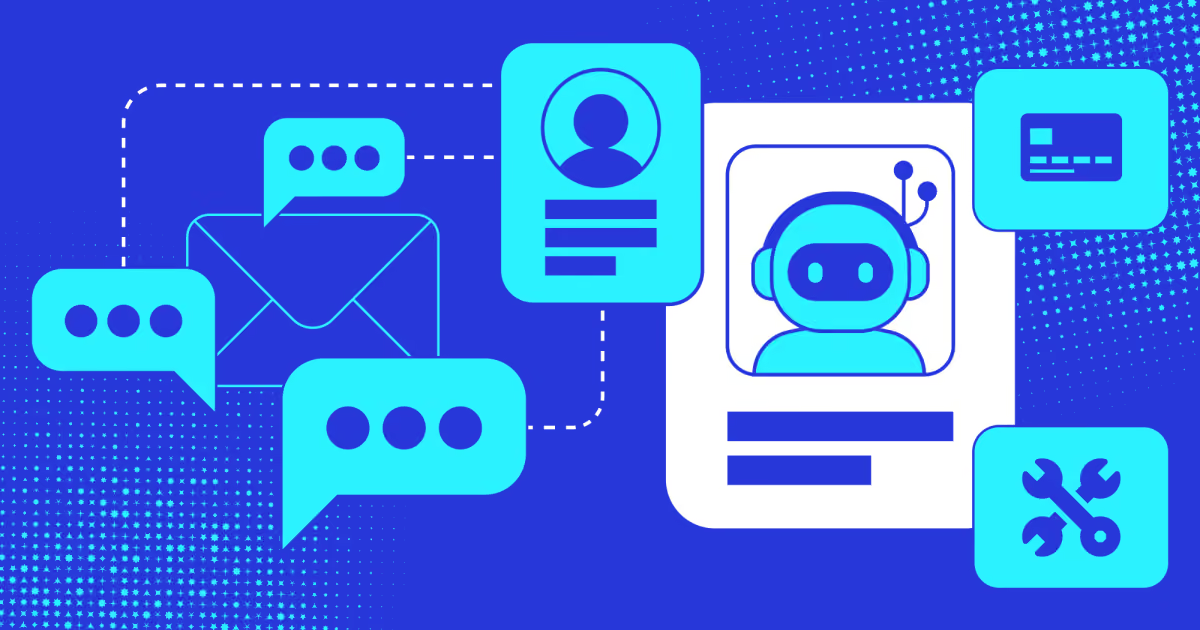
Messaging solutions connect guests and hotel departments to allow mutual communication over the guest's stay. They provide both frictionless messaging tools and issue management systems, or complaint management software, allowing guests to report disturbances while employees record and react appropriately.
Scheduled messaging automation throughout the guest journey, from pre-booking to post-departure.
Multi-channel management solutions that sustain WhatsApp, SMS, Messenger, and email through a common inbox.
AI-driven virtual assistants and chatbots manage standard questions, bookings, and instant support.
Inquiry functionality for housekeeping, room service, and various amenities during the stay
Organized communication intended to aid team workflow and response time.
Automated campaigns to upsell extra services while in-house.
Automated elicitation of feedback post-departure to plan service improvements.
The best hotel connectivity providers for communication solutions are HiJiffy, a guest communications tool that manages bookings, guest inquiries, and requests, and Guesty, an automated communication solution. Also, D-EDGE presents a guest messaging platform that merges channels with real-time AI responses.
Guest messaging solutions fit large independent hotels, hotel chains, and resorts that have responsive guest service and operational coordination as one of their main goals.
Hospitality connectivity implementation
As you see, there are many components for successful hospitality connectivity. This is why we compiled a guide that considers every aspect and solution that you might need to integrate.
System audit and requirements discovery. To start, capture details of all existing systems used to support stakeholders or guest services. This includes the PMS, booking engine, and payment processors. Giannoukou points out that successful digital transformation comes from a strategic convergence of technology and organizational capacity. Create a data flow diagram that details existing information flows between departments. For example, a guest booking with an OTA must send updates to the PMS, then to housekeeping systems, and the guest profile on the CRM is updated to reflect the booking, and the inventory availability is updated across all distribution channels. It’s also a good idea to establish the order of importance of integrations, similarly to this:
Priority level
System connection
Business impact
Critical
PMS ↔ Channel Manager ↔ OTAs/GDS
Prevents overbookings, ensures rate parity
Critical
PMS ↔ Payment Gateway
Enables seamless transactions
High
PMS ↔ CRM
Captures guest data for marketing
High
PMS ↔ Revenue Management System
Enables dynamic pricing
Medium
PMS ↔ Guest Communication Platform
Enhances service delivery
Medium
PMS ↔ Housekeeping System
Optimizes operations
Evaluate integration capabilities. Give preference to connectivity providers who have good integration options. Ask for complete API documentation that indicates which data fields can be supported, the data formats (example JSON or XML), if it can support real-time updates or batch movement, any territorial limitations for sending and receiving updates, processing speed, and lack of error reporting or notification. For example, if you are considering a channel manager, make sure it can send inventory updates to your PMS from the time of the booking within 30 seconds max.
Require that all vendors of your systems support the RESTful API architecture to support all web-based systems, or they can connect with the middleware. For example, your PMS should expose the API that allows a CRM to query a guest's booking history in a real-time format, a communication platform access to the guest preference and room arrangements, and housekeeping systems can update the room status in real-time.
Initiate the network architecture.As indicated by Mercan et al., for IoT connectivity in hotels, you must enable the interconnection of people, systems, and devices. Also, deploy completely separate VLANs for categories of devices: a dedicated VLAN for guest Wi-Fi connections, a separate VLAN for operational systems (e.g, PMS terminals/POS), and a separate VLAN for surveillance equipment/cameras.
Regarding IoT connectivity, select devices that support a standard protocol such as Zigbee, Z-Wave, or Wi-Fi to support interoperability. Once a guest checks out of the property, the PMS should send an automated signal through the IoT management platform (including smart thermostats) for an energy reduction mode. When integrating a mobile key system, ensure the system uses the PMS connection.
Create an IoT gateway or hub to collect device data into one API endpoint for other systems to query against. The processing flow should go through data collection, followed by data normalization when the gateway normalizes incompatible device protocols to a standardized JSON. Finally, it triggers the system integration functionality to push the processed data to the PMS, the energy management system, and the analytics platform via their APIs, and generates alerts to notify maintenance of issues. The smart thermostat would then initiate the back flow to confirm their request and update its interface.
You should establish bi-directional connections across all major systems:
PMS sends occupancy status → Housekeeping updates room status
Real-time
Check-in or out events, maintenance requests
Integration of guest-facing technology. The PMS would connect directly to your booking engine, with the IBE querying the PMS every 30 seconds for real-time inventory of availability and rates. Similarly, when a guest completes their booking, it would create the reservation in the PMS, send an update to the channel manager for all channels, and send a confirmation to the guest via the communication platform. You can also configure rate display logic so the IBE can display the best available rate (BAR) for guests or promotional or package rates based on dates and guest type.
Install kiosks that connect to your PMS through an API, where guests enter their confirmation number to query the PMS for reservation information. After verifying guest identification and completing payment authorization, the kiosk updates the PMS check-in status, calls the smart lock API for mobile key generation, and updates the housekeeping system.
Integration of operational systems. Link the housekeeping system and housekeepers autonomously execute a "clean room" task when a guest checks out in the PMS. Housekeepers will use mobile devices to update the room status, and the status will be sent back to the PMS in real-time, making the room available for the next guest.
Link the restaurant, bar, and spa POS systems to the PMS so that guests can charge their purchases to the folio assigned to their room number, and the POS is able to ask the PMS if there is an active reservation, and then if credit has been extended with the order.
Data analysis and reporting. Data is extracted from the PMS for reservations and revenue, the RMS for rate performance, the CRM for guest segments, and the channel manager for distribution mix. A combination of automated dashboards can visualize real-time KPIs such as occupancy, ADR, revenue per available room (RevPAR), channel contribution, and labor cost.
Security safeguards are in place for connected systems to perform API communication using TLS 1.3 encryption for all communications, API keys, or OAuth tokens for system-to-system communication. Payment systems should also use PCI-compliant payment gateways that tokenize card data.
Prior to going live, fully test all system connections. In your test, you would verify that the booking appears in the channel manager in less than 60 seconds, that the PMS automatically creates the reservation, and that the CRM receives the guest profile data. You should conduct hotel connectivity monitoring of all response times from the API, or if necessary, evaluate the failover procedures if the primary PMS server is inoperable.
According to Giannoukou, when ensuring the successful implementation, alongside the technical side of implementation, you must consider cultural changes as staff members work on a different skill base, embracing new work processes across the organization. You should make the training as simple and bite-sized as possible. For example, provide quick reference guides and video tutorials of common tasks as needed.
To implement hotel connectivity, it’s often unreasonable to rely on one or even several vendors. In the first option, one provider might not have all the necessary solutions and integrations, and in the other one, different systems often conflict and create data loss or silos while transferring. In this case, custom hospitality software development is the best option to establish a fully independent, seamless infrastructure.
At COAX, we provide tailored solutions based on your operational needs, workflows, challenges, goals, and data sources that make your connectivity ecosystem truly unique. We iterate on your feedback and real usage and adjust every feature to make it as convenient as possible. Our expertise allows us to integrate any API securely and implement modern, efficient solutions. For instance, if you need a generative chatbot as part of your communication systems, or AI travel agents for automating booking, we can create scalable solutions that grow with your needs.
FAQ
What is connectivity in hospitality?
Connectivity in the hotel sector covers the array of technological infrastructures that facilitate seamless data flow and interoperability between different systems you use, enabled by internet-based technologies, social networking resources, and mobile technologies that foster partnerships, first-hand experiences, and interactive interactions on an unprecedented scale. This digital ecosystem, which also includes an infrastructure and smart digital grid, enables personalized interaction between customers and hotels by allowing hotels to synchronize real-time data across various projects and technologies.
What are the challenges for hotel booking connectivity?
Areas in which hotels with booking connectivity face challenges:
Double bookings as the result of outdated central reservation systems or inadequate OTA coordination.
System glitches lead to inaccurate guest data, and inaccurate rates stored in the system, negatively impacting guest satisfaction.
API integration issues result in maintaining adequate connections to all OTAs. This can create delays in the update process that can leave room for error.
Unsynchronized rates and availability mean hotels overbook and mismanage pricing across multiple platforms, resulting in negative word of mouth or reputational damage.
Data silos, when booking information cannot be combined across multiple platforms.
Operational lack of capabilities that struggle to integrate into a new technology infrastructure.
Do guests demand hotel internet connectivity as a must?
Being linked to global connectivity is the main demand of modern travelers. According to Forrester Research, 90% of guests surveyed indicated that Wi-Fi was the top amenity, with 34% of the respondents indicating that the lack of free WiFi was a 'deal breaker'. In addition, 85% of respondents travel with two or more devices, and 55% selected their hotels based on the presence of mobile content.
How does COAX build reliable and secure connectivity solutions?
COAX has ISO/IEC 27001:2022 certification, indicating that our security management, risk assessment, and monitoring systems are best-in-class. Also, the ISO 9001 certification guarantees the industry's best-in-class quality processes. For hospitality connectivity, COAX utilizes XML web service interfaces for real-time PMS integration, an automated channel management system, secure API connections between multiple booking platforms, encrypted synchronization of data across platforms, and ongoing monitoring of systems to mitigate discrepancies in the booking process and support multi-platform operations.

























































.avif)



%20for%20hotels.avif)

.avif)
.avif)


.avif)




.avif)
.avif)



.avif)

.avif)

We are interested in your opinion