













































Choose category of your question

Questions
Will you set up analytics/consent mode, event tracking, and server-side GTM?
Content, SEO & migration
Do you implement performance budgets (Core Web Vitals) and accessibility checks?
Content, SEO & migration
Can you migrate content without SEO loss (redirects, canonicals, structured data)?
Content, SEO & migration
How do you quantify ROI for rebuilds versus refactors versus AI add-ons?
Maintenance, scaling & ROI
Can you provide an analytics or observability setup (logging, APM, BI dashboards)?
Maintenance, scaling & ROI
How do you plan for scale (load testing, cost optimization, multi-region failover)?
Maintenance, scaling & ROI
What does long-term support look like (L2/L3, SRE, on-call, budgets)?
Maintenance, scaling & ROI
How do you measure AI success (task success rate, deflection, CSAT, latency, cost per task)?
AI/LLM & “ChatGPT-era” questions
Can you add AI safely to our existing product (support bots, search, summarization, and pricing assistants)?
AI/LLM & “ChatGPT-era” questions
What’s your policy for prompts, logs, and PII in AI features (retention, redaction, access)?
AI/LLM & “ChatGPT-era” questions
How do you reduce hallucinations (RAG, evaluation harnesses, guardrails, human-in-the-loop)?
AI/LLM & “ChatGPT-era” questions
Can you deploy on-prem or VPC models so data never leaves our cloud?
AI/LLM & “ChatGPT-era” questions
What LLMs do you support (OpenAI, Anthropic, Azure OpenAI, or open-source like Llama), and how do you choose?
AI/LLM & “ChatGPT-era” questions
Will our data be used to train public models?
AI/LLM & “ChatGPT-era” questions
Can you localize for markets (currencies, languages, tax/VAT, accessibility/WCAG)?
Travel/TTL specialization
What about PCI-DSS considerations for payments and tokenization?
Travel/TTL specialization
How do you handle refunds, chargebacks, vouchers, and multi-leg itinerary edge cases?
Travel/TTL specialization
Can you build dynamic pricing/RM workflows and connect to RMS/Channel Manager?
Travel/TTL specialization
Do you integrate with GDS/NDC (Amadeus, Sabre, Travelport) and airline APIs?
Travel/TTL specialization
Can you rescue or continue in-progress projects started by another vendor?
Tech stacking & interoperability
How do you approach integrations (ERPs, CRMs, payment providers, analytics)?
Tech stacking & interoperability
Can you modernize outdated systems without full rewrites?
Tech stacking & interoperability
Which stacks do you use most (web, mobile, cloud, data, DevOps), and why?
Tech stacking & interoperability
What is your warranty/bug-fix period after go-live?
Pricing & contracts
What payment schedules and currencies do you support?
Pricing & contracts
Do you offer flexible ramp-up/ramp-down and partial team allocation?
Pricing & contracts
What’s included in your hourly/day rates (PM, QA, DevOps, architecture)?
Pricing & contracts
How do you price discovery, MVPs, and long-term maintenance?
Pricing & contracts
What’s your incident response and uptime/SLA policy?
Security, compliance & data
Will COAX sign a DPA/SCC and complete a security questionnaire?
Security, compliance & data
How do you manage PII, secrets, and keys in development and production?
Security, compliance & data
Can you meet GDPR/CCPA and data residency requirements (EU/US/UA)?
Security, compliance & data
What security standards do you follow (OWASP, CIS, SDLC controls)?
Security, compliance & data
Can you work with our in-house team/other vendors (shared repos, branching, and review rules)?
Process & quality
What does handover look like (docs, runbooks, training, post-launch hypercare)?
Process & quality
How do you handle change requests and scope creep without blowing timelines?
Process & quality
How do you measure success (KPIs, SLAs, DORA metrics, QA coverage)?
Process & quality
What does your delivery process look like from kickoff to launch (tools, ceremonies, sign-offs)?
Process & quality
Where are your teams located, and what time zones do you cover for stand-ups/support?
Company, fit & engagement
What do your standard NDA and MSA cover (IP ownership, work-for-hire, warranty)?
Company, fit & engagement
When do you recommend working under fixed-price, T&M, or dedicated team models?
Company, fit & engagement
Can you start with a discovery sprint or code audit before a full build?
Company, fit & engagement
How do you estimate timelines and costs before a formal SOW?
Company, fit & engagement
What types of projects does COAX take on (size, industries, typical budgets)?
Company, fit & engagement
Answer
Yes. Configuring consent mode to adhere to privacy regulations, event tracking tailored to user interactions, and server-side Google Tag Manager implementations for effective data collection and management are all part of the analytics setup.
Content, SEO & migration
Yes. To preserve speed and user experience, we implement performance budgets that prioritize Core Web Vitals. Ongoing technical SEO audits stop hidden problems that could cause rankings to drop after migration. We prioritize data-driven tactics for qualified lead generation and long-term organic growth. Checking for WCAG and ADA compliance is important in our work because it ensures that all users meet the required standards, which are supported by ongoing improvements and monitoring.
Content, SEO & migration
Yes. At COAX, to migrate content from the old site to the new site without losing SEO value, we have a well-planned process to follow. We complete a full audit of the old site, map old URLs to new URLs with 301s, maintain canonicals, and troubleshoot structured data. After the migration, we conduct a full SEO audit on the new site to address issues ourselves before search engines hit it. We will also submit updated sitemaps to search engines for re-indexing the new site, something we do to limit any possible traffic or ranking impact.
Content, SEO & migration
By examining cost-benefit scenarios for rebuilds, refactors, and AI add-ons, our teams at COAX calculate ROI and apply actions to achieve it. To set priorities and optimize returns, we assess technical debt reduction, performance enhancements, and AI-driven automation potential. We also match investments with strategic objectives and quantifiable business impact.
Maintenance, scaling & ROI
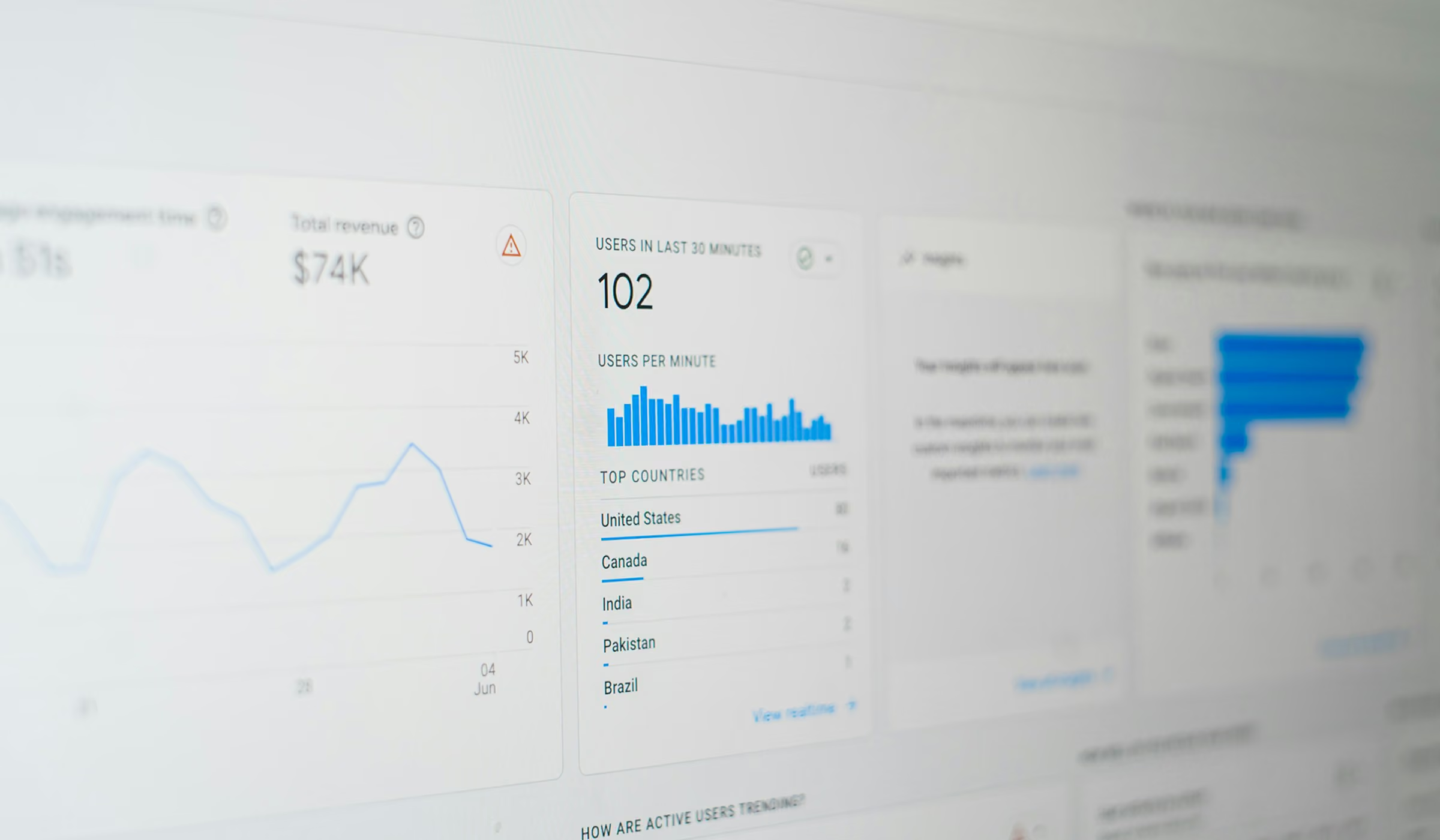
Yes. Our analytics and observability layer at COAX uses centralized logging across services, APM tools, and customized BI dashboards that provide real-time metrics, error reports, and user behavior monitoring, which enables teams to proactively find issues, optimize performance, and analyze business decisions with confidence.
Maintenance, scaling & ROI
COAX prepares for scalability with solid load testing, cost-cutting approaches, and a multi-region failover architecture. Our efforts allow systems to support peak demand while keeping costs down and rerouting traffic automatically during regional outages to maintain availability. Each action is aligned with your goals and applied after your permission.
Maintenance, scaling & ROI
The long-term support model at COAX includes L2/L3 teams focused on SRE practices and on-call rotations for speedy resolutions and system reliability. We are transparent in how we manage budgets for maintenance, upgrades, and incident responses while delivering ongoing proactive monitoring of our system health and improvement plans based on client needs.
Maintenance, scaling & ROI
We keep an eye on many different measurements, like how often tasks are completed to see how well workflows are running, how much automation is helping to reduce workload, customer satisfaction scores to check if users are happy, response times to make sure we meet performance goals, and costs for each task to show if the investment is worth Using Prometheus and Grafana, we create real-time dashboards that track business KPIs, resource usage, and inference speeds. Our frequent A/B testing ensures quantifiable improvements in line with your strategic goals by isolating the impact of AI.
AI/LLM & “ChatGPT-era” questions
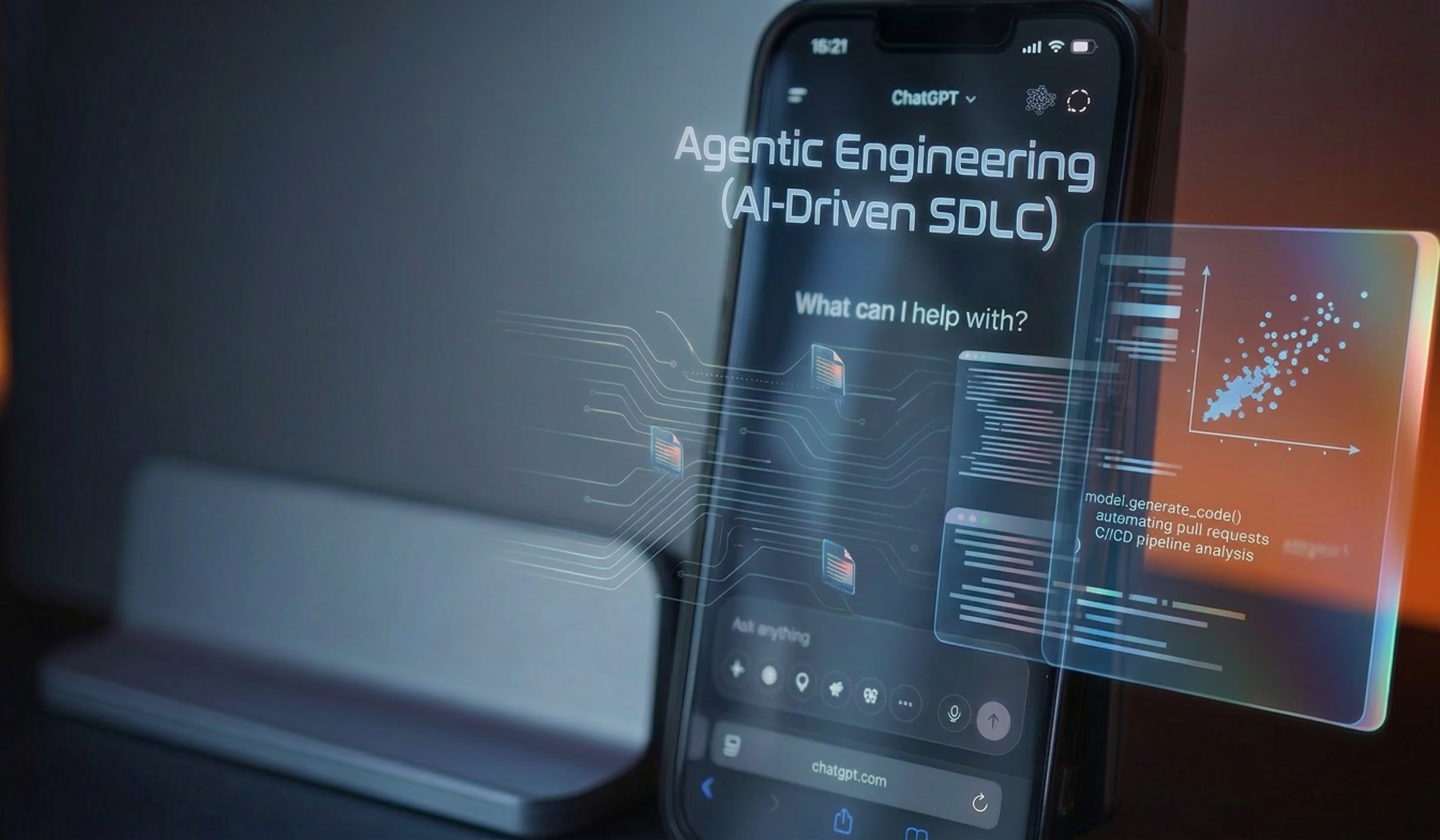
Yes. We integrate AI capabilities into the existing ecosystem or platforms utilizing secure API layers or Model Context Protocol (MCP) implementations. Whether you like onboarding chatbot interfaces with NLP processing, semantic search leveraging vector-based similarity matching, automated summarization, or dynamic price optimization, we can instigate these processes without impacting the current workflow. All implementations will be part of proper error handling and fallback, and performance will be closely monitored to ensure system stability.
AI/LLM & “ChatGPT-era” questions
We enact rigorous data governance:
- PII is automatically detected and redacted before processing with the aid of NLP-based analysis
- Logs are only retained for the time required for operational use and are encrypted at rest
- Access is kept on a need-to-know basis and is duly logged with auditing trails.
All prompt information is retained within your infrastructure, and we have not shared anything outside of your organization nor provided for any LLMs to process without your consent and security protocols. We also maintain GDPR and HIPAA compliance documentation regarding our handling of data and conduct regular security audits.
AI/LLM & “ChatGPT-era” questions
We implement multi-layered validation:
- RAG uses FAISS and HNSW vector indices to ensure responses are grounded in factual data.
- Automated evaluation frameworks examine outputs for factual accuracy.
- Programmatic guardrails filter out inapt materials.
- A human-in-the-loop for reviews of key decisions.
This structure allows AI to accelerate processes while experts confirm the results and establishes reliability for all our implementations with persistent monitoring and model retraining.
AI/LLM & “ChatGPT-era” questions
Yes. We can deploy fully within your private cloud infrastructure using Docker containerization and Kubernetes orchestration. This could be your AWS VPC, Azure private networks, or even your servers on-prem. We never let the data leave your environment. By using tools like Terraform and Pulumi, we set up a safe and organized way to deploy your systems, ensuring that we manage where your data is stored to follow important rules like GDPR and HIPAA.
AI/LLM & “ChatGPT-era” questions
Yes. We support all major LLMs: OpenAI GPT models, Anthropic Claude, and Azure OpenAI, or you can use open-source models like Llama via Hugging Face. The choice will depend on your specific needs, including factors such as data sensitivity, latency requirements, cost, and compliance considerations. We can evaluate performance benchmarks, API reliability, complexity, and integration to suggest the best model based on your use cases and infrastructure.
AI/LLM & “ChatGPT-era” questions
No. Your data is and will always be yours and will never be used for training publicly available models. We enforce rigorous data isolation protocols that keep your training datasets within your infrastructure and never provide your data to external LLMs. While fine-tuning custom models within a service like Hugging Face or building your own proprietary system, all data processing will take place in fully controlled environments, using enterprise-grade encryption and access controls to ensure total confidentiality during your development and deployment.
AI/LLM & “ChatGPT-era” questions
We handle payments in different currencies using up-to-date exchange rates, calculate taxes for different areas, including VAT and GST, and have strong systems to support translating languages. We also conduct accessibility audits based on WCAG 2.1 and WCAG 2.2 AA—our proof point is we'd provide you with a downloadable WCAG accessibility checklist vs. a specific canvas approach to let you self-assess versus a custom checklist approach. We've delivered production solutions that address jurisdictional requirements, such as compliance with EU EAA standards and ADA compliance in the US, so that you can be assured that your platform can operate legally and inclusively in any designated market.
Travel/TTL specialization
Our payment integration enforces PCI-DSS compliance via tokenization, which helps ensure that sensitive card data does not touch your servers. We also utilize secure authentication handoff, encrypted transmission protocols, and vault-based token storage with payment processors. Our architecture maintains strict scope reduction by separating payment flows from your core systems. We also conduct security tests and compliance checks, which include confirming encryption methods, permission levels, and safe management of credentials, during our entire development process to help keep cardholder data secure.
Travel/TTL specialization
We have built payment workflows that manage refund triggers, chargeback dispute automation, and voucher verification. For complex itineraries, our systems can manage partial cancellations and schedule changes from multiple airlines, along with fare recalculation logic. We build transaction state machines that track every booking state change for easy financial reconciliation. Our payment gateway integrations also come with fraud monitoring and automated retry logic and provide an audit trail for regulatory compliance.
Travel/TTL specialization
Yes. We've developed revenue management systems with rule-based pricing logic, demand forecasting algorithms, and automated inventory distribution. Our Channel Manager integrations can sync rates and availability across OTAs, direct booking channels, and distribution systems—in real time. We've also put together a dedicated Channel Manager e-book that is filled with best practices for these systems, with specific references for multi-property scenarios, rate parity challenges, and API improvement strategies for optimizing revenue.
Travel/TTL specialization
Yes. We integrate reservation systems with GDS systems (for example, Amadeus, Sabre, and Travelport) and direct airline NDC APIs for live availability and pricing. For our integrations, we could handle authentication protocols, endpoint structures, and data transformations needed to automatically sync reservations. We have built travel systems connecting CRM, dynamic pricing tools, and property management platforms for seamless data management across your entire reservation ecosystem without a manual touch.
Travel/TTL specialization
Absolutely. We frequently take over stalled projects, performing code audits right away to find problems and technical debt. Our team establishes clear development momentum, refactors troublesome areas, and swiftly assimilates existing documentation. We have completed projects with quality issues, missing features, or overstripped timelines. Our open lines of communication keep you informed about what can be saved, what must be rebuilt, and when deliveries are likely.
Tech stacking & interoperability
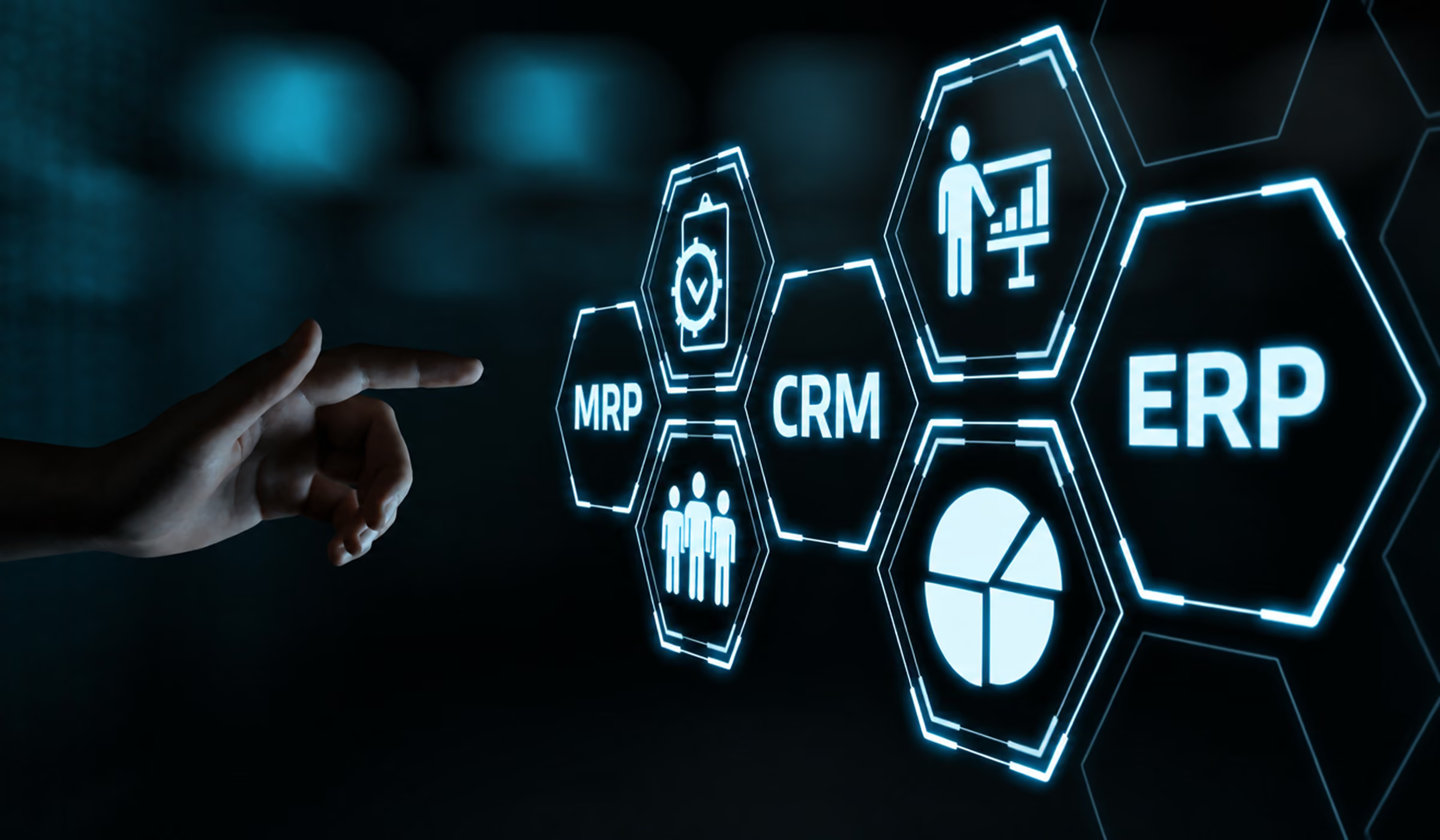
We architect API integrations using standardized protocols, layered with effective authentication mechanisms for security. We begin by mapping your existing systems, designing our middleware connectors accordingly, and handling the data in real-time as needed for your use case. The relationship could be between an ERP system like SAP, a CRM system like Salesforce, a payment gateway, or an analytics system. Regardless of the external system, we ensure reliable data connections with appropriate error handling mechanisms, logging, and monitoring in place. All integrations are also tested for reliability and sufficient security.
Tech stacking & interoperability
Yes. We can modernize legacy systems incrementally by using middleware components that preserve key functionality while allowing for architecture updates. For example, we practice containerization, API-first design, and microservices migration of legacy systems. For instance, we can use our core technologies (such as Node.js, Python (Django), Ruby on Rails, and React.js) to assist in the migration of monolithic applications to cloud-native architectures, deploying them on contemporary cloud infrastructure. We have migrated databases as large as 3GB and provided system migrations with zero downtime.
Tech stacking & interoperability
We have comprehensive experience across the technology spectrum. By using Python, Django, and Ruby on Rails, we can develop highly scalable applications on the web. For mobile experiences, we use both native iOS/Android and cross-platform development frameworks. For cloud infrastructures, we typically use AWS for cloud capabilities, with orchestration through Kubernetes. For data, we leverage MySQL, MongoDB, and PostgreSQL, depending on the use case. Our DevOps practices apply CI/CD pipelines for deployments, along with automated testing and monitoring. We choose our stacks for their quality, reliability, and long-term maintainability, and we align and approve with your team.
Tech stacking & interoperability
Support for our projects includes complete post-launch support, with constant monitoring, issues identified proactively, and defects and issues fixed immediately if they go into production. Each warranty period will be defined as part of the contract. However, ongoing partnerships speak to our commitment beyond the warranty period; for some clients, we have fostered partnerships ranging from 4 to 7 years. We fix important items immediately as high priority, but also fix issues that are recurring so that they don't happen again.
Pricing & contracts
We offer multiple payment arrangements based on project deliverables or milestones, one-time projects, or customized arrangements to accommodate your budgets. The currency and terms of payment are arranged during the discovery process for smooth transactions. The finance team will work with you and your procurement processes to structure arrangements that meet your operational needs.
Pricing & contracts
Yes. Your needs can always be adjusted, with resources produced based on our iterative sprint cycles and team size alignment. We can grow and decrease resources as you may require for specific needs: either dedicated people, creatives for a temporary need during a critical phase of your project, or scaling up and maintaining a dedicated team. Our sprints are always managed in 1-4 weeks of focused, iterative energy. This flexibility makes it easy to increase or reduce the resources associated with your scope of work tasks without losing momentum or quality.
Pricing & contracts
Our rate of $50-$99/hour includes full-service delivery:
- Agile project management and sprint management
- Full-stack (frontend/backend) development
- End-to-end UX/UI design from wireframes to implementation
- Full QA and automated testing
- DevOps capability with CI/CD and cloud infrastructure, technical architecture, and system design.
All roles engage together for delivery capability.
Pricing & contracts
Discovery phases can last from a few days to 4 weeks or more, which can affect the total cost based on other factors that are also part of the estimate. MVP projects typically fall into the $10,000-$50,000 range based on size and features. Depending on the share of work you assign to us, maintenance and retention will work within adaptable engagement models. Many of our clients have partnerships that last 3–7 years. We are pleased to provide pricing either on a fixed-price basis or on a time-and-materials basis, depending on the complexity of the project and the planning and budget needed.
Pricing & contracts
We use CloudWatch/Prometheus to maintain round-the-clock monitoring. Detection, containment, remediation, and reporting within specified SLAs (usually <1 hour acknowledgment, <4 hours resolution for critical issues, any other additional timelines can be discussed) are the documented protocols that incident response adheres to. Depending on your service tier, we provide proactive maintenance, uptime guarantees, and post-launch hypercare.
Security, compliance & data
Yes. We sign Data Processing Agreements (DPAs), Standard Contractual Clauses (SCCs), NDAs, and sign additional documents if discussed and defined as needed by us and the client team. We also complete security questionnaires upon request. We sign SOC 2 and ISO attestations and can sign any other custom compliance documentation you may require, ensuring you have full transparency and regulatory compliance in alignment with your project.
Security, compliance & data
We use AWS Secrets Manager and encrypted vaults for keys/credentials. In our processes, PII is treated with AES-256 encryption at rest and TLS 1.3 in motion. We never send PII to external LLMs or third-party systems (without approved data protection measures). Additionally, the role-based access controls we apply limit exposure, and secrets are never stored in code or logs. We have a strict separation of production vs. dev environments, with audit trails turned on.
Security, compliance & data
Yes. We comply with all GDPR & CCPA, and other regional privacy laws and regulations. Our infrastructure supports data residency in either the EU, the US, or Ukraine, based on AWS Regions. We also have extensive experience delivering applications in diverse industries, and can further adjust to the compliance requirements you have in your specific sector, as we use the best principles of data security and dive into your use case deeply.
Security, compliance & data
We are certified under ISO/IEC 27001:2022 for information security management and approved under an ISO 9001 certificate for quality management processes, as newly updated in 2025. We follow bootstrapped coding practices and OWASP guidelines for secure coding. COAX teams also test for security (OWASP ZAP, Burp Suite), and we build SDLC security controls into every phase of our process. These include threat modeling, penetration testing, and code reviews.
Security, compliance & data
Yes. We fit into your processes. We use shared repositories, your methodology for branching (GitFlow, trunk-based), the code review process, and your CI/CD processes. We can also fit in with your tooling (Jira, Confluence, Slack, or other channels and workspaces) and your standards. Our teams work with your internal staff and any vendors we define as suitable and approved by you daily to ensure we have a smooth, unified delivery process.
Process & quality
You will have all the documentation you may need, including architecture diagrams, API specs, runbooks, deployment guides, and test suites from the dedicated project manager on COAX’s side. During our knowledge transfer sessions, our developers will also provide handover support
for bug fixes and optimization. You will receive all source code and necessary credentials. For fixed-price projects, we usually include a one-month warranty period. Extended support and ongoing maintenance are also available as separate packages based on your specific needs.
Process & quality
All requests for changes are assessed for impact on the budget and timeline, followed by stakeholder approval before we reprioritize the backlog. Time & Materials contracts are flexible enough to absorb any change. For fixed-price projects, we implement a formal change order. We will present options and clarify trade-offs for you to make informed decisions in the adjustment process, so you are not compromising on quality or timelines.
Process & quality
We track DORA metrics (deployment frequency, lead time, MTTR, and change failure rate), test coverage, defect density, sprint velocity, and Net Promoter Scores (NPS). We also have Service Level Agreements (SLAs) to track response times and uptime. Role-based dashboards allow executives to see risk heatmaps, developers to understand failure points, and product owners to see user impact metrics. We make sure every metric aligns with your business goals.
Process & quality
We implement Agile or Scrum with two-week sprints. However, depending on your scope and needs, we can use a different sprint duration. The sprints include daily stand-ups, sprint planning, sprint reviews, and sprint retrospectives. We also use Jira for tracking work, GitHub or GitLab for repositories, and Slack or Teams for ongoing communication. The key sign-offs happen with approved requirements, frozen designs, User Acceptance Testing (UAT) acceptance, and going into production. We’ll document all of these at each milestone.
Process & quality
Our base is located in Ukraine and Europe (EET/EEST) with a 100% remote team globally. We take full advantage of European and US hours of overlap, and we can schedule our stand-ups, syncs, and support windows to your team's availability. You can simply direct us to the most suitable time in EST, PST, or GMT, and we will define the most optimal time for stand-ups and communication.
Company, fit & engagement
Our standard policy, updated in October 2025, includes mutual NDAs, a complete IP assignment to you, work-for-hire, a warranty period that depends on the terms defined by our contract, and a limitation of liability in our standard agreements. We are open to legal demands and can work with your templates or negotiate custom terms based on your organization’s needs.
Company, fit & engagement
We provide all three. We have three service models tailored to your preferences:
- Fixed-price engagements are appropriate when our scope is firm and timelines are specific.
- Time & Materials is good for varying requirements and exploration-style projects.
- Dedicated teams are for sustained developmental engagements over three months or more.
We will recommend the right fit depending on how locked or defined your requirements are and how much flexibility you need.
Company, fit & engagement
Yes. We provide discovery packages and code audits, as well as MVP development services and AI proofs of concept. They can be offered as independent elements or parts of wider custom packages. These services help you validate your concept, evaluate market fit, uncover technical debt, determine the optimal architecture, and de-risk your project by providing a roadmap and project estimate before any development commitment. The packages are updated on our website in October 2025 and are available and accurate.
Company, fit & engagement
We start with a discovery consultation to learn about your scope and requirements while also getting a thorough understanding of your business objectives, pain points, and the needs of your users. From here, we give you a range of sizes, stacks, team breakdowns, timelines, and budgets. To provide more accuracy, we do offer discovery sprints, which generate detailed specification documents, user stories, and the opportunity for a fixed price proposal.
Company, fit & engagement
COAX works in the area of developing custom software for travel, transportation, logistics, retail, finance, healthcare, and construction. Our solutions range from web and mobile apps to enterprise-wide platforms, custom integrations, UI/UX design, DevOps, and other services. Our projects start at $10,000+, with most ranging from $30,000 to $150,000. From aspiring startups to established industry leaders, we serve companies across booking systems, fleet management, marketplaces, CRM systems, and AI-driven software.
Company, fit & engagement
Don’t see the answer you’re looking for?
Describe your question, and we’ll be happy to help and answer it
We are interested in your opinion